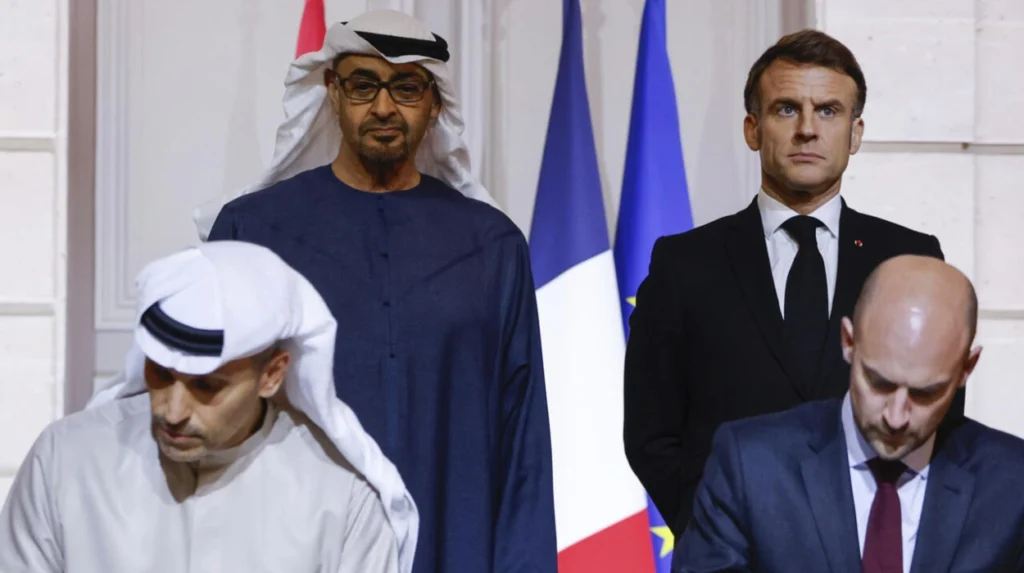
It is explosive because it sits at the intersection of three sensitive issues: European farm subsidies, opaque ownership structures, and sovereign-linked wealth from the UAE. The core allegation is that companies tied to the Al Nahyan family received more than €71 million in EU farming subsidies over six years through land holdings in Romania, Italy, and Spain, with the money spread across 110 payments between 2019 and 2024. If accurate, that is not a small anomaly; it is a test of whether the CAP can distinguish between genuine agricultural support and subsidy capture by powerful, highly resourced actors.
The political charge is sharper because the CAP is one of the EU’s largest spending programs, and France has historically been central to its design and defence. That means any scandal involving large landowners and subsidy concentration quickly becomes a French political question as much as a Brussels one. It also makes the case for reform harder to dismiss as abstract technocracy, because it directly touches the legitimacy of a policy framework France helped shape.
What exactly do the published findings say?
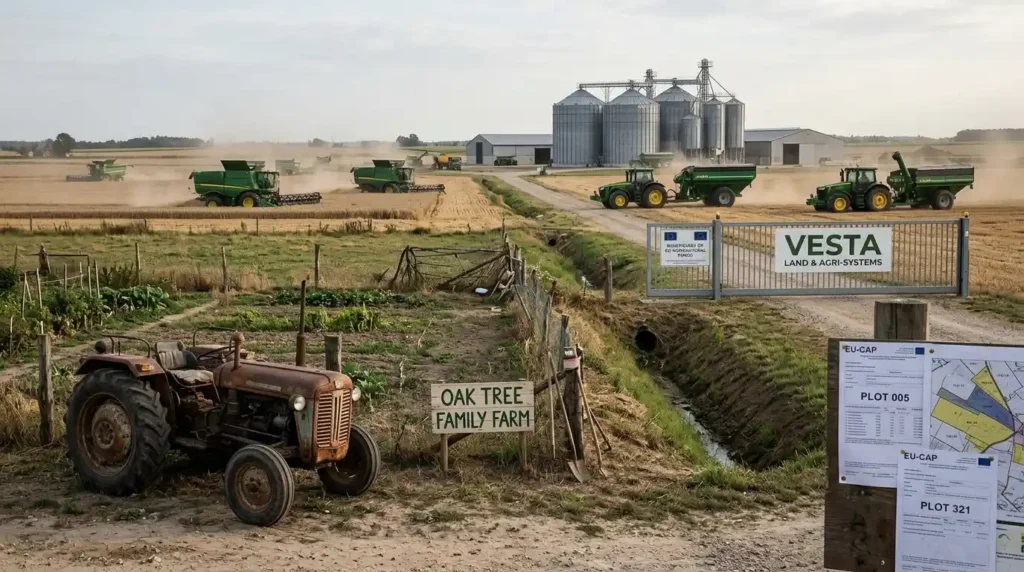
The reporting cited in the coverage says subsidiaries controlled by the Al Nahyan family collected more than €71 million over six years, and that the payments were made through farmland in Romania, Italy, and Spain under CAP rules. One outlet says the investigation traced 110 European subsidy payments to a network of companies and subsidiaries controlled by the Al Nahyans and Abu Dhabi’s investment and holding company, ADQ. Another says the largest payment identified was a 10.5-million-euro payment in 2024 to Agricost, a 57,000-hectare Romanian farm acquired in 2018 by the Emirati group Al Dahra.
Those figures matter because they show scale, continuity, and geographic spread. A one-off payment can happen anywhere in a large bureaucracy, but 110 payments over six years across three member states points to a durable structure rather than an isolated administrative mistake. The fact that the farms were described as mainly producing fodder for export to the Gulf also complicates the public-interest argument, because the subsidies are supposed to support European agriculture and rural development, not necessarily the overseas food-security strategies of wealthy external actors.
Why does ownership opacity matter so much?
The biggest governance problem is not simply that rich owners can buy land. It is that subsidy systems can become vulnerable when the real controller of the beneficiary is hidden behind legal entities spread across multiple jurisdictions. The Commission’s own response, as reported, was that CAP is under shared management and that the Commission does not intervene in the payment of subsidies to final beneficiaries; that responsibility lies with member states, which is why the Commission says it does not have the names of beneficiaries or owners of the legal entities receiving CAP aid. That admission is crucial because it shows the structural limitation at the heart of the system.
If a policy delivers public money but cannot reliably identify the ultimate beneficiary, then the enforcement burden sits with the weakest link in the chain. In this case, that means national agencies, national land registries, and national subsidy administrators. The problem is not just fraud detection after the fact. It is the possibility that the rules themselves allow large, complex ownership structures to operate behind an acceptable paper trail while the real economic controller remains invisible.
Why does the CAP look vulnerable to capture?
The CAP has long been criticised for rewarding land ownership and scale, which can favour large enterprises over smaller farms. The reporting on this case highlights that Agricost alone received over €10 million in direct payments in 2024, and that this was more than 1,600 times the amount collected by the average EU farm. That comparison is politically devastating because it makes the subsidy gap feel structural rather than accidental.
The issue becomes even more sensitive when the beneficiaries are not ordinary agribusiness operators but companies linked to one of the world’s wealthiest ruling families. Coverage describing the Al Nahyan family as among the wealthiest in the world reinforces the perception that a poverty-alleviation instrument may have been captured by capital-rich actors with the resources to navigate complex ownership and compliance systems. That is exactly the type of imbalance critics have long warned about in land-based subsidy models: the more land you control, the more you can absorb public support, regardless of whether the public policy outcome aligns with the stated goal of strengthening European rural communities.
What did the Commission and critics say?
The European Commission said it had taken note of the investigation, with spokesperson Louise Bogey stating,
“We take note of the investigation revealing that the Emirati royal family benefits from subsidies under the CAP”.
She also said,
“It is important to stress that the CAP is under shared management, meaning the commission does not intervene in the payment of subsidies to final beneficiaries,”
and added that the responsibility lies with member states. That response is legally precise, but politically weak, because it sounds like an explanation of why the problem exists rather than a strategy to fix it.
Critics cited in the wider reporting argue that the current structure disproportionately benefits large landowners and multinational investors rather than smaller local farmers. That criticism goes to the heart of the CAP’s legitimacy. If public money is distributed mainly according to land size and legal form, then highly sophisticated investors can do what small farmers cannot: structure ownership, spread risk across borders, and scale up eligibility with professional legal help.
Why should France lead the reform push?
France has the strongest political reason to act because it helped make the CAP the centre of Europe’s farm policy and has traditionally benefited from a well-functioning system. If the CAP is perceived as leaking money to wealthy foreign-linked beneficiaries, France’s argument for defending the policy becomes weaker unless it is paired with a credible reform agenda. That is why the demand for an OLAF investigation, tighter beneficial ownership disclosure, and stronger screening of large-scale agricultural land acquisitions is politically coherent even if it is not yet formally adopted.
France can also frame this as an anti-capture and fairness issue rather than an anti-UAE issue. The point is not nationality alone; it is whether the rules prevent any ultra-wealthy or sovereign-linked group from exploiting subsidy systems designed for European farmers. A France-led push would therefore carry more weight if it focused on transparent eligibility, public-interest safeguards, and enforceable ownership disclosure rather than on symbolic outrage.
What would real reform require?
Real reform would begin with beneficial ownership disclosure at the point of subsidy application, because opacity is the enabling condition here. It would also require stronger coordination between national paying agencies and EU fraud bodies so that repeated high-value payments across multiple years do not stay fragmented in separate administrative silos. The reporting also strengthens the case for examining whether large agricultural land acquisitions linked to sovereign wealth or state-connected entities should fall under a broader screening regime, especially when those acquisitions are tied to large subsidy flows.
The deeper reform question is whether the EU wants CAP to remain a land-heavy transfer system or become a more targeted public policy tool. As long as the rules reward scale without adequately exposing who controls the scale, the system will remain vulnerable to the same type of controversy. That is what makes this case more than a scandal: it is a warning about how easily public policy can be re-routed by sophisticated ownership structures.