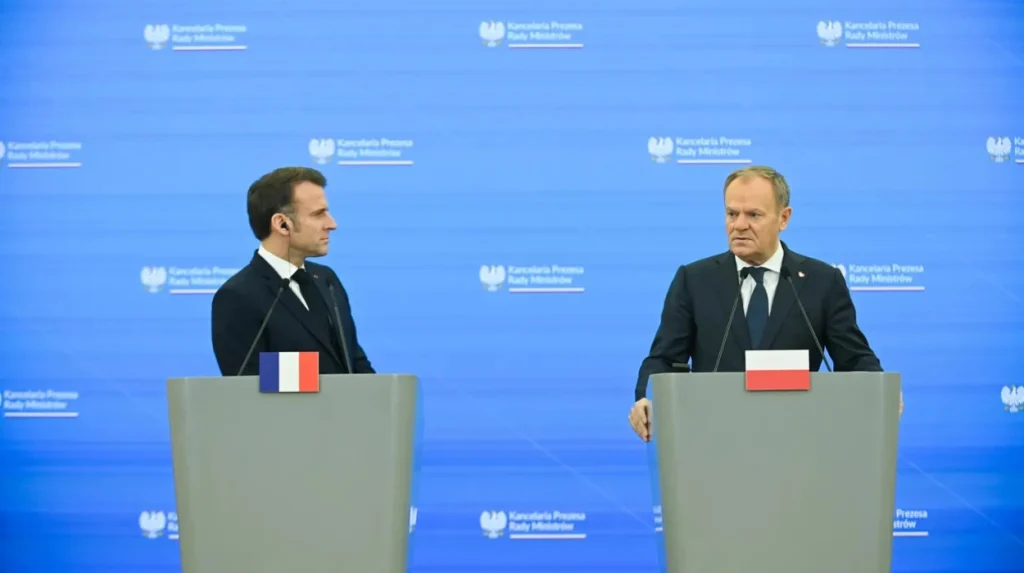
In the latest step by European nations to strengthen military relations in the wake of Russian aggressiveness and doubts about US security guarantees, France and Poland are scheduled to sign a comprehensive pact encompassing both defence and commercial issues.
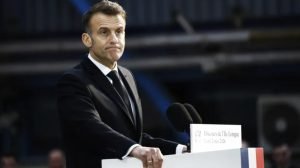
On May 9, Polish Prime Minister Donald Tusk and French President Emmanuel Macron will sign the agreement. Following US President Donald Trump‘s overtures to Russia and vows to revoke American assurances that have supported European security for decades, the long-awaited agreement took fresh significance.
“Washington, our primary ally for so many years, is also receiving a message from Tusk,”
stated Aleksander Olech, a security expert at the Polish think tank Defence24.
“It is a clear signal that Poland can have other powerful nuclear allies in addition to the United States.”
Tusk recently indicated that Poland was willing to looking at methods to be covered by France’s nuclear umbrella, which prompted the defence deal.
In order to dissuade Russia, Tusk also discussed Poland creating its own nuclear weapons. For many years, France has maintained that there is a “European dimension” to the “vital interests” that dictate the deployment of atomic bombs. To keep the president’s choices open and the enemy guessing, Paris, however, never defined the phrase.
When Macron and Tusk meet to sign their pact in Nancy, in northern France, a French official said it is improbable that they will come to a consensus on nuclear deterrent. In addition to covering a wide variety of subjects, the deal will give Poland a treaty like to those that already bind France and its neighbours, Germany, Italy, and Spain.
Additionally, France has more limited defence-related agreements with other nations, such the Lancaster House pact with the United Kingdom. Earlier this week, Tusk declared that the deal will result in “a very serious acceleration” of the continent’s military and economic security. In terms of the economy, France wants to contribute more to Poland’s move away from coal-based energy.
According to the French source, the deal also showed how, in light of the conflict in Ukraine, Paris viewed Warsaw as an increasingly important ally. In order to avoid the prospect of higher US tariffs on European imports, Macron has been making a diplomatic effort to sway Trump in the peace negotiations with Moscow and Kyiv over Ukraine. Both illustrate the French leader’s long-standing claim that in order for Europe to withstand geopolitical difficulties, it must become more independent and competitive.
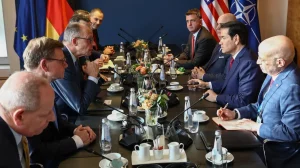
In order to safeguard Ukraine in the event that Trump negotiates a ceasefire without providing US security assurances, Macron has collaborated extensively with UK Prime Minister Sir Keir Starmer. Friedrich Merz, Germany’s incoming chancellor, will go to Paris to meet with Macron on Wednesday and then to Tusk in Warsaw. Merz has also stated that Europe could no longer rely on the United States to protect it and expressed interest in the French nuclear umbrella.
A bilateral agreement between France and Poland that was signed in 1991—shortly after Poland’s transition from communism and years before it joined NATO and later the EU—is being upgraded.
“The objective is to strengthen and operationalise the fundamental components of the Franco-Polish relationship, such as assessing threats, cooperating on defence projects, and expanding the discussion on strategic matters, such as nuclear deterrence,”
the French official stated.
There may be methods to adapt France’s nuclear doctrine to meet the demands of EU partners like Poland, even though it will not alter. When the right-wing nationalist Law and Justice party-led administration in 2016 cancelled a $3.5 billion agreement to buy Airbus Caracal helicopters, which had been agreed upon by the previous Tusk government, the Franco-Polish relationship worsened.
Despite placing the majority of its orders with South Korean and American arms manufacturers, Poland is NATO’s largest spender in terms of GDP, allocating 4.7% of its GDP to defence this year. The new deal would allow France to sell more military hardware to Poland.
A former Polish defence official stated,
“Macron now talks about the need to buy European, but everybody understands that his priority is to sell French [equipment] to Poland and other EU partners.”
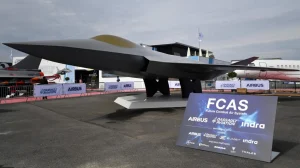
Airbus is vying for Polish contracts for transport, refuelling, and helicopter services to support Warsaw’s expanding fighter jet force, which will also include F-35s next year.
France is one of a few bidders for a significant submarine acquisition that the Polish military is also contemplating. Despite last-minute French pressure to choose EDF, Tusk earlier this week revealed that the US business Westinghouse will construct Poland’s first nuclear power plant.
“To put it bluntly, France hasn’t really been interacting with Poland and considering us to be a very good partner, but they also see an opportunity to be more present here now that the US is changing its policies,”
Olech of Defence24 said.