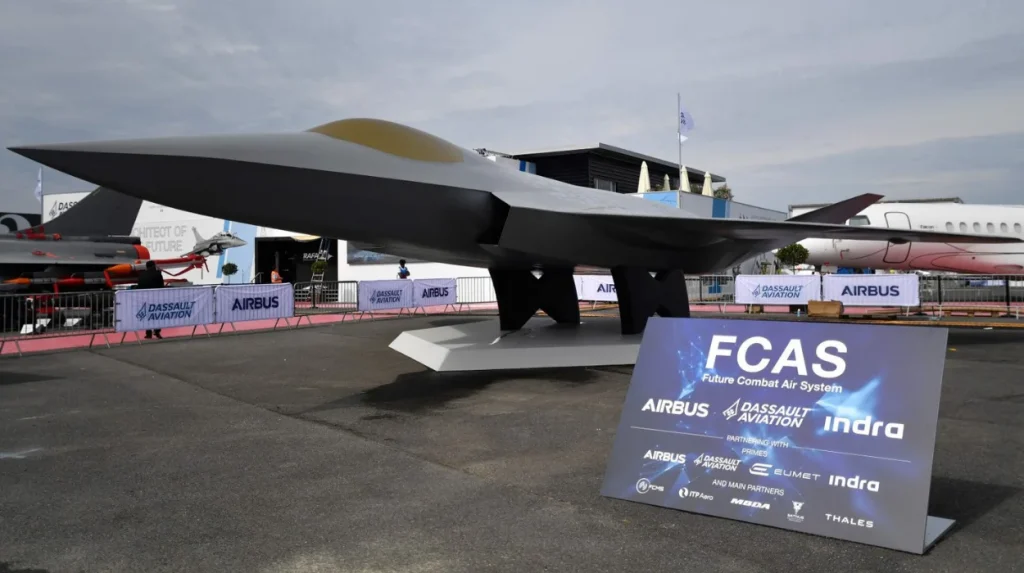
FCAS Deadlock has reached a critical period after Chancellor Friedrich Merz of Germany expressed doubts on whether Berlin can be so committed to the Future Combat Air System. The Franco-German-Spanish programme of producing a sixth-generation fighter by 2040 (priced at EUR100 billion) is now politically uncertain over an underlying history of industrial wrangles.
Merz expressed skepticism publicly about the continuing existence of basic divergent requirement descriptions to support a shared platform, and noted that German taxpayers had to be able to perceive definite strategic worth. His remarks that followed a larger 2025 discussion on efficiency in defence expenditures were broadly understood in Paris and Madrid as an implied threat of exit.
The timing is critical. The Phase 1B demonstrator milestones had slipped even earlier than planned 2027 targets and defence ministers in France, Germany and Spain had not reached a breakthrough agreement by the end of 2025. What had been projected as the face of Europe in defence-industrial terms is now having to face structural pressure.
Diverging Strategic Priorities
France’s defence doctrine prioritizes strategic autonomy, including a carrier-capable, nuclear-delivery option to replace elements of its airborne deterrent. Germany, by contrast, emphasizes air superiority missions, NATO interoperability, and export viability.
These distinctions are not marginal. They shape aircraft weight, range, payload, and stealth requirements. They also determine which nation leads design authority, an issue at the core of current friction.
Industrial Governance Fractures
The defence policy of France stresses strategic independence, with an option of carrier capability, nuclear delivery to substitute part of the airborne deterrent. Germany, in its turn, prioritizes the air superiority missions, NATO interoperability, and export viability.
These differences cannot be marginal. They determine the requirements of aircraft weight, range, payload and stealth. Their decision on who controls design power also defines the issue of who is at the heart of the dispute today.
Phase 1B Demonstrator Slippage
Dassault Aviation pursues a leading position of the next generation fighter component and states that the design coherence is a must. Airbus with the support of Berlin demands balanced governance throughout the system-of-systems architecture, especially the combat cloud element.
In late 2025, German works councils cited elements of the cooperation model as being counterproductive, in terms of internal issues in the industry. The conflict is not just about percentages of the workshare, but it goes further to the right of sovereignty, rights of intellectual property, and export control.
Combat Cloud As A Salvage Pillar
Phase 1B contract, which was signed in 2022 (EUR8 billion) was to mature the key technologies such as engines, sensors, and remote carriers. Nevertheless, the development of fighter demonstrators has not been as vigorous as it should have been. Industry sources have indicated that first prototype flights might be delayed to the early 2030s as long as governance disputes are not ironed out before 2026.
Spain, with an approximate 17% share, has been demanding guarantees that it will not be pushed on the margins by delays, which will impact on its industrial contribution. Countries like Belgium are reconsidering its involvement with Alan, and its expenditure against the fading of clarity.
Strategic Autonomy Under Pressure
With the stalemate, Airbus has been marketing the combat cloud as the anchor programme. The connected architecture would connect manned fighters and swarming drones with the legacy planes (eurofighter and Rafale) using artificial intelligence-based data fusion.
The officials of Germany consider this digital backbone as the most compatible with NATO interoperability objectives. Although a single fighter may lose, the cloud might develop into a single European capability.
Competitive Landscape
The FCAS Deadlock is a backdrop of an increasing European F-35 procurement. The ability requirement due to the acquisition of the U.S. built platform by Germany as a nuclear-sharing mission is important but it also brings to the fore the dependence on external suppliers that are not in Europe.
FCAS has been long presented by European policymakers as a tenet of defence sovereignty. A fragmented programme will serve more to strengthen the addiction to U.S. systems when Washington is more and more strategically divided in Europe and the Indo-Pacific.
Budgetary And Timeline Pressures
The UK, Italy and Japan still continue with the Global Combat Air Programme. In the possibility of FCAS delay will take past 2045, Europe will be exposed to a discontinuous sixth-generation environment, with reduced export leverage and standardization opportunities.
Belgian Defence Minister Theo Francken took the comments made by Merz to mean that the project would no longer provide a single Europe fighter solution. These images have an impact on investor confidence and alignment of partners.
Decision Points In 2026
The billions in the projected lifecycle costs have made the expenditures thereon a point of increased questioning in Berlin, particularly as fiscal consolidation discussions at large scales occur in 2025. With an estimated 34% portion, Germany is in the middle of the financial negotiation table.
France claims that long term industrial dividend is worth the expense. However, increasing development costs, inflation in state-of-the-art materials and propulsion research, leave political space on both sides of indefinite delays tight.
National Calculations And Sovereignty Concerns
Paris retains leverage through continued Rafale modernization and plans for a successor to the Charles de Gaulle carrier. Dassault Chief Executive Éric Trappier has suggested that France could pursue national options if industrial leadership is diluted.
France’s defence establishment views control over fighter design as inseparable from strategic autonomy, particularly given the integration of nuclear deterrence.
German Industrial Balance
Germany’s political leadership must reconcile alliance commitments with domestic industrial priorities. Airbus represents a major employer and technological champion. Berlin’s calculus weighs maintaining equal partnership against the risk of financing a platform that does not fully align with Luftwaffe requirements.
Merz’s comments reflect this balancing act, signaling openness to recalibration rather than immediate withdrawal.
European Defence Architecture At A Crossroads
Fractures in European defence integration The FCAS Deadlock indicates deeper conflicts. As policymakers talk about autonomy, the real implementation requires the ability to reconcile the national beliefs, industrial complexes and budgetary facts.
Provided that compromise is not achieved, Europe is likely to go into the 2030s with the parallel development tracks and low levels of convergence. In contrast, a more limited yet functional cooperation concept focused on the combat cloud might retain the technological benefits at the center-stage and push the fighter conflict off.
Whether the process of transforming the rhetoric to the structure of political leadership is possible, the next few months will tell. With 2026 funding timelines nearing, it is less an issue as to whether Europe can come up with a sixth-generation aircraft, and more whether the region can remain united enough to put it in service on identical terms.