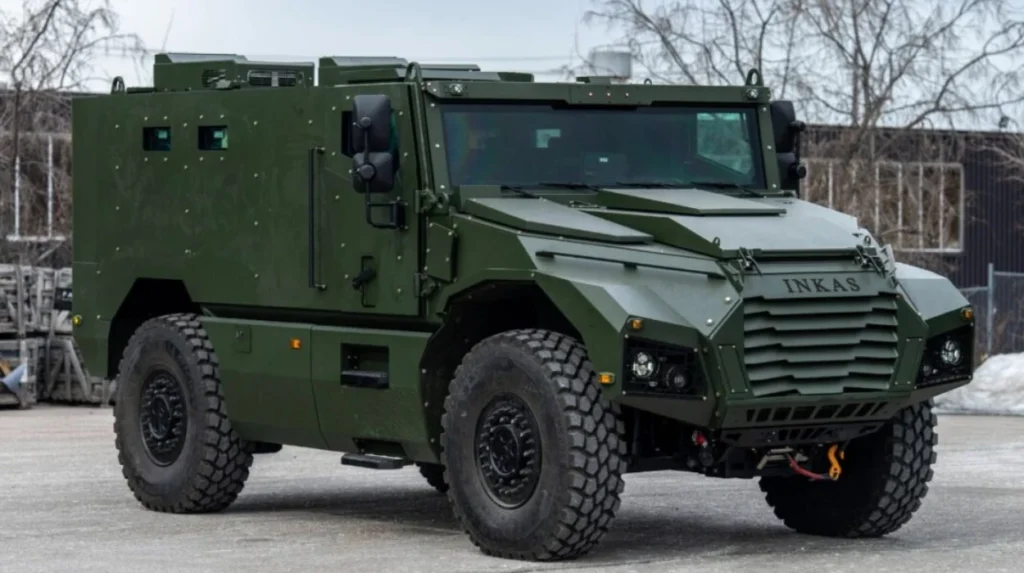
Recent announcements have highlighted an example of cooperation between Canada and France to provide NATO allies with a newly designed MRAP. The INKAS M1 MRAP is a NATO compliant all-terrain vehicle that combines Canadian engineering with French technology to accommodate the rapidly changing security environment in Europe.
This vehicle has been developed by INKAS (Canadian manufacturer) and KNDS Mobility (French Mobility company formerly Texelis) as one of several projects which convey increased levels of industrial and strategic cooperation between Canada and France under the NATO umbrella.
For French decision makers, the announcement of this partnership is more than just a buying and selling of products; it represents a change in how France intends to position itself within NATO and at the same time how it seeks to establish its own national independence for defence and industrial actions.
What the MRAP Project Actually Is
The INKAS M1 MRAP is a wheeled mine-resistant armored vehicle made for use in high-threat environments, such as those characterized by IEDs, ambushes, or asymmetric threats. The vehicle is built on a 4×4 chassis from Texelis that has been modified by Canadian company INKAS into a single monocoque blast-deflecting hull designed to maximize crew safety and to best withstand the effects of blasts.
Publicly, the vehicle is described as being modular, meaning that it can be configured differently on the inside for use as a troop transport, command post, medical evacuation, or logistics support. Therefore, one basic platform can accommodate multiple types of missions within a single force.
The reason why this vehicle is so important to NATO forces is that while deployed to unknown environments, they need their vehicles to be able to transition seamlessly between combat operations, police-like activities, and humanitarian missions. By marketing the M1 MRAP as a “configurable system,” rather than a fixed-role vehicle, INKAS supports NATO’s desire for more flexible and interoperable fleets.
Mobility is derived from the Texelis‑based 4×4 platform, tuned for rough terrain and rapid deployment, making it suitable for both European rear‑area operations and expeditionary deployments into unstable regions. Exact engine and horsepower figures are not always disclosed in public summaries, but the intention is clear: the vehicle must be NATO‑logistics‑compatible, using standard fuel, maintenance, and transport systems so that it can move seamlessly through allied supply chains.
NATO‑Aligned Interoperability and Industrial Messaging
The label “NATO‑aligned” appears repeatedly in the project’s marketing and technical documentation, underscoring that the M1 MRAP is not just an armoured vehicle but a political and industrial statement about interoperability within the alliance. NATO has long pushed its members to harmonize platforms, communications, and logistics so that forces can operate together without being hamstrung by incompatible equipment. The M1 MRAP is being positioned as a response to that demand: a vehicle that can plug into existing NATO fleets with minimal adaptation, using standard radio systems, power interfaces, and weapon mounts.
This interoperability message is particularly attractive to smaller NATO members or partner nations that cannot afford to develop bespoke platforms but still want modern, survivable MRAPs for high‑threat operations. By offering a NATO‑compliant baseline, INKAS and KNDS Mobility are effectively pitching the M1 MRAP as a “turnkey” solution for allies looking to modernize without reinventing the wheel.
“The M1 MRAP is designed from the ground up to be NATO‑aligned,”
said an INKAS spokesperson at the International Armoured Vehicles 2026 conference, emphasizing that the vehicle’s architecture is built around allied standards rather than national quirks.
From a French perspective, the “NATO‑aligned” label is also a subtle nod to France’s complex relationship with the alliance. France rejoined NATO’s integrated military command in 2009 after decades of semi‑detachment, but Paris has never fully abandoned its language of strategic autonomy and European sovereignty. By co‑developing a NATO‑aligned MRAP with Canada — a fellow North Atlantic ally but not a European power France is signaling that it can participate fully in NATO projects while still exporting its own industrial and mobility expertise.
Canada–France Defence and Industrial Partnership
The MRAP project sits within a broader Canada–France defence and security partnership that has been intensifying over the past few years. In 2024, Ottawa and Paris signed a Canada–France Declaration on a Stronger Defence and Security Partnership, committing to closer cooperation on joint exercises, patrols, and industrial defence projects. More recently, Canada has outlined a roadmap toward a strategic defence partnership with France, including collaboration on industrial capabilities and interoperability initiatives.
Within this framework, the M1 MRAP is being described as the first industrial collaboration of its kind between Canada and France in the defence‑vehicles sector, explicitly tying it to NATO‑aligned interoperability and allied supply‑chain resilience. For Canada, the project strengthens its position as a niche but capable defence‑industrial player that can partner with European powers without relying solely on American platforms. For France, it offers a way to extend the reach of its own defence industry — particularly through the Texelis‑derived platform — into markets that might otherwise default to American or German designs.
Strategic and Political Implications for France
The project illustrates how France is simultaneously reinforcing its ties with NATO partners like Canada while trying to project its own defence and industrial sovereignty through technological exports. This duality is central to contemporary French strategic thinking: Paris wants to be a leader within Europe and a full partner in NATO, but it also wants to avoid complete dependence on U.S. systems and industrial models.
There is also a domestic industrial‑policy dimension. The French government has repeatedly emphasized the importance of maintaining a strong, sovereign defence‑industrial base, especially as European defence spending rises in response to geopolitical tensions.
By partnering with INKAS on a NATO‑aligned MRAP, France is effectively using its mobility technology as a export product that can generate revenue, sustain jobs, and maintain technological momentum in the defence sector. This aligns with recent French efforts to boost defence exports and secure long‑term contracts with NATO and partner‑nation militaries.
Broader Context of European and Transatlantic Security
The M1 MRAP project must be understood within the broader context of NATO’s push for greater multinational capability cooperation and interoperability. In recent years, NATO has encouraged members to develop joint platforms and share industrial burdens, especially as defence budgets rise and the alliance confronts both near‑peer competition and persistent asymmetric threats. This push is driven by the realization that fragmented, nationally specific fleets are harder to sustain, more expensive to maintain, and less effective in coalition operations.
This approach may satisfy some French strategic‑policy makers, but it is likely to frustrate others who see true European strategic autonomy as requiring a much more independent industrial and technological base.
The MRAP as a Political Mirror
The Canada and France NATO‑aligned MRAP project is more than a technical collaboration; it is a political mirror of France’s current dilemma in European and transatlantic security.
On one side, France is deepening its cooperation with NATO partners like Canada, reinforcing the alliance’s interoperability and industrial cohesion. On the other, France is using its own defence‑industry assets particularly through the Texelis‑derived platform to assert its own technological and industrial sovereignty in a way that remains compatible with NATO standards.