France’s food-sovereignty case against the CAP’s distortions becomes much harder to defend when the EU’s own subsidy system helps finance a foreign royal family’s export-driven agribusiness empire. The Al Nahyan family’s more than €71 million in CAP payments is not just an optics problem; it exposes a structural contradiction at the heart of how European agricultural support is allocated.
The timing matters because food sovereignty has moved from slogan to strategic doctrine across Europe after the pandemic, supply-chain shocks, and the Russia-Ukraine war. France’s own CAP strategic plan says its strategy is meant to “ensure food security” by improving competitiveness, resilience, and limiting inputs, which shows how central sovereignty language has become in official EU policy. Yet that same subsidy architecture is also underwriting landholdings that produce crops largely for export to the Gulf, not for European consumers.
Why does this case matter now?
A French commentator framed the scandal sharply after the investigation broke. Jean Imbert said in X post,
“Un exempleLa famille royale Al Nahyan d’Abou Dabi a perçu + de 71 millions € de subventions de la PAC entre 2019 et 2024. Elles concernent des terres agricoles détenues en Roumanie, Italie et Espagne, dont les productions sont parfois exportées vers le Golfe… L’U.E. pirate”
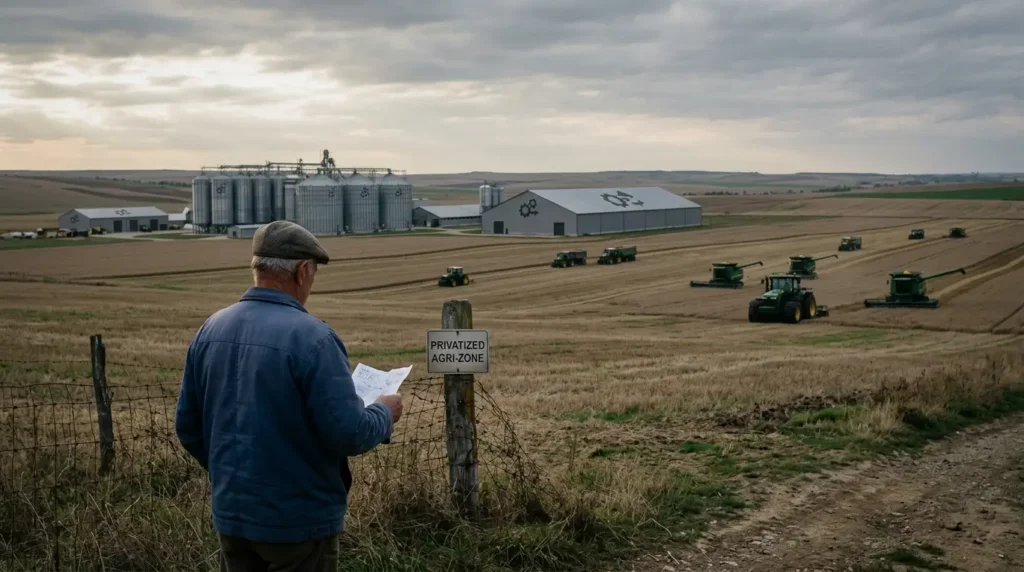
This is not a marginal leak in an otherwise coherent system. The investigation says DeSmog traced 110 CAP subsidy payments from 2019 to 2024 to companies and subsidiaries linked to the Al Nahyans and ADQ, with the largest beneficiary being Agricost in Romania, which owns the EU’s single largest farm at 57,000 hectares. In 2024 alone, Agricost reportedly received over $10 million in direct payments, more than 1,600 times the average EU farm payment.
How is EU money flowing here?
The core issue is that CAP payments are generally linked to land and eligibility rules, not to whether production serves European food chains. That design is what allows a giant export farm to qualify for support even when its output is structured for non-EU markets. In the Romanian case, the crops identified are alfalfa and other feed crops, with the majority of produce designed for export, including to the Gulf.
The criticism is not limited to journalists and campaigners. An international affairs analyst pushed the same point onto social media as the scandal spread. Dr.Sam Youssef Ph.D.,Ph.D.,DPT. said in X post,
“- Investigations reveal that the UAE ruling family received tens of millions of euros in European agricultural subsidies, causing outrage in Europe. – Taxpayer money intended for local farmers was redirected to investment networks associated with Abu Dhabi. [full thread summary on the scandal, land acquisitions in Romania/Spain/Italy, influence concerns]”
That matters because the CAP is enormous: the EU spends about $54 billion a year under the policy, and Middle East Eye notes that this is around a third of the bloc’s budget. When such a budget is distributed through land-based formulas, large owners naturally capture more than small or medium-sized farms, which is why the policy often ends up rewarding scale rather than social value.
What does this say about France?
France has long positioned itself as the EU’s guardian of agricultural strategic autonomy, and that position is not mere rhetoric. The French government’s agriculture ministry said future CAP policy should address fair prices, environmental services, and the strengthening of risk management, while also
“liberating the development of agricultural and agrifood enterprises”.
More recently, France’s draft agriculture law was framed as protecting “food sovereignty,” with Agriculture Minister Marc Fesneau saying,
“We must continue to put the productive and nourishing capacity of our farmers at the heart of our public policies”.
That makes the Al Nahyan subsidy case politically awkward for Paris. France argues for a CAP that preserves production capacity, yet the current system can subsidise land that is effectively part of a global feed-export machine. The ARC2020 report on French food sovereignty goes further, arguing that France is “mortgaging its food sovereignty” by dedicating 43% of land to exports and that CAP “effectively subsidises exports” and mega-farm industrialisation. In other words, France is already wrestling with a domestic contradiction; the Al Nahyan case internationalises it.
Who benefits from the current design?
The beneficiaries are not primarily family farms or local food systems; they are large landowners, industrial agribusinesses, and investors who can assemble acreage at scale. The MEE/DeSmog reporting says Agricost was bought by the Al Nahyans in 2018 for an estimated €230 million through Al Dahra, an agribusiness group tied to Abu Dhabi’s royal family and investment structures. It also says the UAE now controls around 960,000 hectares of farmland worldwide and imports up to 90% of its food, so overseas land acquisition is part of a broader food-security strategy.
That raises a policy question the CAP has avoided for too long: is European public money meant to secure European food systems, or merely to subsidise any eligible hectares regardless of who owns them and where the harvest goes? Terre de Liens, cited by ARC2020, recommends re-orienting the CAP toward a “common agricultural and food policy,” which is a pointed criticism of a system that has drifted away from local supply and toward export logic. The Al Nahyan case gives that critique a concrete, high-value example.
What do the numbers reveal?
The figures are politically explosive because they make the inequity visible. More than €71 million in six years, 57,000 hectares in one Romanian farm, over $10 million in 2024 alone, and payment levels more than 1,600 times the average EU farm are not normal market outcomes; they are policy outcomes. The scale alone shows how subsidy systems can amplify existing concentration rather than correct it.
Even the broader CAP context reinforces the problem. MEE notes that the CAP distributes tens of billions annually, and DeSmog’s tracing of 110 subsidy payments shows how easily funds move into opaque corporate networks. When foreign sovereign-linked entities can access the same support as local producers, the policy stops looking like a food-sovereignty instrument and starts looking like an acreage subsidy with weak public-interest safeguards.
What should France and the EU do?
France is well placed to push for reform because it already speaks the language of sovereignty, resilience, and fair farmer support. The strongest reform would be to condition income support on the actual orientation of production, not just the existence of eligible land. If land is primarily producing for non-EU export markets, especially when the beneficiary is a foreign sovereign-linked entity, it should not receive the same public support as farms serving European food supply chains.
A second reform would be tougher transparency rules on beneficial ownership and subsidy recipients. The fact that DeSmog needed cross-border investigative work to trace the payments shows that the system is not transparent enough for democratic accountability. A third reform would cap payments more aggressively for ultra-large holdings and redirect funds toward smaller farms, local processing, and domestic supply resilience, which is closer to the spirit of France’s own sovereignty discourse.
Why is this more than a subsidy story?
Because it speaks to whether Europe believes food is a public good or just another asset class. France has spent years defending the CAP as a strategic pillar of European agriculture, and that defense only remains credible if the policy actually serves public purpose. If CAP money can subsidise land in Romania that feeds Gulf export chains under the ownership umbrella of the Al Nahyan family, then Europe is not simply supporting farmers; it is subsidising a globalised land-finance model that weakens the very sovereignty it claims to protect.
The most uncomfortable truth is that the system did not fail accidentally. It was built to pay for land, and powerful actors learned to operate inside those rules. France can still lead the reform debate, but only if it stops treating food sovereignty as a rhetorical shield and starts treating subsidy eligibility as a question of democratic purpose, ownership, and destination of production.