Israel is weighing the expulsion of British — and possibly Italian and German — officials from the International Gaza Support Center (IGSC), the US‑led coordination hub created to monitor the Gaza ceasefire and steer post‑war efforts, according to reporting by the Financial Times on 27 August 2026.
The move, which has been characterized as a reaction to increasing European criticism of the policies of Prime Minister Benjamin Netanyahu in the West Bank and Gaza, will be yet another development in an ongoing diplomatic split over settlements, the two-state solution, and the stalled ceasefire process brokered by the United States. On Thursday, there was no official announcement of any expulsion, as the issue is still being discussed internally; however, precedent from the recent expulsion of the Spanish and Dutch delegations makes the possibility increasingly likely.
The IGSC: What It Is, Where It Operates and Why It Matters
At the core of the story lies the IGSC – the Israeli-Gaza Supervision Centre. This is the large three-story building in Kiryat Gat, southern Israel, which acts as the operational hub of the ceasefire mechanism between the warring factions. Operated by US military personnel together with the Israel Defense Forces, the center employs dozens of diplomats from around 50 countries and international organizations in their efforts to oversee the implementation of the ceasefire, deliver assistance to Gaza and facilitate the overall process of transition and reconstruction within the framework of the United States-led Board of Peace.
Naturally, the work of the IGSC involves not only technical aspects but also politics – it is supposed to build trust among the sides, ensure compliance with the ceasefire terms and provide a foundation for reconstruction after disarming and withdrawing from the area. Hence, access to the IGSC has a political meaning behind it: expelling the representatives of any country from the supervision center is interpreted as the sign that that particular country cannot be trusted to contribute to shaping Gaza’s future. From this point of view, the idea of kicking out the British officials is less of a logistical issue and more about sending a message to Jerusalem’s European partners on its policy regarding settlements.
From Spain to the Netherlands: The Precedent for Expulsions
Israel has followed this logic twice already in 2026. First, in April 2026, the Israelis expelled Spanish representatives from the IGSC, citing Spain’s “obsessive anti-Israel bias” and “consistently standing against Israel.” Secondly, on 25-26 August 2026, Israel’s foreign minister Gideon Sa’ar ordered the immediate expulsion of Dutch representatives from the ceasefire arrangement because the Dutch government was threatening a boycott of Israeli products from occupied settlements in the West Bank, East Jerusalem and the Golan Heights. Sa’ar stated that
“Israel will not allow measures to be taken against it without a response,”
thus giving the Dutch a deadline of one week to leave the ceasefire arrangement.
This shows how Israel can turn the policy dispute over the settlements into an immediate consequence within the ceasefire architecture. The logic has thus been set in stone – if Europe adopts any measures against Israel, whether in the form of boycotts, threats of sanctions or harsh diplomatic criticisms, then Israel can retaliate by stripping those states of their privileges within the IGSC. This explains why the recent Financial Times report regarding discussions between Israel and the UK and Italy is significant for diplomats.
The UK’s Hardening Line: E‑1, Settlements and the Two‑State Solution
The immediate trigger for heightened tensions with London is the E‑1 settlement tender. On 19 August 2026, Israel published a tender for the E‑1 project near Jerusalem, a plan for around 1,200 housing units that analysts warn could bisect the West Bank and sever the geographic contiguity between its northern and southern halves, with profound implications for any future Palestinian state. British Foreign Secretary Ed Miliband swiftly condemned the move, calling it an “unacceptable and destructive act” and demanding that Israel
“halt E1 plans immediately, retract the tender and stop all settlement expansion.”
Miliband’s language has grown more pointed in recent weeks, reflecting a broader shift in the UK’s posture. He has argued that
“E1 would cut across the heart of Palestine and risks separating the West Bank from East Jerusalem, which would endanger the viability of a two‑state solution.”
He has also insisted that
“all settlements … are a flagrant breach of international law,”
a formulation that leaves little room for diplomatic ambiguity. Most significantly, he has signalled that Britain is preparing targeted sanctions against Israelis involved in “illegal settlement expansion,” declaring that
“Britain will not stand back and accept the destruction of the two‑state solution.”
This hardening stance is not confined to the foreign ministry. Prime Minister Andy Burnham has indicated he would seek to pressure Israel further, including through a potential ban on trade in goods from settlements, and more than 140 MPs recently signed a letter urging him to proceed. Last week, the UK joined Germany, Italy and nearly 20 other countries — along with the European Commission — in a joint statement slamming Israel’s E‑1 plans, underscoring that London’s position is part of a wider European pushback.
Jerusalem’s Pushback: Sovereignty, History and the Limits of “Lectures”
In response to the threats from the British government, officials in Israel have used legal and historical arguments in defense. In a direct challenge to Miliband, Israeli Foreign Minister Gideon Sa’ar stated that the UK should not be lecturing
“the Jewish people about where they may live in their historic homeland.”
This statement summarizes the stance taken by Jerusalem on the matter of Israeli settlement policies, which are based not only on negotiations but also on Jewish self-determination in lands claimed as part of its historic heritage and the illegitimacy of attempts to limit the rights of Israelis to live in these lands.
With regard to the particular case of expulsions from the IGSC, the positions of Israeli representatives vary as well. An unnamed Israeli official stated in an interview that
“Israel has good relations with Germany and Italy.”
While not making any references to the United Kingdom, this remark suggests that the expulsion will not be applied equally to all European nations. Moreover, according to another third-party source, the US and Board of Peace do not hold any vetoes concerning entry of individuals onto Israeli territory.
The Governance Question: Does the Board of Peace Have a Veto?
A central uncertainty is whether Israel needs external approval to remove additional delegations from the IGSC. Two people familiar with the matter told the FT that expelling more international representatives could require approval from the US‑led Board of Peace, the body established by President Donald Trump in 2026 to oversee Gaza’s post‑war transition and reconstruction, including the centre’s work. If that is correct, any move against the UK would not be a unilateral Israeli decision but a negotiated step within the Board’s framework, potentially forcing Washington to weigh in on the boundaries of multilateral access.
However, a third person contested this interpretation, insisting that Israel has full sovereign control over access to its territory and the centre. The Board of Peace itself has offered only a cautious public line, with a spokesperson saying:
“We continue to engage our Israeli counterparts on ways to maintain and strengthen multilateral co‑ordination and to accelerate progress on the president’s Comprehensive Peace Plan for Gaza.”
That carefully neutral phrasing avoids confirming or denying a veto, while signalling that Washington’s priority is to preserve the coordination mechanism rather than escalate a public dispute with Jerusalem. Reuters noted it could not independently verify the FT report at the time of publication, adding another layer of caution to the story.
Ceasefire Stagnation: The Political Backdrop to Diplomatic Friction
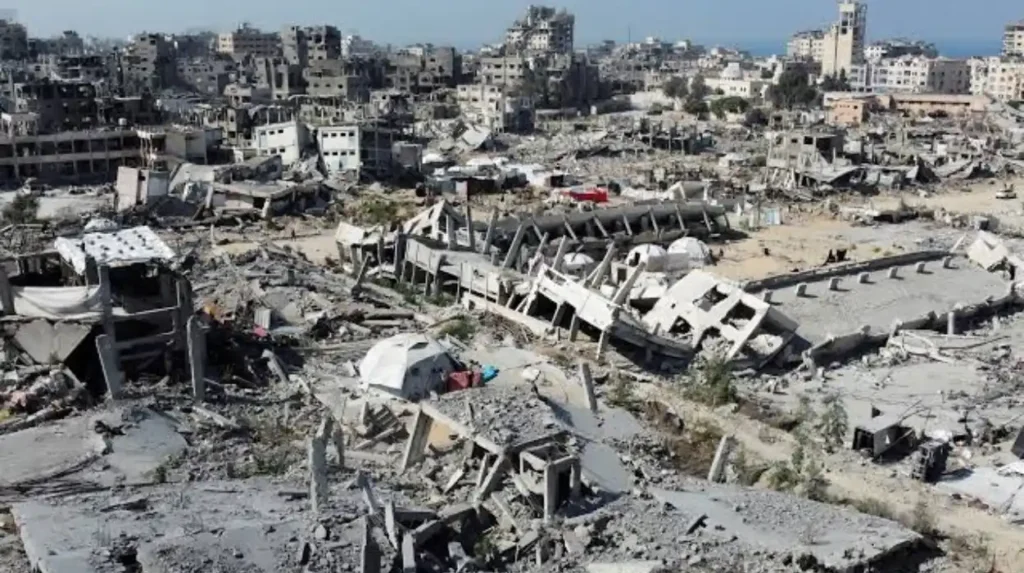
The question of expulsions cannot be considered without regard for the overall stagnation of the ceasefire. The peace deal brokered by the US in October 2025 has been unable to realize the anticipated process of disarmament, withdrawals and reconstruction. Israeli troops still control over half of Gaza territory and carry out frequent raids into the territories controlled by Hamas, which did not disarm and for which reconstruction has not yet begun on a big scale. This standstill has affected people’s confidence about the political perspective, and has led to disagreements about what is needed next.
Recently, the Board of Peace tried to revive the process through the insistence on Hamas disarmament and withdrawal of IDF forces, but the attempts proved to be ineffective. It was even reported that the high-profile visit last week of US envoy Jared Kushner, who met both representatives of Hamas and Netanyahu, “went poorly.” Under these circumstances, the question of settlements and the two-state solution acquires greater significance; they become indirect struggles about whether the ceasefire arrangement can produce a political result, or is merely stabilizing a frozen conflict.
What an Expulsion Would Mean for Britain and Europe
If Israel proceeds against the UK, the immediate operational impact inside the IGSC may be limited; British officials are described as “sanguine” about the prospect, viewing it as a plausible form of payback given London’s hardening line and the precedents with Spain and the Netherlands. But the symbolic and strategic costs would be significant. Losing access to the IGSC would reduce Britain’s ability to monitor ceasefire implementation up close, constrain its influence over aid coordination and reconstruction planning, and weaken its hand in shaping the post‑war order. It would also send a clear signal to other European capitals that criticism of Israeli policy can carry concrete diplomatic penalties inside the very mechanism designed to stabilise Gaza.
For Europe as a whole, the episode underscores a growing dilemma: how to maintain leverage over settlement policy and the two‑state solution without being sidelined from the core coordination structures that will determine Gaza’s future. The joint letter from the UK, Germany, Italy and nearly 20 other countries shows that European states are attempting to act collectively, but the expulsions of Spain, the Netherlands and potentially the UK suggest that collective statements may not be enough to deter Israeli countermeasures when Jerusalem feels cornered.
Scenarios Ahead: Restraint, Retaliation or a Managed Compromise
There are three possible courses that seem most likely to occur. First, Israel chooses not to go through with its threats against the presence of British officials in the area but rather conveys dissatisfaction by other means while maintaining the involvement of London in the IGSC in order to preserve multilateral cooperation. Second, Israel actually follows through with its threats and removes the representatives of the UK, possibly stretching the boundaries to include Italy and Germany, thus putting into practice the need for the Board of Peace to specify the terms of access and of unilateralism.
Third, some kind of compromise solution is reached: Israel eases up on its measures while UK softens its statements, allowing both parties to preserve face and uphold their own principles while at the same time preventing the collapse of the coordination mechanism. Whichever way things develop, the outcome will have little to do with the intricacies of the IGSC process and much more to do with political considerations in Jerusalem, London and Washington. It remains to be seen whether Netanyahu’s challenge to Europe on the issue of settlements will strengthen his position domestically without weakening the ceasefire mechanism he still needs. Also to be seen, whether Burnham and Miliband could put pressure on settlement policy without forfeiting their place in the negotiating forum on Gaza’s future.