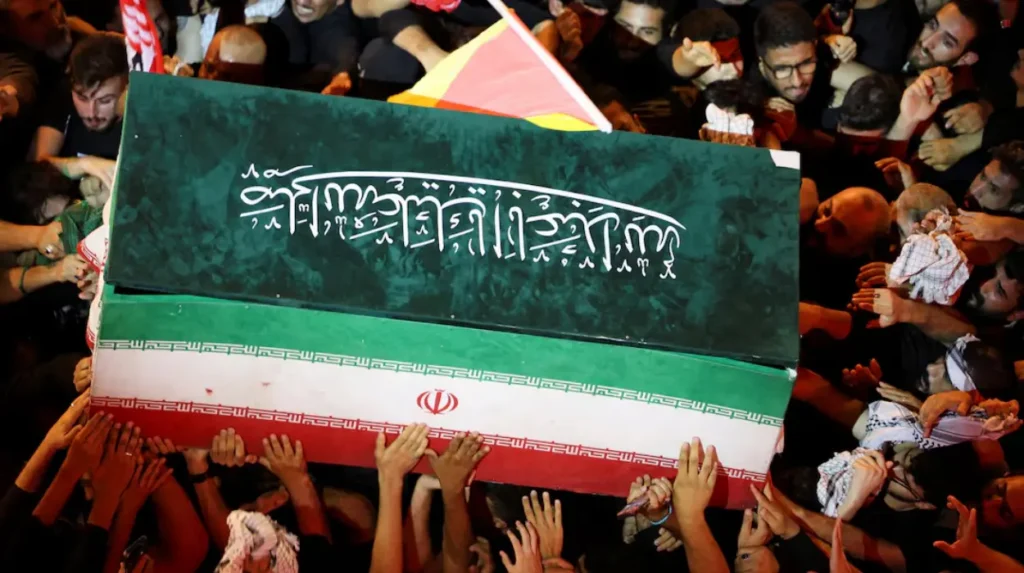
Iran’s state funeral for its slain Supreme Leader has become far more than a burial ceremony. It has turned into a highly charged political moment, blending national mourning, regime messaging, succession signaling, and public anger after months of war. The event, described across several reports as a dayslong procession culminating in burial at one of Iran’s holiest shrines, has drawn massive crowds, senior officials, and intense anti-U.S. and anti-Israel rhetoric.
It is not just the sheer magnitude of the funeral itself, but also its ability to showcase continuity at a moment of great uncertainty. Through the rituals that took place in Tehran and other places around the country, the Iranian regime had an opportunity to showcase their control, mobilize their loyalists, and present the death of their leader as part of a bigger battle and not one of national vulnerability. In essence, it was more than just a send-off; it was a political ritual.
Funeral turns into power message
The death of Ayatollah Ali Khamenei, according to the news reports, has been marked by a ceremony that has been set up as a national-level event with great symbolic significance. Reuters reported that Iran had been burying their murdered Supreme Leader at their holiest shrine, with the presence of his son and successor Mojtaba being there to mourn him. This is significant from a political perspective, since it allows the idea of succession to enter into the ceremony and suggests that the transfer of power has already been planned and presented to the people. The Washington Post explained the funeral ceremony as an opportunity for the regime to exert power after months of warfare with Israel and the US. This explains the size of the event; rather than having a religious ceremony alone, the leaders have ensured that it becomes a show of their ability to endure.
This is typical of authoritarian political theater: the state absorbs loss and repackages it as resilience. In Tehran, that dynamic appears to be playing out in real time. The funeral has become a moment to remind both domestic supporters and foreign adversaries that leadership succession will not create visible disorder.
Massive crowds and public mourning
The scale of public participation has been one of the defining features of the funeral. The New York Times reported that “millions” of Iranians descended on Tehran to pay their respects, while other outlets described tens of thousands gathering for prayer ceremonies in the capital. Even allowing for some variation in crowd estimates, the broader point is clear: the funeral drew an exceptionally large and emotionally charged turnout.
According to NPR, the funeral took place in Tehran and was to continue for a few days until the body was buried. NBC News further indicated that the streets were closed off, along with the airways, and that normalcy was interrupted by the mourning process. In such an event, there are two factors that come into play: first, the sheer magnitude of the occasion, and second, the state’s need to keep control of the mood created by the funeral itself. In suspending normal urban activity in order to mourn, the state is saying what it values. There was also an emotional reaction from the people. According to The New York Times, they were saying an emotional goodbye, while according to other news sources, the crowd was chanting vengeance and anger against their enemies.
Chants, slogans, and anger
The most striking public statements reported from the funeral are those of the mourners themselves. The Independent said some mourners chanted “kill Trump” slogans, while the New York Times reported chants of “revenge” at funeral prayers. These are not incidental expressions; they reveal how the state’s wartime narrative has fused with public mourning.
The slogans also indicate that funerals in Iran can be used as grounds for political statements. In a carefully controlled public sphere, the chants and slogans always convey a mixture of actual emotions and the atmosphere set out by authorities. From the analysis of this particular report, it can be concluded that the anti-American sentiment was not a minor detail, but one of the key aspects of the ceremony. It is vital to understand that the funeral became an additional element of the war story, but not a break in the action. In turn, it should be emphasized that there is also the strategic importance of such chants. These chants contribute to reinforcing the image of uncompromising and mobilized leadership, even if it has just buried one of its members.
Succession enters the frame
Succession is one of the major political dimensions of the funeral ceremony. It is worth mentioning that Reuters highlighted the presence of the successor and son of Khamenei named Mojtaba. Thus, the above-mentioned fact suggests that the funeral ceremony is used for the legitimization of the power transmission. Before the burial process is completed, people are informed about the continuity story – the old leader died but the institution and the power chain survived. The Japan Times informs that three sons of the murdered leader attended funeral ceremonies, whereas Mojtaba did not make any public appearances. There were rumors that he might have been wounded during the assassination of his father. Even though not all of the facts may be confirmed by the sources provided, the general information is that the issue of succession is being discussed publicly instead of privately, which is quite an uncommon case in such highly centralized countries.
The funeral therefore operates as a bridge between eras. It honors the dead while preparing the public for what comes next. By allowing succession figures to appear in the ritual space, the regime is reducing uncertainty and demonstrating that the chain of command remains functional.
War context shapes the ceremony
This funeral must not be separated from the backdrop of war presented in the reporting. For instance, NPR stated that Khamenei had been killed in an airstrike on Feb. 28 as part of the US-Israeli war against Iran. Likewise, The Washington Post characterized the burial service as the delayed conclusion of a wartime death that left the regime with a big responsibility. This background sheds light on why this event was emotionally charged and politically loaded. Funerals in times of war become a national story. In this way, they can help in identifying the enemy, glorifying sacrifice, and solidifying loyalty to the regime. In this case, it seems like Iran is trying to convey through the burial ceremony that it has survived the strike, maintained its system, and is now embarking on a new journey while maintaining its political power.
The reporting also shows how tightly the state has managed the ceremony. From road closures to security measures and public processions, every element appears to have been choreographed to reinforce the regime’s preferred image. That level of control suggests the funeral is not just a historical event, but a carefully managed act of statecraft.
What the burial signals
Beyond the immediate emotions, the burial signals how Iran wants this moment remembered. By staging a mass funeral at a holy shrine, the leadership is connecting political succession with religious legitimacy. That matters in a system where authority is tied not only to force but also to sacred symbolism. A burial in a revered site is a way of saying the deceased leader remains part of the political-religious tradition that governs the state.
The event also reinforces the idea that the regime expects continuity under pressure. Reuters, the Washington Post, and NBC all describe a setting in which mourning, public mobilization, and state control are happening together. That combination is the core of the regime’s message: the leader may be dead, but the system remains intact and capable of organizing national life.
For observers, the funeral should be read as both a domestic and international signal. Domestically, it is meant to unite supporters and calm succession concerns. Internationally, it sends a warning that Iran will respond to war and assassination with ritual, defiance, and continuity rather than disarray. That is a powerful message, and one that the funeral has delivered with unusual force.
The interment of the dead Supreme Leader constitutes a political spectacle by virtue of the fact that it manages to bring together grief, anger, and succession in one spectacle. The size of the crowds attending the ceremony, the cries for revenge, the involvement of high-ranking government officials, and the participation of successor figures all indicate an attempt to ensure that the spectacle of power is stabilized. Even the simple act of blocking streets and airspaces transforms the city into a platform of political communication.