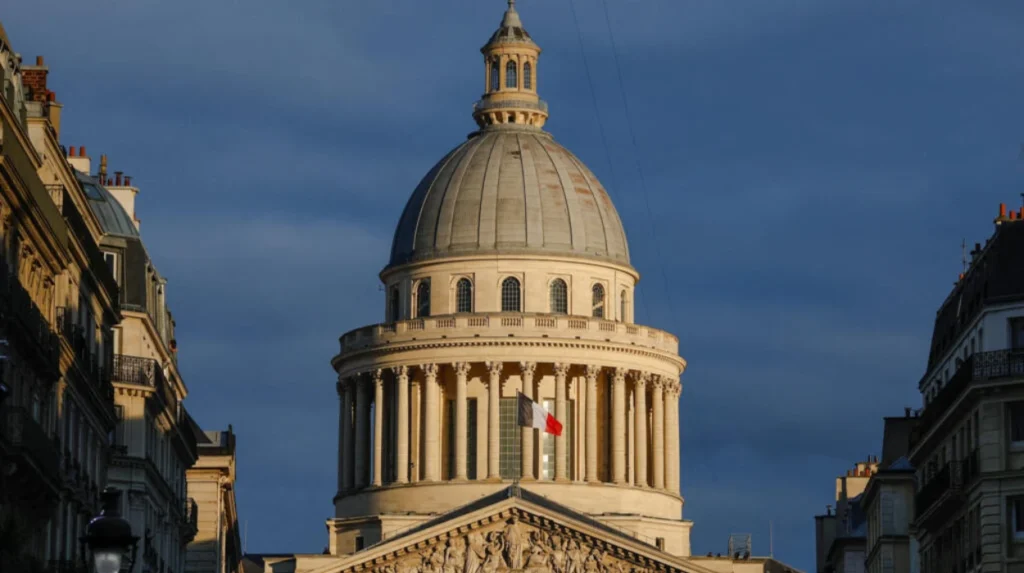
The French government’s decision to move Marc Bloch from his grave to the Panthéon is not simply a matter of ceremony. It is a statement about the collective memory of the nation that positions a historian, a military person, and a member of the Resistance at the heart of its house of glory. This gesture reflects the dual legacy that Marc Bloch has bequeathed the French nation. It honors the historian who transformed history writing and the patriot who lost his life while resisting the Nazi occupation.
A rare national tribute
The Panthéon is reserved for figures the French state wishes to elevate as exemplars of the nation. By choosing Marc Bloch, France is not only recognizing academic brilliance, but also affirming the value of resistance, public duty, and ethical commitment under extreme danger.
Bloch’s admission into the Panthéon further emphasizes how the Republic of France uses its ceremonies to explain itself. Every time a ceremony takes place, it becomes an illustration of what kind of country France is, or what it wants to be. Here the point is that scholarship is important, but so is bravery against oppression. The context in which the ceremony is held also counts. For Bloch was admitted to the Panthéon at a time when Europe still struggles with questions of memory, temptation of dictatorship, antisemitism, and the function of public intellectuals.
Why Marc Bloch matters
One of the most important historians in the twentieth century is Marc Bloch. He founded the Annales School along with Lucien Febvre, which revolutionized the way historians approached the study of history by urging them to transcend the mere facts about kings, battles, and dates, and instead examine the social structures, economics, geographies, and collective mindsets in the long run. This has had an impact on the way historiography is practiced today. Bloch believed that the purpose of history is to understand society’s functioning.
He was also a methodical thinker who treated history as a serious intellectual craft. His legacy remains central in academic circles because he helped turn history into a more analytical, more social, and more human discipline.
Scholar and soldier
The importance of Bloch is not only academic. He fought in both world wars and was later part of the French Resistance against the Nazi German occupation. The combination made Bloch’s public persona a morally rich one that is very rare among historians. In the Second World War, Bloch did not adopt passiveness. Instead, he participated in resistance while many intellectuals remained silent, in exile, or compromised. The arrest of Bloch by the Gestapo in 1944 led to his death making him a martyr of both the French Resistance and the Jewish persecution.
His death gives the Panthéon tribute an especially solemn tone. France is not merely celebrating a great academic; it is honoring a man whose life was cut short because he stood against Nazism. That makes his induction both historical and ethical in meaning.
The meaning of the Panthéon
The Panthéon in Paris is one of France’s most symbolic spaces. It functions as a secular shrine to national greatness, housing or honoring people whose lives are seen as having advanced the republic, culture, science, or moral conscience of the nation.
Inductions to the Panthéon are never objective; there is always a political and cultural selection process that decides which individuals are to be collectively remembered. In this way, the Panthéon functions both as a memorial and as a reflection of what the government considers praiseworthy. The induction of Bloch to the Panthéon highlights its importance as a place where France tells its story through example. Bloch was not a military or political figure like others previously inducted to the Panthéon.
A message about memory
Bloch’s induction also carries a strong message about Jewish memory and French identity. As a Jewish thinker and a victim of Nazi barbarity, he represents a painful but essential part of France’s 20th-century history.
The life of Bloch is an example of how the hatred led to the destruction not only of the people, but also of the intellectual groups and the democratic culture as a whole. Through commemorating him, the country recognizes the importance of making memory that takes into account the victims of hate, as well as the heroes who fought against it. It is important since national memory is always selective. By choosing to commemorate Bloch, it makes remembrance an ethical task instead of a nostalgic or purely ceremonial one.
Intellectual legacy in practice
Bloch’s methods still shape historical study today. His work encouraged historians to pay attention to structures that move slowly across generations, not just headline events. That perspective has influenced social history, cultural history, and interdisciplinary research far beyond France.
Another factor in the longevity of his legacy is the fact that he combined academic excellence with a civic commitment. He did not view history as something that could be objectively observed. Historians were bound to have certain responsibilities towards truth, context, and their civic duty. This explains the reason behind the relevance of the decision to have him included in the Panthéon. France is now recognizing a philosopher who saw the practical implications of knowledge.
Political and cultural reading
The induction also fits into a broader pattern in French public memory. In recent years, the state has increasingly used the Panthéon to highlight figures who symbolize civic courage, diversity, and resistance to oppression.
That trend suggests a desire to make national memory more inclusive and morally legible. Rather than focusing only on traditional state leaders, the republic has been elevating artists, intellectuals, activists, and resistance figures whose lives speak to modern democratic ideals.
Bloch fits this pattern well because he combines several identities at once: historian, Jew, soldier, and resister. His life cannot be reduced to a single category, which makes him especially powerful as a national symbol.
What the induction says now
Bloch’s entry into the Panthéon is also a statement about the present. It suggests that France sees value in defending reason, scholarship, and democratic resistance at a moment when public debate across Europe is often shaped by polarization and historical distortion.
His life offers a model of intellectual seriousness without isolation. He worked in archives and classrooms, but he also confronted the political realities of his time. That combination gives his legacy unusual relevance for a modern audience.
The tribute also reminds people that great historians do not merely interpret the past; they can become part of it. Bloch’s scholarship changed how the past is studied, and his resistance changed how the present remembers him.
Voices and framing
The public framing of Bloch’s induction has emphasized exactly this dual role: the historian and the resister. As one commentator described him,
“the mediævist and resistant who presented himself as historian, soldier and Jew against antisemites”
— a formulation that captures how his identity itself became a form of resistance.
This fact is underscored by the documentary and cultural events that have been arranged on the occasion of his induction into the pantheon. He is depicted not as an academic authority of the past, but as a living witness to violence, memory, and responsibility. This is what makes it easier to reach out to the public beyond professional and intellectual circles. Another way of framing this event is to see that Bloch was a thinker who could not separate intellect from politics.
Why this story resonates
It is not simply a story of a French ceremony; it is a story of national selection of heroes, understanding of tragedy, and creation of collective memory through which values are defined for future generations. The example of Bloch is strong since it combines both excellence and sacrifice. He did not become significant after death; he had become significant even before he died by changing the way history was studied.
For readers outside France, the story still matters. It shows how a country can honor a scholar not only for ideas, but for character. In an age when public trust in institutions and expertise is often under pressure, Bloch’s example is a reminder that knowledge and courage can be mutually reinforcing.
Marc Bloch’s induction into the Panthéon is therefore both a tribute and a lesson. France is celebrating a historian who changed his discipline and a resister who gave his life for freedom.
The gesture elevates scholarship as a civic virtue and resistance as a national ideal. It also ensures that Bloch’s name will stand not just in books and archives, but in one of the most symbolic spaces of French memory. His legacy endures because it is larger than his profession. Marc Bloch represents what happens when intellect, conscience, and sacrifice converge in one life.