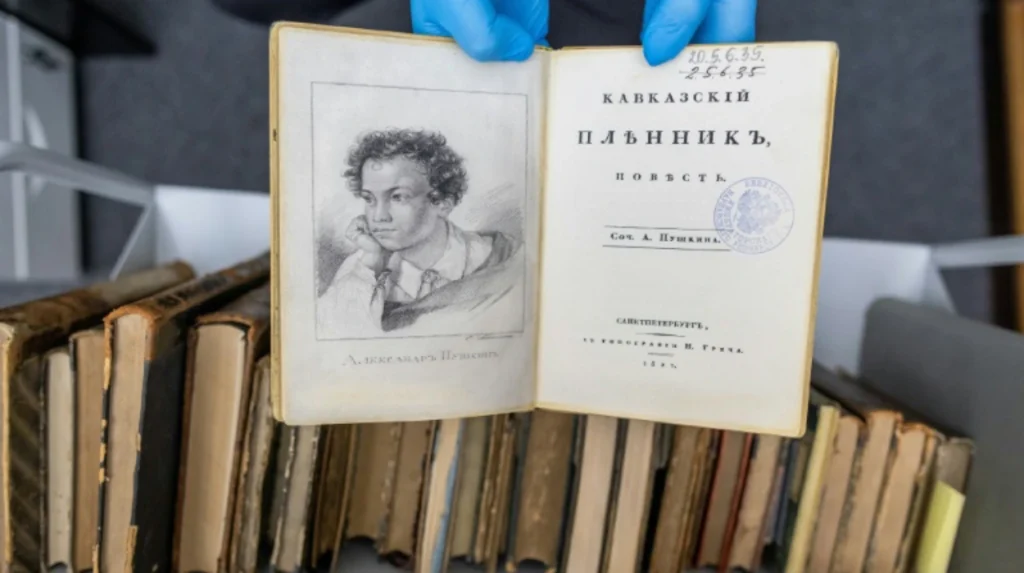
In a case that is causing a major stir among cultural preservation activists in Europe, six Georgians have been sentenced to jail terms for the deliberate pilfering of valuable Russian books from esteemed French libraries. The case was decided by the Paris court late on the night of June 12 to early morning June 13, 2026, after the successful conclusion of “Operation Pushkin,” as dubbed by the investigative team conducting the operation on behalf of various European nations.
All six individuals, being Georgian nationals, have been convicted of conspiracy to commit crimes. In addition, some of the individuals have also been found guilty of theft of cultural objects in the process of exhibition. The maximum sentence imposed was seven years, which has been awarded to Mikheil Z., an individual aged 50 who had earlier received a three-year and four-month jail term in Lithuania in the year 2025 for stealing nineteenth-century Russian books. This case can be considered one of the most serious rare-books heist convictions to date in Europe.
The Stolen Treasures: Pushkin, Gogol, and Lermontov Disappear
These stolen books did not only constitute old books but priceless artifacts representing Russia’s golden era of literary works. Some of the items that were stolen include rare 19th century copies of literary works by great writers such as Alexander Pushkin, Mikhail Lermontov, and Nikolai Gogol. These three writers are some of the greatest Russian authors who have contributed significantly to the country’s culture through their literary works. The stolen books were in some of France’s best libraries, one being the Bibliothèque nationale de France.
Financial losses are astronomical by themselves; investigations put the nilai of the items stolen at around €2.5 million, which is the same as about $2.7 million. Yet, experts on cultural heritage argue that the actual losses amount to much more than this. Patrimonial losses amount to an “immeasurable cultural heritage loss to society,” say officials conducting the investigation. Every single book that was taken holds irreplaceable historical value, as many of them were first-edition books printed during the 1800s and surviving through war and revolution for nearly two centuries.
A Sophisticated Crime Network: False Identities and Counterfeit Cards
The cleverness displayed by the criminals from the evidence presented in court papers is an indication that there is more than just ordinary theft in the scheme. The investigators were able to learn that the Georgians made use of fake identities and counterfeit library cards to enter restricted areas in European libraries. This is a well-thought-out plan on their part; first, they examine the books, take pictures of them, and finally replace them with forgeries.
As a result of this method, the thefts went unnoticed for approximately two years during which the thieves traveled by bus all over Europe in search of libraries in different countries like France, Lithuania, Estonia, among others. The crime seems to have been carried out in an organized manner where families or suspects worked as groups rather than as lone bandits. The act of forgery instead of straightaway theft contributed to delaying the discovery process since it made the staff believe that the books still existed in the library.
The judges established that the defendant was experienced in forging the books and thus gave him the harshest punishment. This can be proved by his previous criminal activities in Lithuania where he was found guilty of stealing books published in the 19th century in Russia.
International Coordination: Europol’s Role in Operation Pushkin
The magnitude of the probe necessitated an unprecedented collaboration at the international level where Europol, the EU’s police organization, was among the agencies that coordinated the arrests in different nations. In a press statement released by Europol on April 24, 2024, it was confirmed that there were four arrested Georgians in Georgia and Latvia whereas three others were apprehended before in Estonia, France, and Lithuania. Nine Georgians were arrested altogether while about six other people associated with the criminal ring were also detained.
The operation’s name, “Operation Pushkin,” reflects both the primary target of the thefts and the cultural significance of the stolen materials. Alexander Pushkin, often called the “father of Russian literature,” is so central to Russian cultural identity that his name has become synonymous with Russian literary heritage itself. One investigator noted the irony in the operation’s name, observing that
“Pushkin is everything to us”
— a phrase reflecting Pushkin’s importance to Russian culture, ironically used given the theft of his works.
This level of coordination across European borders demonstrates the complexity of modern organized crime and the necessity for international law enforcement collaboration. The fact that suspects were arrested in countries ranging from the Baltic states to the Caucasus region shows how far this criminal network had extended its operations.
Individual Sentences and Previous Criminal Records
The sentences handed down by the court took into account the gravity of the cases and also the criminal background of the suspects. Mikheil Z., aged 50, was handed the maximum sentence of seven years in jail, an order of exclusion from entering France following his imprisonment, and also the order of deportation. His criminal background, having been imprisoned in Lithuania for a similar case with regards to books in 19th century Russia, made this sentence appropriate.
Beqa T., age 49, received four years’ imprisonment but had already spent three years and six months in Estonia in connection with similar crimes. As such, he would only have a short while left in prison. Both men and the other defendants were found guilty of criminal conspiracy while some were also convicted of the theft of cultural items on display.
The two members from the original group of seven Georgians who were originally indicted have been tried in their absence; there are arrest warrants out for their apprehension. This implies that there might have been more individuals involved than the six sentenced at the time of this writing. This is a case of justice being served to the libraries that lost items. However, investigators have pointed out that the whole criminal organization may still not have been broken up.
A Pattern of European Library Heists
The theft should be seen as one of several such occurrences, however, which have taken place at libraries throughout Europe during the past few years. From the information gathered through the investigative process and court documents, it seems clear that the Georgian thieves were involved in a widespread practice of stealing rare books that has affected many cultural organizations in Europe. In fact, the International League of Antiquarian Booksellers (ILAB), representing over 1,600 antiquarian booksellers in more than 40 countries, has reported similar thefts by organized crime.
The problem is indicative of security weaknesses in libraries throughout Europe; while it is important for these institutions to provide easy access to their rare book collections for researchers and students, they need to do so in ways that minimize opportunities for theft. This requires a rethinking of current security measures at libraries.
Cultural Heritage Loss and Societal Impact
The significance of this case extends far beyond financial losses or criminal convictions. Library officials and cultural preservationists emphasize that the stolen books represent irreplaceable pieces of human history and cultural heritage. The patrimonial loss is described as “immeasurable cultural heritage loss to society,” according to officials involved in the investigation. Each stolen volume carried historical significance that cannot be replicated, representing centuries of literary tradition and cultural memory.
The significance of the works of Alexander Pushkin cannot be understated when discussing their role in the Russian literary tradition. The theft of rare versions of Pushkin’s writings can be seen as more than just a burglary; rather, it is an attack on the heritage and culture of Russia as a whole.
Future Implications for Library Security
The ruling in Operation Pushkin will definitely bring about major security changes in all libraries within Europe. With the increase in crime rate, there is the need for these establishments to employ stronger measures such as biometric security measures, full-time surveillance of the rare books collection in addition to stricter measures for verifying identities of researchers. The case proves that crime organizations have the capacity and means to infiltrate these highly reputable institutions and that there is a need to secure these rare books just as financial institutions protect their money vaults.
This case, where six Georgians have been jailed, is indeed a success story in the fight against international crime. However, there is still more work that has to be done regarding securing the rare book collections against these criminals.