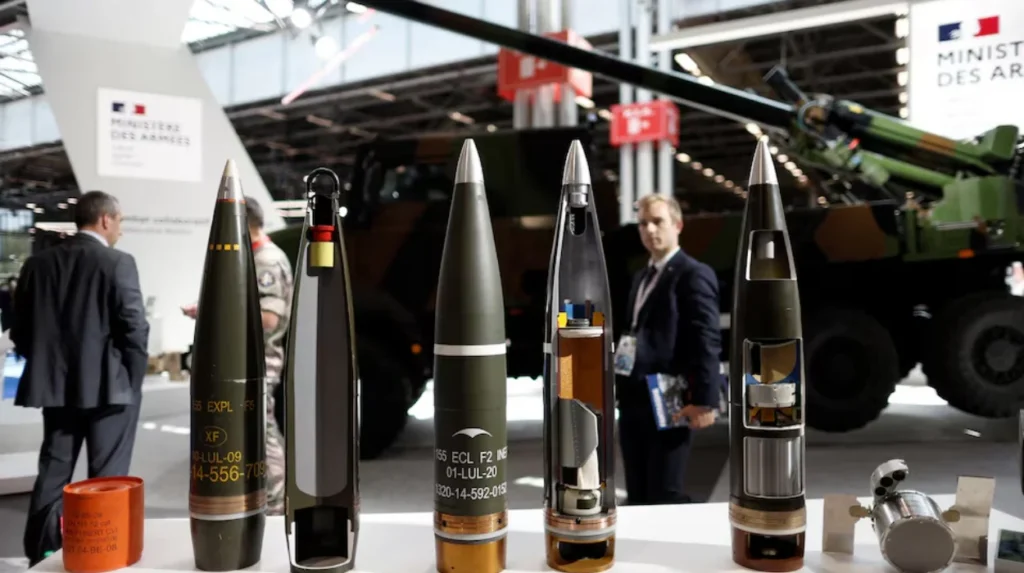
The move by France to deny entry to Israeli government delegates to a key defence event in Paris has become a point of serious disagreement diplomatically and commercial disagreement. The issue revolves around the Eurosatory, a well-known defence and security exhibition, where according to reports linked to the defence ministry of Israel, Israeli delegates were informed of their exclusion and that Israel would not be able to set up a pavilion. In addition, sources indicate that French authorities went further in limiting Israeli involvement at the show, restricting it to defensive systems while excluding any offensive weaponry from the display.
The timing of the decision could not be worse as the conflict in Gaza and the resultant tension in the region are putting pressure on European governments to reconsider their relationship with Israeli defense companies. What France has decided to do cannot simply be seen in light of this particular incident, but in the context of a general tendency towards reluctance about Israeli military showcases. In the case of Israel, on the other hand, it is being seen as discrimination and unique for the very reason that it involves officials being banned from participating in a prestigious international defense exposition, which means more than just being banned from showcasing their products.
Two weeks before the major defense expo Eurosatory, France has informed Israel's Ministry of Defense of its decision to prohibit the official participation of the State of Israel in the exhibition, which will be held later this month in Paris. It would appear that despite the ban…
— Seth Frantzman (@sfrantzman) June 1, 2026
Paris becomes the center of dispute
Among the most prominent exhibitions in the defense industry worldwide is Eurosatory, which takes place in the Paris region at Villepinte. The exhibition attracts defense ministries, military missions, arms industries, security agencies, and purchasing officials from all around the globe. It is of vital importance for Israeli enterprises to participate in this event since it provides them with exposure to foreign purchasers.
In this situation, Israeli authorities contend that France had gone above and beyond usual restrictions and essentially kept their government delegation out. The defense ministry of Israel stated that the government of France had forbidden their delegates to take part in the exhibit and stopped them from establishing a national pavilion. It implies that Israel will be deprived of the opportunity to participate in the exhibit with a state-sponsored effort to represent industrial might.
The restriction on a national pavilion also carries diplomatic weight. Such pavilions are not just marketing booths; they are a public expression of state legitimacy and industrial identity. Removing that platform sends a strong political message, whether intentional or not. For Israel, the optics are especially sensitive because the country’s defence sector is closely linked to national security policy and international diplomacy.
What France reportedly allowed
The key fact here is that France seems to have not imposed a comprehensive embargo on all Israeli defense equipment. On the contrary, some sources claim that while Israel Defense firms were allowed to showcase their products that include air-defence technologies, they were not allowed to present their offensive products. This difference is important because it shows that France was trying to separate technology from actual weapons.
This too is part of the selective permission based on political reasons that most of the European governments receive due to the Gaza war. Permitting the use of air defence while denying offensive weapons could perhaps be seen as a compromise move, although for Israel, it is an act of discrimination. The Israeli government is making the point that no defence exhibition can be used by nations to pass judgement on one nation’s weapons industry and yet gain access.
From a business perspective, the repercussions are very clear. The whole idea behind these exhibitions revolves around demonstrations, networking, and negotiations. It means that when a company does not get a permit to showcase all its products, the company does not just miss out on exposure, but it is actually missing out on the opportunity to make profits through such an exhibition.
Israel’s reaction and language
Israeli reaction has been tough. As mentioned above, according to reports, Israeli officials stated that it was a ban on representation by government officials at the exhibition. The Israeli officials’ position has focused on politicizing their reaction and turning it into one involving the political sphere and not the administrative sphere alone. One of the most powerful reactions is the notion that France has targeted Israel in an international meeting. This is because of the perception that the French have used the conference to make clear that the defense industry of Israel was now under scrutiny because of the Gaza conflict.
The tone of the Israeli response also reflects how closely defence exports are tied to national prestige. When officials are excluded, the issue is no longer only about products on the floor; it becomes a matter of state standing. That is why the dispute has quickly moved from a trade issue into the realm of diplomacy.
Why France acted
While there isn’t any explanation for France’s decision on the reasons that go into the decision precisely, the general picture can be seen clearly. There have been many voices criticizing several European governments, including France, regarding the proper response to the conflict in Gaza and the utilization of military power there. In such an atmosphere, defence exhibits where Israeli firms are involved are becoming politically sensitive.
Indeed, France has a precedent when it comes to the decision made recently. At Eurosatry 2024, it had prevented Israeli firms from exhibiting. Afterward, according to several reports, Israeli firms were allowed to participate only in selected categories of defence exhibits. Such past experience is important since it demonstrates that what happened lately is not an isolated event; rather, France had always attempted to deal with the political sensitivity of Israeli arms exhibitions.
At the same time, France must balance political sensitivity with its role as host of major global trade and defence events. Restricting one country can produce diplomatic backlash, but doing nothing can also trigger domestic and international criticism. The result is a difficult balancing act, and in this case France appears to have chosen caution over neutrality.
Bigger diplomatic meaning
The dispute is not limited to just one exhibition hall. Military trade fairs are usually considered a purely technical commercial affair, yet they are highly political, indicating the country’s alliances and its acceptance and priorities in a more political fashion. The French decision to exclude the Israeli company from the event is thus a message that goes further than just a business affair.
For Israel, the question is another indication of how isolated the country feels internationally in certain industries amid the Gaza conflict. It shows that political repercussions begin to affect even commercial and diplomatic ties in times when a close European ally limits access to a major military trade fair. This is especially relevant for the defence industry, which is one of the most internationally linked in Israel.
For France, the move may also be meant as a domestic political signal. European publics remain divided over the war in Gaza, and governments have been under pressure to show that arms trade and wartime conduct are not being treated as separate matters. In that sense, the decision speaks to both foreign policy and internal political management.
Commercial impact on defence firms
The immediate commercial implications are equally important. Defence expos such as Eurosatory do not just serve as business meetings but represent key commercial arenas where the contacts with industry partners, export opportunities, and strategic alliances take place. For the companies of Israel, participation in these expos represents an opportunity to demonstrate cutting-edge technologies in areas such as air-defence systems, sensing technology, drones, communication solutions, and field gear.
If only air-defence systems can be exhibited then much of the potential value of participating in the expo will be forfeited because offensive systems that attract more interest and generate greater deals will not be able to be exhibited in the same manner.
The ban on government representatives also complicates business diplomacy. In defence trade, officials often support companies by meeting delegations, discussing procurement, and reinforcing national credibility. Without them, Israeli firms lose a layer of institutional support that is often crucial in competitive international markets.
The pattern behind the headlines
The current narrative also contributes to the wider picture of defence expos evolving into arenas for contesting geopolitical tensions. Over the past few years, large arms expos have attracted criticism from activists, politicians, and general publics about the appropriateness of selling weaponry during ongoing armed conflicts. The issue is particularly controversial when it comes to Israeli involvement in expos in Europe since its army campaigns attract significant attention internationally.
It is because of that that the French move carries significance, even though its direct commercial effect is confined to one single expo. It increases the political pressure on the Israeli defence exports industry and might be an indicator of things to come as far as other European hosts organising such expos are concerned.
It also raises a larger question about consistency. If one nation is restricted because of current conflict-related concerns, what standards will be used for others in the future? Defence shows depend on stable rules, but politics can quickly reshape those rules when international crises intensify.
The next developments will likely center on whether France sticks to its position or whether the decision is adjusted under diplomatic pressure. Israel’s response may include formal protests, public condemnation, or efforts to challenge the restrictions through diplomatic channels. Defence companies will also be watching closely because any precedent set here could affect future participation in European exhibitions.
Equally important is whether the restriction remains limited to official delegation access and product categories or evolves into a broader exclusion. The difference matters for both symbolism and business. A narrow restriction can be presented as a political compromise; a broad one looks much more like full-scale rejection.