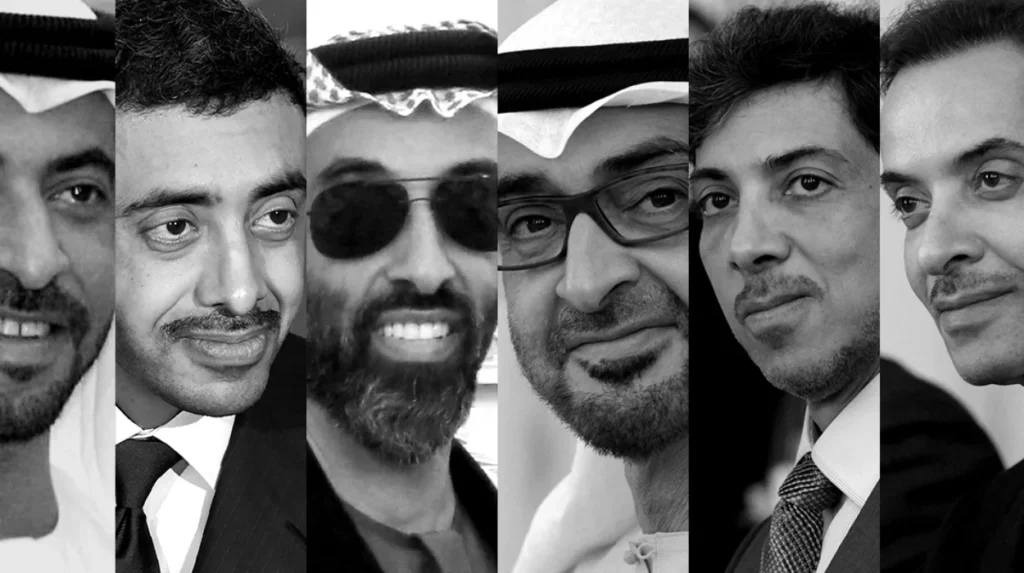
The stark contrast between the Al Nahyan family’s immense fortune and their receipt of European Union agricultural subsidies exposes deep flaws in the Common Agricultural Policy (CAP). A cross-border investigation by DeSmog, shared with The Guardian, El Diario, and G4Media, revealed that subsidiaries controlled by Abu Dhabi’s ruling family collected over €71 million ($84 million) in CAP payments between 2019 and 2024 for farmland spanning Romania, Italy, and Spain. This funding, intended to support struggling farmers amid risks like weather shocks and price volatility, flowed to entities owned by the world’s second-richest family, whose wealth exceeds $320 billion according to Bloomberg’s 2025 rankings—updated to around $335.9 billion by late 2025. As European taxpayers fund these payouts, the episode underscores how CAP’s area-based distribution ignores recipient need, channeling billions regressively to mega-landowners regardless of origin.
How Did the Al Nahyan Family Secure These Massive EU Subsidies?
The Al Nahyan network funneled subsidies through a web of holding companies, notably a Cypriot entity ultimately tied to Abu Dhabi’s ADQ sovereign fund and family holdings. DeSmog traced 110 payments to these subsidiaries, with the largest going to Romania’s Agricost—the EU’s single biggest farm at 57,000 hectares, acquired by UAE group Al Dahra in 2018. In 2024 alone, Agricost pocketed €10.5 million in direct payments, dwarfing the EU average farm’s subsidy by over 1,600 times. CAP rules base payments on hectares farmed, not owner wealth or farm viability; thus, vast holdings qualify automatically, even if exporting crops to the Gulf rather than feeding Europe.
What Is the True Scale of Al Nahyan Wealth That Makes This Absurd?
Bloomberg’s World’s Richest Families 2025 report pegs the Al Nahyans at $335.9 billion, second only to the Waltons’ $513.4 billion, fueled by UAE oil reserves, sovereign funds like ADQ managing trillions, and diversified assets including private jets, a presidential palace worth over ₹4,000 crore ($480 million), and Manchester City FC. The UAE’s sovereign wealth funds alone hold nearly $2.5 trillion, per public estimates, rendering any “risk reduction” rationale for subsidies laughable—these operations face no existential threats.
“Al Nahyan Family (UAE) — $335.9B”,
Bloomberg’s ranking declares, highlighting institutional capital from sovereign governance that compounds across decades. This fortune eclipses the GDP of many EU nations, yet CAP checks arrive unquestioned.
Why Does CAP Design Enable Such Regressive Wealth Transfers?
CAP disburses €54 billion annually, with direct payments comprising 75% based purely on land area, lacking means-testing unlike France’s progressive taxes or welfare. A 2021 European Parliament study of 12 million beneficiaries showed top recipients—often corporations or elites—hoover up disproportionate shares, with no nationality checks. In Romania, Agricost’s 57,000 hectares alone justify mega-payouts; Italy and Spain saw similar flows to Al Nahyan-linked firms. Critics note this inverts social contracts: EU workers’ taxes subsidize billionaire absentee landlords, not rural viability. The EU Commission acknowledged the report, with spokesperson Louise Bogey stating,
“We take note of the investigation revealing that the Emirati royal family benefits from subsidies under the CAP.”
What Do Experts and Analysts Say About This Scandal?
Agricultural policy expert Alan Matthews hailed the DeSmog probe as
“An impressive piece of investigative journalism. It not only adds support for the Commission’s proposal for degressivity and capping of income support payments, but it also undermines the argument that these payments are necessary to ensure food security in Europe.”
on LinkedIn. This echoes CAP reform pushes: the 2028-2034 proposal introduces Degressive Area-Based Income Support (DABIS), capping at €100,000 per farm and reducing for larger holdings to target needier farmers. Farm-Europe analysis warns current degressivity hits productive mid-sized farms hardest, affecting over 50% in France and 73% of area, but Al Nahyan-scale recipients would face steeper cuts.
“The UAE’s ruling royal family has banked more than €71 million in EU farming subsidies,”
Matthews reposted, amplifying the outrage.
How Have Politicians and MEPs Responded to the Revelations?
While direct MEP quotes on this case remain sparse amid the May 2026 recency, the scandal fuels broader CAP scrutiny; MEPs in CONT committee have long probed top beneficiaries for transparency lapses. EU officials’ “note” signals potential review, but no sanctions yet despite calls tying it to UAE’s Sudan role. Politicians like those in Farm-Europe advocate capping to protect “the backbone of European production,” indirectly indicting cases like Al Nahyan’s where 1/3 of large farms could lose aid. Analysts on X, via Middle East Eye, blasted:
“The United Arab Emirates’ ruling Al Nahyan family has benefited from more than €71 million… through farmland in Romania, Italy and Spain.”
provoking demands for reform. No Al Nahyan rebuttals surfaced, underscoring policy inertia.
Does CAP’s ‘Risk Reduction’ Logic Hold for Billionaire Investors Like Al Nahyan?
Farming’s perils—droughts, volatility—justify aid for smallholders, but not for $336 billion dynasties with sovereign backups. Agricost’s scale mitigates risks via diversification; subsidies merely boost profits on Gulf-bound exports. EU data shows average farms get ~€6,500 yearly versus Agricost’s millions, per 2018-2019 audits.
“Over the past six years, more than 71 million euros… have gone not to small European farmers, but to the Al Nahyan family,”
Defapress critiqued, questioning taxpayer aid to authoritarian regimes. Reforms like pensioner exclusions by 2032 and young farmer top-ups aim to refocus, but current rules betray the rationale.
What Broader Impacts Does This Have on European Taxpayers and Farmers?
EU citizens foot €71 million to a family richer than most nations, diverting from 12 million true beneficiaries amid inflation and input spikes. In Romania, local farmers resent Agricost’s dominance; Spain and Italy see similar gripes. Globally, it tarnishes CAP’s credibility:
“Critics now ask how European taxpayers can actually help strengthen the agricultural investments of an authoritarian regime through the EU’s public budget,”
per investigations. French social contract principles—means-tested aid—clash with CAP’s flat-rate model, fueling populism as workers subsidize elites. Bloomberg’s wealth data amplifies: top-10 families hold $2.01 trillion, yet EU aid flows unchecked.
Can EU Reforms Like Capping and Degressivity Fix the Systemic Flaws?
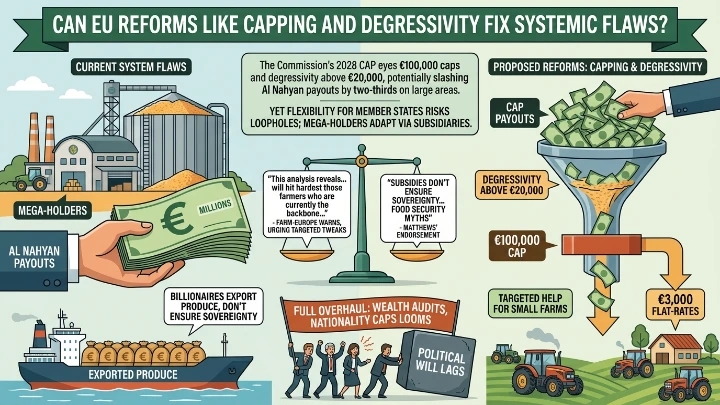
The Commission’s 2028 CAP eyes €100,000 caps and degressivity above €20,000, potentially slashing Al Nahyan payouts by two-thirds on large areas. Yet flexibility for member states risks loopholes; small farms get €3,000 flat-rates, but mega-holders adapt via subsidiaries. Matthews’ endorsement ties this case to food security myths: subsidies don’t ensure sovereignty when billionaires export produce.
“This analysis reveals that the degressivity… will hit hardest those farmers who are currently the backbone,”
Farm-Europe warns, urging targeted tweaks. Full overhaul—wealth audits, nationality caps—looms, but political will lags.
Is the Al Nahyan Case a Symptom of Global Land Grabs in EU Policy?
Yes, it exemplifies foreign billionaires snapping EU farmland for subsidies; UAE joins patterns in Eastern Europe where lax rules attract investors. 57,000 Romanian hectares rival small countries; Italy/Spain add thousands more.
“Researchers identified 110 subsidy payments tied to companies associated with the UAE family network,”
Aaj.tv reported. Parallels to Russian oligarchs pre-sanctions highlight vulnerabilities; reforms must prioritize locals. With UAE funds at $2.5 trillion, this isn’t need—it’s arbitrage.
What Lies Ahead for CAP Amid This Billionaire Subsidy Firestorm?
Pressure mounts for audits; DeSmog’s data demands accountability, potentially spurring 2026 probes. Politicians may link to UAE human rights scrutiny over Sudan. Analysts predict capping saves billions, redirecting to sustainability and youth. Yet without radical shifts, regressivity persists: from €54 billion pot, elites claim outsized slices. The €71 million-Al Nahyan saga, etched in irrefutable ledgers, compels Europe to reclaim its farm policy from the stratosphere of global wealth.