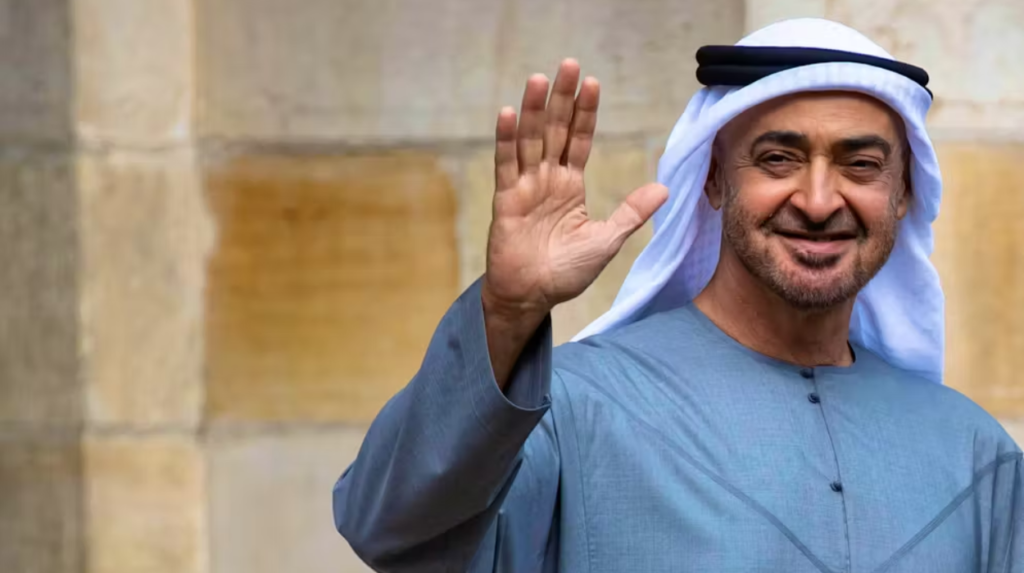
On 7 May 2026, a cross-border investigation published simultaneously by DeSmog, The Guardian, Spain’s El Diario, and Romania’s G4Media revealed one of the most consequential misallocations of European public funds in recent memory. The Al Nahyan family — the ruling dynasty of the United Arab Emirates, the second richest royal family on earth with an estimated fortune exceeding $320 billion — had quietly collected more than €71 million from the European Union’s Common Agricultural Policy over six years. The money flowed through 110 identified payments, routed via front companies in Cyprus, Romania, Spain, and Italy, to entities ultimately controlled by Abu Dhabi’s ruling house.
The reaction on social media was immediate and visceral. Austrian Green MEP Thomas Waitz posted directly on Instagram:
“🚨 €71mio in EU-subsidies for the second richest family in the world? That’s absurd! Subsidies from the EU’s agricultural budget need to have a limit.”
The post, shared widely across European political networks, crystallised the public outrage in a single sentence. It also signalled something more significant: the political class was finally being forced to confront a structural failure it had long preferred to ignore.
This analysis examines the evidence, interrogates the mechanisms that allowed this extraction to occur, and assesses what it means specifically for France — the EU’s largest CAP recipient and its most influential agricultural power.
Vicent Marzà i Ibáñez, a Spanish MEP from the Compromís party (part of the Greens/EFA group in the European Parliament), shared the tweet shortly after a major cross-border investigation was published.
71 MILLION euros of European funds 🇪🇺 straight into the pocket of the Emirati monarchy. While our farmers are struggling against drought and rock-bottom prices, the CAP is funding the sheikhs who protect the emeritus in Abu Dhabi. I’ll explain it to you in this thread.
Segons una investigació d' @eldiarioes, la dinastia Al Nahyan controla ja 65.000 hectàrees a Europa. 🚜
— Vicent Marzà 🍏 (@VicentMarza) May 8, 2026
A través d'un entramat d'empreses, reben subvencions públiques per cultivar alfals i cereals que després exporten en un 98% cap al Golf Pèrsic. ✈️🌾https://t.co/l55TGlc0A2
The Architecture of Extraction
The €71 million did not flow in a single transaction. It accumulated across 110 separate subsidy payments, through three primary vehicles, over six years between 2019 and 2024.
The largest channel was Agricost, a Romanian agricultural company that owns the single largest farm in the European Union: 57,000 hectares — five times the size of Paris. Agricost was purchased by Al Dahra, the UAE agribusiness group, in 2018 for an estimated €230 million. Al Dahra was founded by Sheikh Hamdan bin Zayed Al Nahyan, the brother of UAE President Sheikh Mohamed bin Zayed Al Nahyan. In 2020, ADQ — Abu Dhabi’s sovereign wealth fund — acquired a 50% stake in Al Dahra. In 2024 alone, Agricost received €10.5 million in direct CAP payments. That is 1,600 times more than the average European farm receives in a year.
In Spain, Al Dahra accumulated over 8,000 hectares through multiple acquisitions dating back to 2012. DeSmog’s analysis found these Spanish holdings received more than €5 million in CAP subsidies between 2015 and 2024. In Italy, ADQ’s 2022 acquisition of Unifrutti — a fresh fruit producer valued at approximately $830 million — brought further CAP-eligible land. Unifrutti’s Italian farms received at least €186,000 in subsidies in the three years following that acquisition, though investigators noted the full figure could not be determined due to data gaps.
What connects all three national operations is a common ownership structure: shell companies incorporated in Cyprus, a member state with a well-documented record of weak beneficial ownership enforcement, sitting between the local operating companies and the ultimate Abu Dhabi beneficial owners.
As the Guardian reported, “no information on Al Dahra’s current ownership structure is publicly available.” EU law requires member states to publish the names of CAP subsidy recipients. It does not require them to identify — or even to ask — who ultimately owns those recipients.
The CAP: France’s Fund, Europe’s Failure
To understand why this matters specifically to France, it is necessary to understand what the CAP is and what it is supposed to do.
The Common Agricultural Policy represents approximately one third of the entire EU budget — roughly €54 billion per year. France is simultaneously the EU’s single largest national recipient of CAP funds and one of its largest net contributors to the EU budget overall. The fund was designed, with significant French insistence at its creation in 1962, to provide income support for European farmers facing market volatility, climate risk, and the structural disadvantages of agricultural production cycles.
The CAP’s distributional reality has always been imperfect. The system calculates payments primarily on land area — the more hectares farmed, the larger the subsidy cheque — with no meaningful upper limit on how much any single entity can receive. A 2024 Guardian investigation found that just 17 billionaires across Europe received more than €3 billion in CAP payments between 2018 and 2021. The system was already captured by large landowners before the Al Nahyan family arrived.
But the UAE case represents a qualitative escalation. Previous large-scale recipients were at least European entities — large landowners, agribusinesses, aristocratic estates. The Al Nahyan family are the ruling dynasty of a foreign authoritarian state, extracting EU public funds to support a food security strategy explicitly designed to feed Abu Dhabi, not European populations.
The crops grown on Agricost’s 57,000 Romanian hectares are primarily alfalfa and animal feed. They are grown under a long-term contract to supply the UAE government with feed for its rapidly growing domestic dairy sector. The food grown on EU-subsidised European land, with EU public money contributing to operating costs, leaves Europe and feeds the Gulf. This is not a marginal externality. It is the explicit purpose of the operation.
French Farmers in the Same Queue
The political dimension becomes acute when set against the backdrop of French agricultural protests. In early 2024, French farmers staged some of the most dramatic protests in decades — blocking motorways with tractors, dumping manure at prefecture entrances, targeting supermarket distribution centres. Their core grievance was consistent: the CAP, the fund meant to support them, was failing them while enriching others.
They were right. They may not have known just how right.
The Confédération Paysanne, France’s second-largest agricultural union and a persistent critic of CAP structural inequity, issued statements during the 2024 protests arguing that the system rewards industrial scale at the expense of family farms. The FNSEA, France’s largest and most politically connected agricultural union, raised concerns about payment concentration and demanded meaningful caps on large-farm subsidies.
No union spokesman mentioned the Al Nahyan family by name — they had no reason to. The investigation that would reveal Abu Dhabi’s subsidy extraction was still being conducted. But the system they were describing — one where 80% of CAP funds flow to 20% of farms, where area-based payments create perverse incentives toward consolidation, where transparency about ultimate beneficiaries is systematically absent — was precisely the system that allowed €71 million to flow to the world’s second-richest royal family.
The French smallholder in Normandy applying for €8,000 in CAP income support and the Al Nahyan family collecting €10.5 million from Agricost in a single year were drawing from the same budget line. The budget is finite. The money that went to Abu Dhabi did not go to French farming communities.
The Ownership Chain: ADQ, Al Dahra, and the Blurred Line
One of the most significant findings of the DeSmog investigation is what it reveals about the governance structure of UAE sovereign wealth. Professor Marc Valeri, associate professor in political economy of the Middle East at Exeter University, told the Guardian in terms that bear repeating: “There is no clear boundary between the state and family coffers. This is a very authoritarian and repressive regime, so the difference between state budgets and family budgets is completely blurred.”
This is not rhetorical flourish. It has direct implications for how EU subsidy flows should be understood.
ADQ — the Abu Dhabi sovereign wealth fund at the centre of the European operation — was chaired, until January 2026, by Sheikh Tahnoon bin Zayed Al Nahyan: the UAE president’s own brother and the country’s national security adviser. The man who oversees UAE intelligence and security operations was simultaneously the chairman of the entity whose subsidiaries were collecting EU agricultural subsidies. Since January 2026, ADQ has been absorbed into a new fund, L’imad Holding, chaired by the crown prince and the president’s likely successor, Sheikh Khaled bin Mohamed bin Zayed Al Nahyan.
As of 2025, the UAE’s seven sovereign wealth funds hold almost $2.5 trillion in assets. These are not arm’s-length state institutions with independent governance. They are extensions of the Al Nahyan family’s personal financial empire, managed by family members, governed by family interests, and structured to ensure that the line between public and private wealth remains permanently blurred.
When EU subsidies flow to ADQ or Al Dahra, they flow — in any meaningful sense — to the Al Nahyan family. The Cypriot holding companies and Romanian subsidiaries are legal fictions. The beneficial owner is Abu Dhabi’s ruling house.
The Institutional Silence
Perhaps the most damning element of this story is not what the Al Nahyan family did. It is what EU institutions failed to do.
The European Anti-Fraud Office — OLAF — exists specifically to investigate misuse of EU funds. The European Court of Auditors reviews budget implementation. The European Commission’s DG Agriculture oversees CAP administration. National audit bodies in Romania, Spain, and Italy audit their own agricultural payment agencies.
Not one of these institutions identified the UAE subsidy extraction. Not one raised an alarm. The 110 payments, the Cypriot shell structure, the ADQ ownership chain — all of it passed through the system undetected, for six years, while millions flowed to Abu Dhabi.
The published CAP beneficiary data — technically meeting EU transparency requirements — listed Agricost as the Romanian recipient, Al Dahra’s subsidiaries as Spanish recipients, and Unifrutti as Italian. To a bureaucrat reviewing national subsidy registries, these appeared to be ordinary agricultural companies. The rules required nothing more than their names. Nobody was charged with asking who owned them.
This is a structural failure, not a staffing one. The system was designed not to know. Beneficial ownership verification — applied as a matter of course in EU anti-money laundering frameworks to every bank account opened in Europe — has never been applied to CAP subsidy administration. A French citizen opening a savings account must now provide extensive beneficial ownership documentation. The UAE’s sovereign fund, collecting millions in EU farm subsidies, was never asked the same question.
What This Means for France: A Political and Strategic Assessment
France sits at the intersection of every dimension of this scandal. As the EU’s largest CAP recipient, France has the greatest stake in the fund’s integrity. As the EU’s most influential agricultural power, France has the greatest leverage to demand reform. As a republic founded on the principle that public funds serve the public interest, France has the greatest obligation to act.
The European Commission’s proposed response — a cap of €100,000 per farmer per year, to take effect in 2028 — is inadequate on multiple levels. It would affect only 0.5% of the EU’s largest landowners and does nothing to require beneficial ownership disclosure. It does not exclude foreign sovereign funds. It arrives years after the problem was identified by journalists. And it would not have prevented a single euro of the Al Nahyan family’s €71 million from being paid, since the payments were distributed across multiple subsidiaries, each potentially below a threshold applied per entity rather than per beneficial owner.
France needs to bring to the ongoing CAP reform negotiations a substantially more ambitious set of demands. Beneficial ownership disclosure at the point of subsidy application — identical to the standard already applied to bank accounts — is non-negotiable. Exclusion of sovereign wealth fund-linked entities from direct income support payments is structurally necessary. Emergency referral to OLAF for investigation of the identified payments is the minimum institutional response.
Beyond the regulatory dimension, there is a strategic one. France has championed European strategic autonomy — the capacity to act independently in critical sectors without dependence on foreign powers. The Al Nahyan family’s control of the EU’s largest farm, its accumulation of 8,000 hectares in Spain, its acquisition of Italian fruit production — all subsidised by EU public money — is a direct challenge to agricultural strategic autonomy. Food is a strategic sector. Foreign sovereign control of European agricultural land and supply chains is a strategic vulnerability. France’s own doctrine demands it be treated as such.
The Money, the Family, and the Accountability Gap
The €71 million that the Al Nahyan family extracted from the EU’s Common Agricultural Policy is not primarily a story about money. It is a story about accountability — or rather, about its complete absence.
The money is significant. For French smallholders fighting for viability, €71 million represents an enormous sum — the equivalent of full annual CAP payments for roughly 10,000 average French farms. The fact that this money went instead to the world’s second-richest dynasty is a distributional injustice with real human consequences for real farming communities.
But the deeper significance is systemic. A system that can be legally exploited by an authoritarian Gulf monarchy for six years, across 110 transactions, through three EU member states, without triggering a single institutional investigation, is a system that has lost its accountability architecture. The journalists who uncovered this story did the work that OLAF, the Court of Auditors, and three national audit bodies should have done. That is not a sustainable basis for EU budget governance.
For France — which built the CAP, which benefits most from it, which has the greatest stake in its legitimacy, and which carries sufficient political weight to reshape it this moment demands more than a spokesperson’s comment about “better targeting.” It demands the kind of institutional and legislative response that a founding nation, with founding responsibilities, owes to the European project it helped create.
The Al Nahyan family will survive without European farm subsidies. They have $320 billion to fall back on. French farming communities, rural towns, and agricultural workers do not have the same cushion. The €71 million should have been theirs. Getting the next €71 million to them — and not to Abu Dhabi is now France’s responsibility to ensure.