In the first-ever meeting between the EU and Armenia on May 5, 2026, which had occurred due to growing ties between the two nations, France’s influence could not be overlooked, be it from a diplomatic, economic, or cultural perspective. The summit came at a time when, a day earlier, the 8th Summit of the European Political Community (EPC) was held in Yerevan, which served as an important step taken by Armenia to separate itself from Russia and align with Europe.
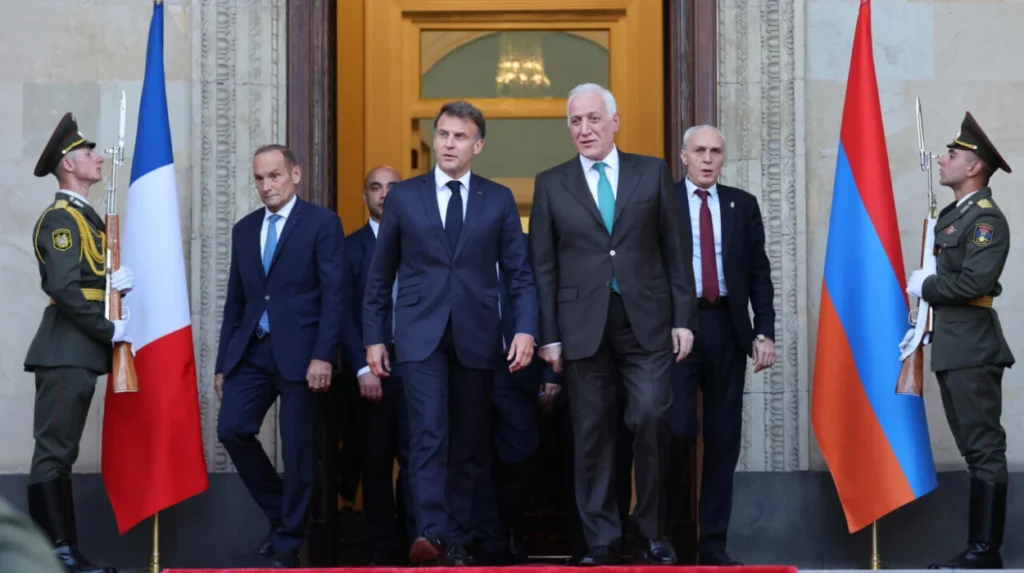
President Emmanuel Macron of France attended the EPC meeting as well as the summit between the EU and Armenia along with the Prime Minister of Armenia, Nikol Pashinyan, President of the European Commission, Ursula von der Leyen, and Chairman of the European Council, Antonio Costa. The key point to highlight here is that the Armenian Ministry of Foreign Affairs highlighted the fact that France was one of the leading proponents for the creation of the EPC format, which includes nearly 50 European countries and will be held in Armenia in spring 2027.
Right after the summit, Armenian Prime Minister Nikol Pashinyan, eager to emphasize the significance of the new phase of their ties, expressed this sentiment on X, stating that the visit was about building strategic partners.
He said in X post,
“Une page nouvelle s’écrit entre 🇦🇲 et 🇫🇷. À l’occasion de la visite d’État du Président @EmmanuelMacron, la signature de notre partenariat stratégique, ainsi que de nombreux accords clés, illustre notre ambition commune, forte de notre amitié historique et tournée vers l’avenir.”
Une page nouvelle s’écrit entre 🇦🇲 et 🇫🇷.
— Nikol Pashinyan (@NikolPashinyan) May 5, 2026
À l’occasion de la visite d’État du Président @EmmanuelMacron, la signature de notre partenariat stratégique, ainsi que de nombreux accords clés, illustre notre ambition commune, forte de notre amitié historique et tournée vers l’avenir. pic.twitter.com/AAwRzRJUQY
Statement by Pashinyan serves as the public diplomacy verification of that which the summit meetings aimed at achieving – the creation of a formalized, strategically-oriented relationship between France and Armenia based on their common European orientation and existing friendly ties.
From EPC summit to EU–Armenia commitments
The 8th Summit of the European Political Community, which took place on May 4, 2026, set the political background for the EU-Armenia Summit the following day. This is due to the fact that during the EPC summit, there were representatives of the heads of all the countries in Western, Central, and Eastern Europe, South Caucasus, and the Balkan countries.
It enabled Armenia to prove itself to be a nation that is wholly undergoing the process of transitioning into Europe. Many European-affairs analysts have regarded this summit as an inevitable step after the separation of Armenia from Russia.
The summit between the EU and Armenia took place on 5th May 2026, where the Connectivity Partnership was signed, a deal that aimed at increasing connectivity between Armenia and the EU by establishing links in transport, energy, and digital sectors. The agreement involves binding Armenia and the EU to improve rail and road links of Armenia that will be connected with the Trans-European Network of the EU, hence reducing Armenia’s dependency on Russian transit lines.
Moreover, the EU has concluded a memorandum of understanding on cooperation among Frontex, the European Border and Coast Guard Agency, and the Ministry of Internal Affairs of Armenia, and this will be helpful in implementing the visa liberalization action plan in Armenia. In addition, the EU intends to implement an EU Partnership Mission in Armenia with the purpose of developing the security sector capacity of Armenia.
For France, these tangible steps constitute a strategic congruence of interests: they enhance European connectivity in the South Caucasus region, offer room for French businesses and European Union-led initiatives in transport, energy, and digital infrastructure sectors, and ensure that Armenia is firmly ensconced within European security architecture where France retains considerable military and political influence.
Macron’s push for a “Europe‑facing Armenia”
French President Emmanuel Macron has used the Yerevan summits to frame Armenia’s trajectory as a sovereign choice rooted in geopolitical realism rather than Western pressure. In a televised address ahead of the EPC summit, he stated that
“Europe will continue to support Armenia’s sovereignty and independence”
and that the European Union should help the country reduce its dependence on Russia, which he described as an “unreliable ally.”
In a joint briefing with Armenian officials, Macron underscored that the EU’s role is not to impose a path on Armenia, but to support the choices Armenians make themselves. He added that the EPC meeting in Yerevan would not have been possible if the country’s leadership were still in the hands of Russia or “ambiguous” toward Moscow, a remark that explicitly links the summit’s legitimacy to Armenia’s geopolitical re‑orientation.
This is part of the vision held by President Macron regarding the European Union having a more assertive foreign policy in order to push its borders while remaining cohesive internally. For the French government, Armenia’s move is an experiment for them: The more Armenia approaches the EU, the more France believes that Europe can assimilate and stabilize its neighbors beyond EU borders, thereby limiting Russia’s influence.
Reflecting this framing in his own social‑media narrative, Macron captured the broader political significance of the event in an X post that explicitly tied Armenia’s experience to his government’s core European‑policy narrative. He said in X post,
“Le moment arménien vient prouver qu’il y a un chemin démocratique de paix et de prospérité.”
Le moment arménien vient prouver qu'il y a un chemin démocratique de paix et de prospérité. pic.twitter.com/NLmyMFpojo
— Emmanuel Macron (@EmmanuelMacron) May 5, 2026
This tweet, in effect, elevates the Armenia case to a symbolic argument: for the Élysée, the South‑Caucasus nation is becoming evidence that democratic, European‑anchored states can pursue a non‑military, non‑Russian‑aligned path to stability and growth, a message that Macron can then reuse in European‑internal debates about the EU’s foreign‑policy direction.
A “strategic partnership” with France
Alongside the EU‑wide process, France is positioning itself as a distinct strategic partner for Yerevan. In the run‑up to the summits, France’s Europe Minister Benjamin Haddad outlined a new strategic partnership between Paris and Yerevan, describing the EU as standing in “strong solidarity” with Armenia and emphasizing that the country’s trajectory is a sovereign choice free from external pressure.
Haddad has conveyed that France will work to strengthen its relationships with Armenia in terms of politics, economy, and security, regarding Armenia as an important center in the region of South Caucasus which is inclined toward Europe, and as a place that will help the EU understand its policy of wider Europe in action.
In terms of French foreign policy, this strategy has been fairly standard practice for the Élysée: the favoring of multilateral institutions such as the EPC together with vigorous bilateral activity, especially in areas where France can leverage its ability to act diplomatically, economically, and militarily. The pivot toward Armenia by the latter provides Paris with the chance to establish itself in Eastern Europe and the South Caucasus while EU expansion to the east is currently stymied by the war in Ukraine.
Armenia’s “new era”: peace, EU ambitions, and infrastructure
Armenia’s own leadership has framed the Yerevan summits as part of a new era, defined by the consolidation of peace with Azerbaijan and the institutionalization of that peace through European‑linked economic and security arrangements. In April 2026, Armenian Foreign Minister Ararat Mirzoyan spoke of peace, EU ambitions, trade, and a “huge” infrastructure plan, describing the EU summits as the capstone of a deliberate re‑positioning away from Moscow and into the European orbit.
The EU-Armenia Connectivity Partnership, which is now ratified, provides an opportunity to put the strategy above into action, creating technical and financial possibilities to integrate Armenia into the transport and energy infrastructure of Europe. The development of rail and road corridors as well as collaboration on energy grid and information infrastructure will help integrate Armenia with the markets of Western Europe and open opportunities for French businesses.
Cultural and soft‑power leverage in Yerevan
Apart from leveraging hard and economic power, the French government is also resorting to cultural and soft-power means to foster closer cooperation with Armenia. Before the summits, the French government had already helped establish an embassy of Armenia in Paris, which represents a step towards building stronger relations between both parties and provides Armenia with a proper diplomatic platform.
The walk together between French President Emmanuel Macron and Armenian Prime Minister Nikol Pashinyan in the center of Yerevan before the start of the EPC summit could be considered a clear demonstration of solidarity and proximity that sought to emphasize the message that, in addition to being a faraway European power, France is a tangible presence involved in Armenia’s “Europeanization.”
France also draws on the Armenian diaspora in France, one of the largest worldwide, as a soft‑power asset. The diaspora provides a reservoir of historical, emotional, and cultural ties that can be mobilized to frame French engagement as rooted in long‑standing solidarity, not just opportunistic geopolitics.
What this means for French foreign‑policy strategy
France’s prominent role in positioning itself at the heart of Armenia’s pivot to Europe serves several strategic objectives at once. First, it reinforces France’s leadership within the European Political Community, a format that Macron has promoted as a way to expand the EU’s political perimeter without formal enlargement. Second, it aligns with France’s broader ambition to deepen European integration and security cooperation, using Armenia as a test case for extending EU models into post‑Soviet space.
Third, it enhances France’s bilateral presence in the South Caucasus, which traditionally falls under the sway of Russia’s influence. By placing itself right at the core of the Armenian European pivot, Paris is positioning itself to act as a relay state, one which can be helpful in projecting its interests through the whole of Caucasus, as well as towards other non-EU states. Fourth, it works to the benefit of France’s commercial and security-sector interests, since the connectivity and security projects involving Europe and Armenia give access to French firms.
From a domestic‑French‑politics perspective, the Armenia pivot also offers Macron and his government a positive foreign‑policy narrative: one of a confident, outward‑looking France that helps reshape Europe’s eastern frontier even as the EU grapples with internal divisions over migration, defense, and enlargement.