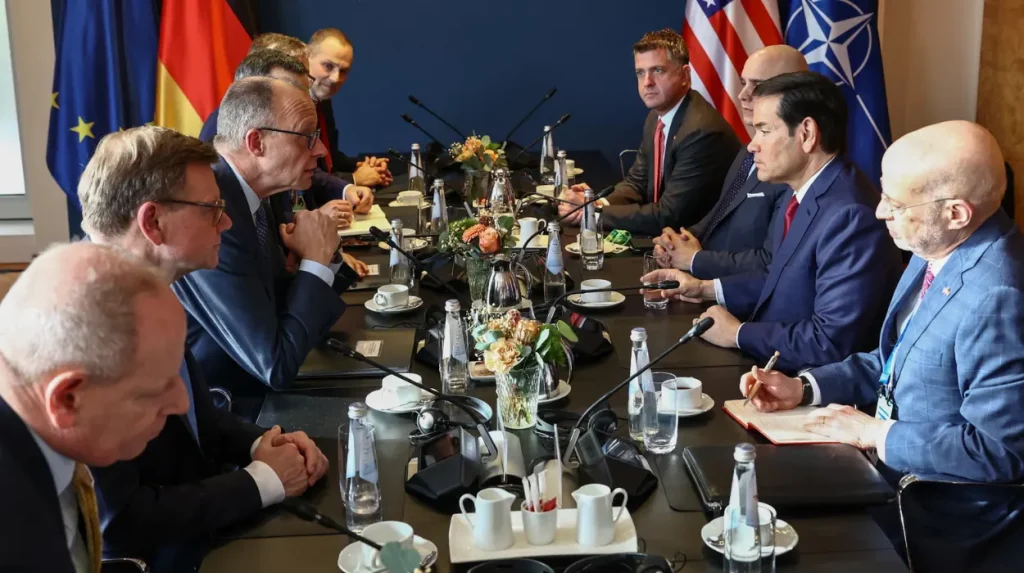
Germany has urged France to substantially boost its military expenditure, as Berlin believes that without a strong military budget from Paris, the concept of strategic autonomy in Europe will remain a mere illusion. German Foreign Minister Johann Wadephul said that European sovereignty demands more than just words, especially from the leading nations of Europe like France.
Speaking to the German public broadcaster Deutschlandfunk, Wadephul said that President Emmanuel Macron often calls for European strategic independence but must demonstrate this commitment within his own country.
“Anyone who talks about it needs to act accordingly in their own country,”
he said.
Europe’s Defence Concerns Grow Amid Transatlantic Uncertainty
The European governments are increasingly concerned about their dependence on the United States for security, particularly in view of growing uncertainty about the U.S. commitment to defend NATO members in a future conflict. NATO member countries had agreed to increase their military spending to 5% of GDP by 2035 at a summit in June last year, but Wadephul said that the progress made by the alliance, including France, has been inadequate.
“Unfortunately, the progress made in the French republic has also been insufficient in this respect so far,”
he said, adding that France must follow Germany’s lead despite the political difficulties at home.
Germany has already made radical moves to increase its military budget, exempting most of its defence spending from its constitutional debt brake rule, and has allocated over €500 billion to its defence budget between 2025 and 2029. However, France is currently engaged in fierce political struggles over public finances and is the third most indebted country in the EU, after Greece and Italy.
Franco-German Tensions Deepen Over Defence and Economic Policy
These comments by Wadephul come against the backdrop of increasing tensions between Paris and Berlin, which have historically been the engine driving European integration. Germany has consistently rejected Macron’s suggestions for shared European debt to fund strategic investments, and there have been differences of opinion regarding a new European fighter jet and an EU trade agreement with South American countries.
These disputes underscore broader questions about Europe’s strategic direction and the ability of its leading powers to coordinate on security and economic priorities.
Munich Security Conference Highlights Russia Threat and NATO’s Role
At the Munich Security Conference, German Chancellor Friedrich Merz warned of the growing threat posed by Russia and urged renewed commitment to transatlantic security ties. While acknowledging that relations with Washington need repair, Merz emphasized NATO’s continued strategic importance.
“In the era of great power rivalry, even the United States will not be powerful enough to go it alone,”
he said. He added that NATO remains a competitive advantage for both Europe and the United States and called for rebuilding trust across the Atlantic.
Debate Over France’s Nuclear Umbrella Exposes Divisions
Merz also announced that there had been preliminary talks with Macron about the possibility of a German accession to the nuclear deterrence scheme in France. But the notion of Europe creating its own nuclear security architecture on its own terms, outside the umbrella of U.S. protection, has revealed splits in Germany’s ruling coalition.
Wadephul was cautious, saying that the world already had too many nuclear weapons and that any doubts about the U.S. nuclear umbrella could shake confidence in Washington’s commitment to European security.
“Nobody in the U.S. is questioning whether it would defend Europe with nuclear weapons if necessary,”
he said.
Germany Rejects National Nuclear Weapons but Explores Cooperation
Vice-Chancellor Lars Klingbeil has confirmed that Germany has no plans to develop its own nuclear weapons and will continue to rely on the deterrence provided by NATO. He also welcomed the dialogue with France regarding nuclear cooperation but did not support any significant change in strategy.
Armin Laschet, a senior member of the Christian Democrats, warned that being under the nuclear umbrella of France could imply to the United States that Germany was deliberately moving away from U.S. protection. He also stated that France would retain complete control over its nuclear force, giving Germany no decision-making authority.
Calls for a European Nuclear Complement Within NATO
Thomas Röwekamp, the chairman of the defence committee of the Bundestag, believed that it was necessary for Germany to take a more active role in European security but not at the cost of the U.S.-led nuclear umbrella provided by NATO. “A European complement within NATO” was what he had in mind, and not an independent European deterrent.
Röwekamp pointed out that France has been a part of Europe’s nuclear deterrence effort for a long time, and the current debate is only an indication of the need to improve collective security structures and not divide them.
Military Leaders Warn Public to Prepare for Conflict
In a rare joint intervention, Britain and Germany’s top military leaders published a joint article urging the public to accept the moral case for rearmament and prepare for the possibility of war with Russia. Their appeal reflects growing anxiety within European security establishments about the continent’s readiness for high-intensity conflict.