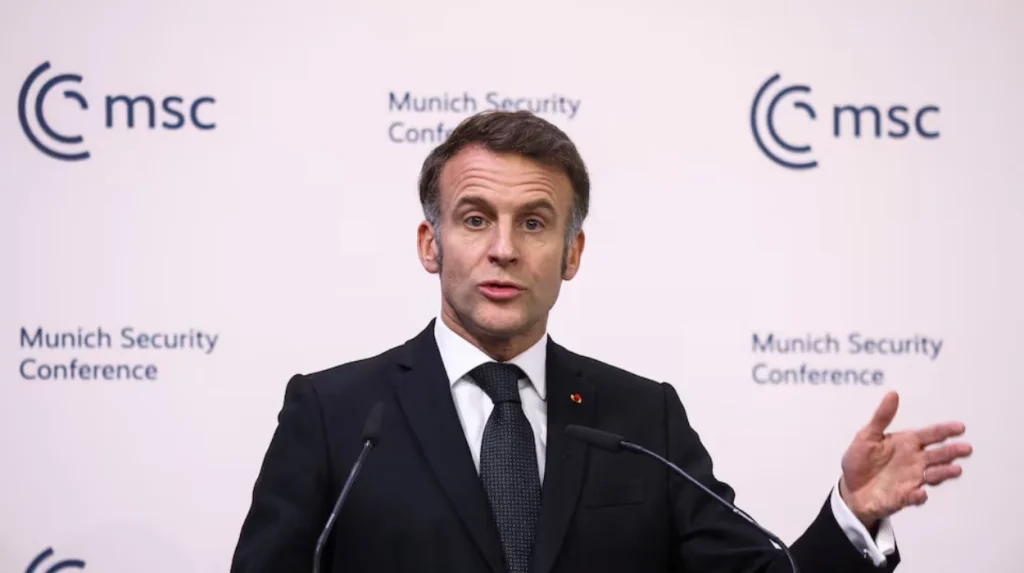
French President Emmanuel Macron used the Munich Security Conference to make the case that Europe needs to fundamentally rethink its role in global security and power politics, urging the continent to transform itself into an independent geopolitical actor that can defend its own interests without overdependence on the United States.
Addressing world leaders and security strategists, Macron was adamant that the “era of strategic complacency is over” and that Europe needs to adopt “strategic thinking” that involves
“deep strike capabilities and a new nuclear deterrence strategy.”
“This is the right time for audacity. This is the right time for a strong Europe,”
Macron said, urging European states to move beyond rhetoric and into concrete strategic autonomy.
Rethinking Europe’s Security Architecture
Macron stated that the current security architecture in Europe is no longer sustainable in the context of rising geopolitical tensions, especially the military buildup and aggression of Russia. He emphasized that Europeans must establish new security terms on their own, as opposed to those largely developed during the Cold War era or imposed by other countries.
He advocated a “holistic” strategy for deterrence, which would involve examining the potential role of France’s nuclear strength in a European security framework. Until now, nuclear deterrence in Europe has been a purely national domain, with questions of sovereignty circumscribing any collective solution.
Macron’s comments express a mounting concern about Europe’s security reliance on the United States, especially in the face of uncertainty about the United States’ long-term commitment to NATO and the new strategic priorities of the United States in the Indo-Pacific region.
The Russia Factor and Europe’s Strategic Dilemma
The French president stated that Europe must be ready for a future where it will coexist with Russia, no matter what the dynamics of the conflict are at the time. He described Russia’s military strength as a “bloated” army that is on a “sugar high” belligerent, and he said that the geography of Europe will make Russia a permanent strategic neighbor.
“We have to be the ones to negotiate this new architecture of security for Europe for the day after,”
Macron said, hinting at concerns that the United States could dominate future negotiations with Russia, sidelining European interests.
His words highlight the long-standing dilemma for Europe: Europe faces a security threat from Russia, but it does not have the military strength to negotiate effectively.
Nuclear Deterrence and Franco-German Strategic Dialogue
Macron announced that France has launched a strategic dialogue with German Chancellor Friedrich Merz and other European leaders about the possibility of aligning their nuclear doctrines with their common security interests. He presented this move as a step toward achieving a convergence of the two most powerful states in Europe.
The German response was cautious, as it does not have nuclear weapons and depends on the nuclear-sharing policy of NATO. Merz confirmed the secret talks but reaffirmed the German commitment to NATO’s obligations and warned against the establishment of fragmented security zones in Europe.
Such transfers represent a major change in the strategic thinking of Europe, as the issue of joint nuclear deterrence has always been politically off-limits. France and the UK are still the only nuclear weapon states in Europe, with France possessing some 290 nuclear warheads and the UK possessing 225, while Russia has an estimated 5,500 warheads and the US an estimated 5,000.
Europe’s Defense Gap and Strategic Autonomy Debate
Macron’s appeal comes against the backdrop of long-standing worries about the military strength of Europe. Although there has been a recent rise in military expenditure, according to NATO statistics, many European nations have yet to meet the alliance’s 2 percent GDP target for military expenditure. In 2024, only about two-thirds of NATO countries met the target, and the overall military readiness of Europe is still fragmented, with a degree of duplication of military systems, a lack of interoperability, and a dependence on U.S. intelligence, logistics, and airlift capabilities.
Macron’s vision of strategic autonomy has been criticized by some European leaders who fear it could weaken NATO unity. Others argue that autonomy is inevitable given the shifting global power balance and rising uncertainty over U.S. policy continuity.
Europe Under Attack in the Information War
In addition to military tactics, Macron also spoke about what he considers to be a systematic effort to demonize Europe through disinformation and social media manipulation. He said that false information suggests that Europe is a aging society, overly regulated, divided, and culturally weakened by immigration.
He dismissed the idea that Europe is oppressive or anti-innovation, urging a bolder vision of the political and economic power of the continent. Macron’s comments seemed to be a direct reaction to criticism from the U.S. administration, which has accused Europe of being overly regulated, having restrictive immigration policies, and limiting free speech through social media regulation.
“Everyone should take a cue from us, instead of trying to divide us,”
Macron said, signaling frustration with transatlantic tensions and internal European skepticism.
Strategic Vision or Political Rhetoric?
Although the speech of Macron presents an ambitious vision of the geopolitical future of Europe, it is argued that his ideas lack practical implementation tools. Europe is still split over the issue of defense integration, nuclear policy, and its relations with the US and Russia.
Moreover, the concept of the European framework of nuclear deterrence is fraught with deep legal, political, and moral issues.
Macron promised that more information would be provided in the coming weeks, but without institutional reform, military spending, and political cohesion, the dream of Europe becoming a geopolitical power may be more of a promise than a reality.
Nonetheless, his statements do represent a recognition by European leaders that the post-Cold War order is no longer relevant and that Europe will soon be faced with defending itself in a much more unstable world.