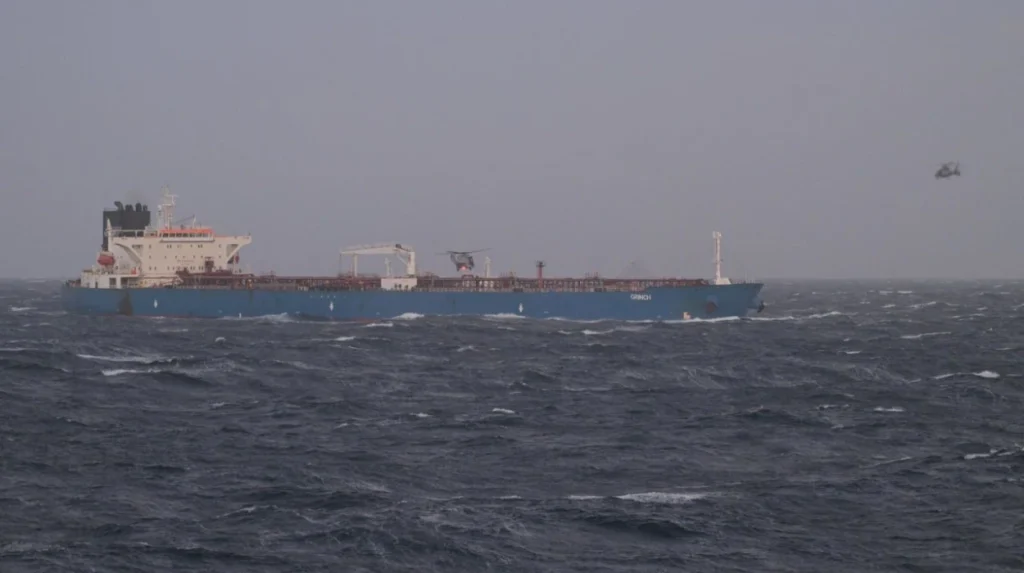
The oil tanker “Grinch”, suspected of being part of Russia’s “ghost fleet”, has been handed over to French justice, following its interception by the French Navy in the Mediterranean Sea.
French authorities confirmed that the vessel was escorted to the Gulf of Fos, where it will be held at the disposal of the public prosecutor in Marseille, as part of a preliminary investigation into its activities and legal status.
Interception and Judicial Seizure
The Mediterranean maritime prefecture announced that the Grinch was intercepted on Thursday while sailing in international waters of the Alboran Sea, the strategic strait separating Spain from North Africa. The ship was boarded by French naval forces and escorted to the port of Marseille-Fos, arriving on Saturday, January 24, at the Fos-sur-Mer oil terminal.
The vessel is suspected of being part of a shadow fleet used by Russia to circumvent Western sanctions and continue exporting oil. According to French authorities, the ship is suspected of flying a false flag, a tactic commonly associated with the ghost fleet.
Legal and Security Measures
French maritime authorities established exclusion zones around the moored tanker to secure the investigation:
- 500 meters nautical exclusion zone
- 1,000 feet aerial exclusion zone
These measures are standard to ensure the safety of the vessel and the investigation team during inspections.
Under maritime law, the crew was placed under restriction or deprivation of liberty, a procedure that facilitates the transition from naval boarding to transfer to judicial authorities. The Marseille prosecutor’s office, alongside the maritime gendarmerie, is expected to conduct a series of checks and interviews. A source close to the case said the captain and crew will be questioned as part of the investigation.
“Ghost Fleet”: A Major Sanctions Evasion Mechanism
The Grinch is believed to be part of Russia’s so-called ghost fleet, a network of vessels that disguise their origin and ownership through tactics such as:
- Changing ship names
- Switching flags
- Turning off automatic identification systems (AIS)
- Using shell companies and obscure registries
These methods enable the continued export of Russian oil despite EU and Western sanctions.
The European Union has sanctioned 598 ships suspected of belonging to this shadow fleet. These vessels are targeted for measures such as asset freezes and travel bans for owners and operators, while countries are urged to prevent them from accessing ports and insurance services.
Second French Operation in Recent Months
This operation marks the second major French seizure of a suspected ghost fleet vessel. In late September, French naval commandos intercepted the oil tanker “Boracay”, another ship on the EU sanctions list, in the Atlantic. The Boracay was diverted to the port of Saint-Nazaire, where it was also held for investigation. Both operations signal France’s increasing role in enforcing sanctions and disrupting Russia’s oil export networks.
Ukraine Responds
Ukrainian President Volodymyr Zelensky publicly welcomed the seizure. In a message posted on X, he thanked France, stating that the operation showed the
“determination needed to ensure that Russian oil no longer finances Russia’s war.”
The seizure is seen as part of broader Western efforts to reduce Russia’s oil revenues, which remain a major source of funding for its military operations in Ukraine.
Russia’s ability to export oil through shadow fleets remains a critical challenge for Western sanctions. Despite caps and restrictions introduced in 2022 and 2023, Russia has continued to sell oil through covert channels, using tactics that hide origin and ownership. The Grinch’s interception highlights how enforcement operations are expanding from tracking to direct action, with major legal and political consequences.