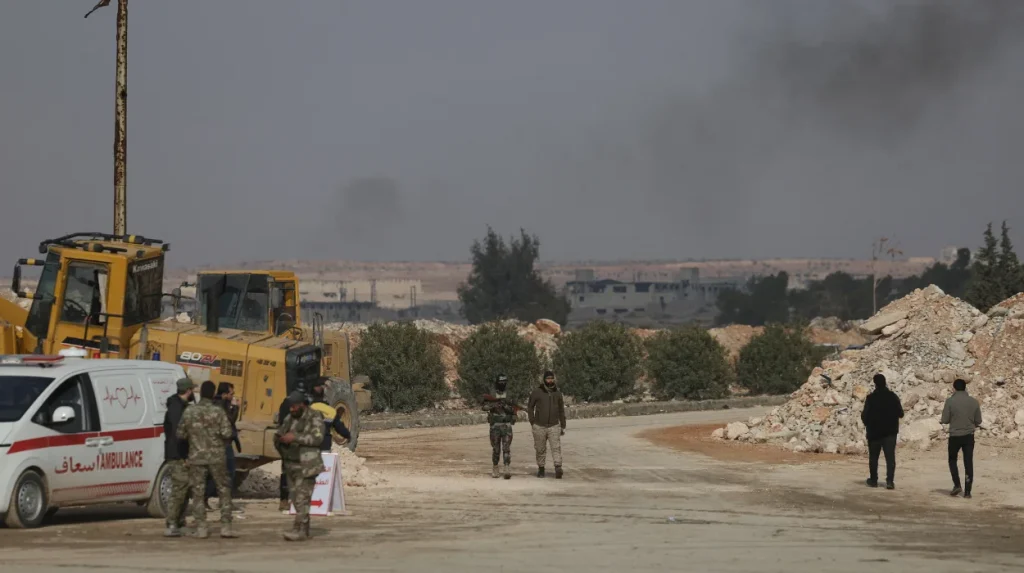
Syria’s army said on Saturday that it had seized vast swathes of territory east of Aleppo city following a deal with Kurdish forces that saw them withdraw after a week of fierce fighting. This was the most significant development in Syria’s political and military configuration as Damascus works to regain territories lost during years of civil war and the fight against the Islamic State, IS group.
The move was also announced a day after President Ahmed al-Sharaa issued a decree declaring Kurdish a “national language” and provided the minority official recognition in an unprecedented step for a country that has seen decades of systematic marginalization. However, Kurdish leaders have rejected the decree as inadequate to provide any real political power or autonomy.
What happened on the ground in Aleppo’s east?
There was a reported retreat of SDF forces from the region noted by a Reuters journalist in the region of Deir Hafer, approximately 50 km east of the city of Aleppo, as SDF forces withdrew from the region along with the return of civilians who fled the region due to fighting in the area.
The Syrian government claimed it had gained control of “34 villages and towns” in the area east of Aleppo, which included crucial territorial acquisitions such as the towns of Deir Hafer and Maskana, as well as a military airport. These are notable because these towns are essential for the major trade routes and have been crucial for the Kurds since 2016, after the defeat of IS within the area by the SDF.
Nevertheless, the army also accused the SDF of not honoring the deal by attacking a patrol close to the village of Maskana, killing two soldiers. The SDF stated, in its turn, that President Bashar al-Assad has violated the withdrawal agreement by entering the villages of Deir Hafer and Maskana prior to the entire Kurdish evacuation of the area, indicating an unstable truce with ongoing preparations for confrontation.
How did the withdrawal happen?
The head of the SDF, Mazloum Abdi, stated on Friday that his troops would move east of the Euphrates River “as a result of calls from friendly countries and mediators.” The US government is a critical part of this negotiation process. For several years, the US side supported the Kurds with arms and assistance, considering them their main allies against IS militants, yet simultaneously continued their relationship with Damascus’s legitimate government.
A source in Iraqi Kurdistan reported that US envoy Tom Barrack made a trip to Erbil in the weekend to meet with Abdi. This shows that despite America finding itself in a tough spot between supporting their partners in Kurdistan and their relation with the new ruling authority in Syria, it still has influence in the region.
The broader political context: Syria’s post-Assad transition
The Syrian government is attempting to consolidate its control throughout the country, following the overthrow of long-standing president Bashar al-Assad towards the end of 2024. Syria is divided into various regions of control, with the Kurds in control of the main region rich in petroleum in the northeast, Turkey in control of the north, and the Syrian government in control of the main cities and coastal area.
In March, there was a categoryId to include the Kurdish autonomous administration into the Syrian state, but the process is at a deadlock. The central point of contention has been the Kurds’ demand for a decentralized political order, which Assad has rejected many times. The Kurds demand a decentralized political order, like the one in the autonomous region of Iraqi Kurdistan, where the Kurdish regional government is in charge of its own security and oil.
Why the language decree matters—and why it doesn’t
Sharaa’s decree is the first official acknowledgement of Kurdish rights since Syria’s independence in 1946. It ranked Kurds as “an essential and integral part” of Syria and established Kurdish as a national language which can be instructed in public schools where the number of Kurds is significant. Also, it returned nationality to all Kurds. This is because around 20% of Kurdish Syria had been deprived of their nationality in the disputed 1962 census.
For the Kurds, on the other hand, the decree was more of a triumph of symbolism than politics. The decree did not meet the aspirations of the Kurds regarding their desire for constitutional recognition and political autonomy, according to the Kurdish government. In the Kurdish-majority city of Qamishli, there was reluctance on the part of the residents regarding the new decree.
Nanar Hawach, a senior Syria analyst at the International Crisis Group, described the decree as a tactic to offer
“cultural concessions while consolidating military control.”
She warned that Damascus appears to be attempting to
“drive a wedge between Kurdish civilians and the armed forces that have governed them for a decade.”
This approach fits a pattern seen in other authoritarian states: granting limited cultural rights while denying political power.
Why the Kurds control the northeast—and why Damascus wants it back
The Kurdish-led Syrian Democratic Forces (SDF) have managed to control a significant portion of northeast Syria as a result of the civil war and their struggle against IS militants. This region houses a significant portion of Syria’s oil resources, including a substantial number of agricultural areas, such as wheat and cotton crops. This leverage could be a strong tool for negotiations with Damascus and internationally for the Kurds.
Approximations show that Syria’s northeast region has a major reserve of oil resources, which are essential to revitalize Syria’s economy. The Syrian northeast region has intermittently produced oil, though the region’s importance to Syria remains significant. The retrieval of these areas would boost Syria’s economy because it would give the Syrian government more financial sovereignty and limit the Kurds’ level of autonomy.
The risk of renewed conflict
Although the withdrawal agreement appears to have been implemented, the dispute over its terms suggests that tensions remain high. Syria’s army has reportedly deployed reinforcements near Deir Hafer, signaling that Damascus is prepared to use force if necessary. The Kurds, meanwhile, have not accepted full integration into the Syrian state without guarantees of decentralized governance.
International mediation could still play a role, but the future of the Kurdish autonomous administration remains uncertain. If the Syrian government continues to press for full control, the Kurds may either accept a reduced status or resist, potentially sparking a new wave of conflict.
What comes next?
The withdrawal east of Aleppo is likely to reshape the power balance in northern Syria. The Syrian government may now attempt to consolidate control along the Euphrates River and expand its presence toward the Kurdish-held northeast. Meanwhile, Kurdish forces may shift their focus to defending their remaining territories and seeking international support.
Ultimately, the fate of Syria’s Kurds will depend on whether Damascus is willing to accept a form of decentralization and whether international actors are prepared to support Kurdish political rights. Without a constitutional framework that guarantees Kurdish representation and autonomy, the decree may remain a temporary measure rather than a lasting solution.
The Kurdish issue in Syria is not only a matter of language or citizenship; it is a struggle over political power, resource control, and national identity. The latest developments east of Aleppo show that the Syrian conflict is far from over, and that the Kurdish question remains central to the country’s future.