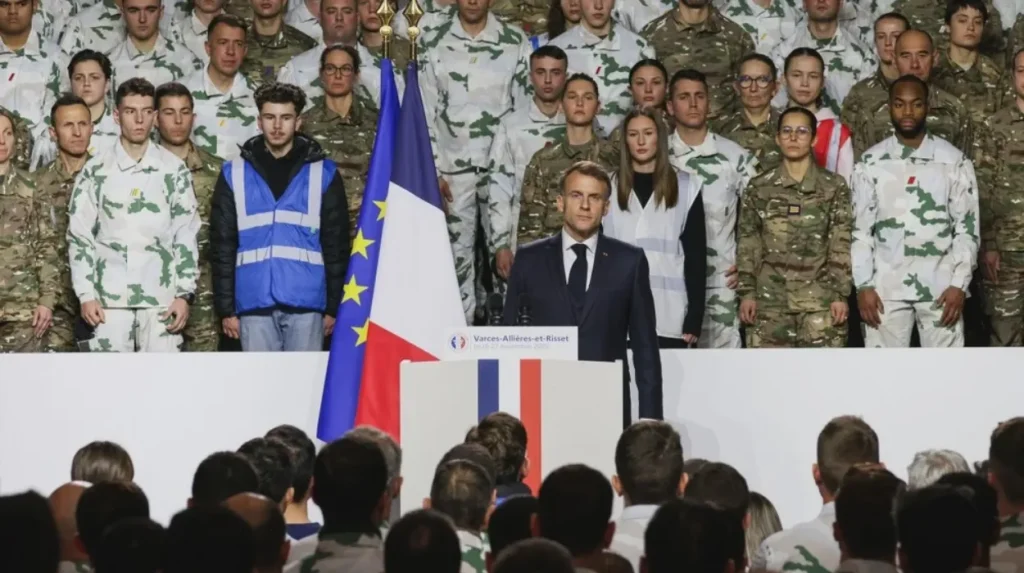
The revival of voluntary service in France comes at a time when Europe was more insecure. As Russian invasion of Ukraine reaches the fourth year of invasion in 2025, President Emmanuel Macron has increasingly raised the alarm over an increasingly hostile strategic environment. In his visit to the 27th Mountain Infantry Brigade at Varces, he positioned the effort as a crucial part of national resilience, basing the action on a deeper European concern over the potential violence expanding out of Ukraine.
France presently has some 200,000 active men and 47,000 reservist men. The government is planning to have 210,000 active forces and 80,000 reservists in 2030 which can be seen as an attempt to restore depth in the army, which is a long-term project. Macron stressed that France should be prepared and respected, that is, the phrase also highlights that Paris does not want to be strategically complacent.
A shift from civic service to a security-oriented model
The france voluntary service revival is one that is used to replace the previous Universal National Service program that was mainly centered on civic involvement. The re-alignment is an indication of a more national-security-focused approach, which is necessitated by the necessity to mobilize quickly, have more powerful reserves, and become more integrated into society through defense agencies.
The 2026 cohort will be the first to be targeted under the new structure and will target men and women aged 18 and 19, with applications being accepted starting mid-January. The program is voluntary; however, it is aimed at developing a pool of recruits who can strengthen the armed forces and domestic security services of France.
Program structure and implementation phases
The initial working stage will start in summer 2026 and include an initial group of 2,000-3,000 volunteers. Every one of them shall receive an initial month of training on basic training, handling of weapons, field training and basic discipline classes. After nine months, they are put in regular military units, where they are given uniforms, housing, meals and an allowance of around 800 Euros a month.
Other such missions could encompass the volunteers under the missions such as Operation Sentinelle, which France has been involved in since the 2015 terrorist attacks for internal security patrols. The focus of selection is on appropriateness and incentive, where the representatives of the military believe that the model establishes a direct connection between the citizens at a young age and the national defense.
Expansion toward new security branches
Starting in 2027, the participants can opt to work in the gendarmerie or firefighting services, and this will be a huge milestone in the process of combining various pillars of domestic security. France’s inner ministry is advocating the growth on the basis that they need a more dynamic response to a crisis that includes terrorism and natural calamities.
The operational reserve is immediately made available to all volunteers when the service is completed. This supports the hybrid nature of France, which combines new recruits, the already-reservists system, and active-duty soldiers on a larger national readiness system.
Long-term scaling ambitions
As per government estimates, growth is expected to reach out to 10,000 recruits by 2030 to 50,000 per annum by 2035. The model is based on the experience of Norway, where 15 percent of every age group does 12 months of service. During extreme crises the parliament in France has the power to go past the voluntary participation but leaders have emphasized severally that normal operations will stay elective.
These are also consistent with more general European trends in 2025, as twelve EU states still have obligatory national service and some others- most recently Latvia and Sweden- have reestablished conscription.
Budgetary implications and resource challenges
The revised 2026-2030 Military Programming Law incorporates the france voluntary service revival with over 2 billion euros in expansion of barracks facilities, training facilities, equipment acquisition and staffing expenses. The promise however, comes at an opportune wrong time, fiscally. France already handles high levels of public deficits and military assistance to Ukraine as well as increasing costs of operation of national security operations.
Analysts believe that the level of recruitment of volunteers is not certain and it may need more incentives or training capacity on part of France. Macron has demanded a sense of reality in the financial direction of the program, recognizing that the scaling objectives will be based on the fiscal restraints and development of the threat.
Operational integration and reserve reinforcement
One of the goals is to build the reserves of France. Researchers observe that during the time when conscription was in place until 1997, the provision of training required 600,000 or 800,000 young people in a given year. The rediscovered voluntary service is incapable of providing such numbers, but it can greatly strengthen the operational reserve, especially in case of an emergency.
General Fabien Mandon who is the Chief of Defence Staff has emphasized the need to prepare the country psychologically and structurally to make sacrifices. His words echo the general French opinion which is that Europe is likely to experience extended strategic turbulence over the decade.
By 2035, training 50,000 volunteers annually will add massive infrastructure improvements, such as training facilities, logistics hubs, and finding instructors. This will challenge the abilities of the defense ministry since the program will be developed in a series of stages.
Broader European and geopolitical dynamics
The france voluntary service revival is part of a continental movement upgrading the military capability to meet the ongoing military aggression by Russia. Sweden, Lithuania, and Finland have focused on the increase in forces, mobilization of reserves, and quick preparedness structures.
The model of France aims at strengthening the efforts of the EU Common Security and Defence Policy, yet upholding national autonomy. The program is being seen as a part of wider European deterrence by Paris that does not replace, but reinforces NATO commitments.
NATO exercises have continued unabated, Nordic defense collaboration has grown, and there have been increased alerts on hybrid threats, all of which further makes the decision of France more contextual.
Domestic social and political considerations
The first public relations have been directed towards reassuring any prospective volunteer that the program is strictly domestic. To stop any apprehensions of overseas operational involvement, Macron has made it clear on multiple occasions that deployments will take place on the national territory and only on national territory.
The general opinion of the military is still quite favorable, and the polls, conducted at the beginning of 2025, reveal a high level of trust in the younger demographics. There are also some political voices which claim that voluntarism can become ineffective in the times of high danger, and the increasing number of threats can also lead to the situation when even voluntary programs prove to be not economically viable in case of the worsening of economic conditions.
The government will use the first data at the 2026 cohort to a great extent to understand whether it can recruit without the mandatory aspects.
Geopolitical uncertainty ahead
France now stands at a pivotal moment as it balances budgetary constraints with growing defense responsibilities. The france voluntary service revival seeks to create a more resilient society, a deeper reserve pool, and a broader understanding of national duty among younger generations.
Whether the initiative ultimately strengthens France’s readiness or exposes new strains will depend on volunteer enthusiasm, fiscal endurance, and Europe’s evolving security landscape. As the first cohort prepares for 2026, unanswered questions remain about how far France will go if volunteer numbers falter and how its neighbors may adjust their own models in response.