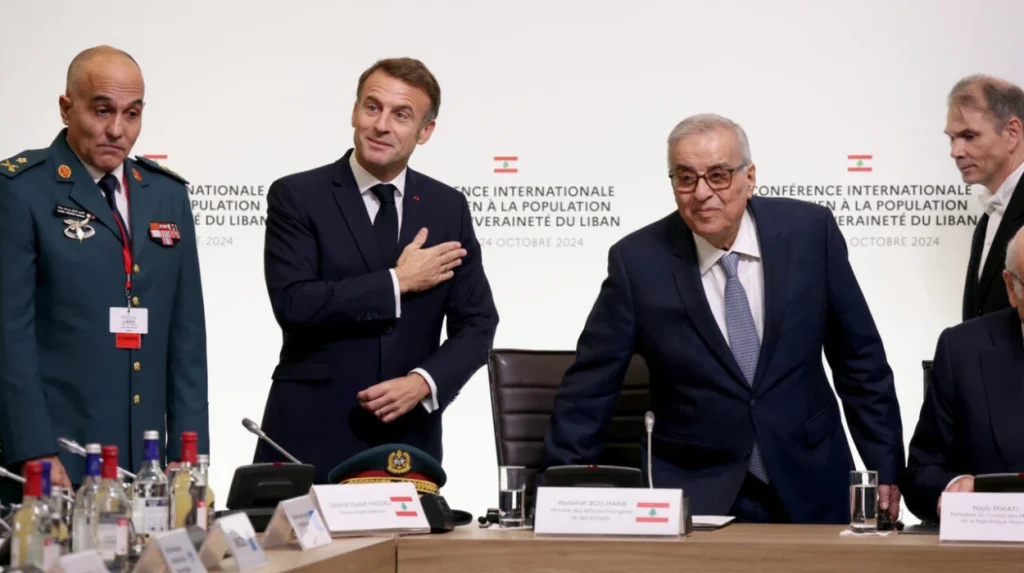
Lebanon remains under acute institutional pressure, with a chronic state of political polarization, economic distress and poor services. The 2019 financial collapse has left state authority weak because decades of sectarian power-sharing, breakdown in governance, and social tensions weaken state authority. This weakness impacts the capacity of the state to exercise reforms, exercise territorial dominance, as well as address citizen demands. A lack of a fully functioning government during prolonged periods of time has compounded administrative paralysis and distrust amongst the citizens.
The French involvement in Lebanon has acquired a new meaning and has been under fresh perspectives as Paris takes the center stage in executing international action to strengthen Lebanese institutions of state. The French government explains its involvement as being in the form of a long term and strategic alliance as opposed to short term aid. This assistance is aimed at stabilizing the state authority in 2025 with the help of strengthening military potential, specific reforms and modernization of governance in partnership with the United Nations Development Programme.
Strengthening The Lebanese Armed Forces
One of the few institutions, which are seen to be cross-sectarian and relatively stable, is the Lebanese Armed Forces (LAF). The assistance of France involves high levels of training cycles, logistical equipment and coordination of operations. The French officials cite that centralization of the LAF forces is the key to security throughout the country and this is more so given the ongoing unrest along the southern border and occasional violence within the Palestinian camps.
Supporting Social Stability Within The Military
In addition to military equipment, France has offered welfare-based services, such as food stamps and scholarships to the families of soldiers. The officers of Lebanon often mention that the morale is as vital as the equipment to keep the units together. Such social provisions are used to alleviate the economic strains on the service members who have been subjected to years of currency meltdowns.
Fulfilling Security Obligations Under Resolution 1701
France still reaffirms its dedication towards UN Security Council Resolution 1701. Its assistance is in line with peacekeeping efforts in South Lebanon and supplements the efforts undertaken by UNIFIL, which consolidates joint security actions that are crucial to the maintenance of precarious stability within the area.
Digital Governance As A Pathway To Stability
Coupled with providing security, France focuses on governance reforms to restore trust in the citizens and efficiency in the administration. These reforms have also entailed digital transformation, which has tackled institutional flaws that are revealed by the multi-layered crisis in Lebanon.
Modernizing Public Administration
France and UNDP have also invested in the digital platforms of services where citizens can make applications, receive public records, and transact without the intermediary. The civil servants in central ministries in Lebanon report less pedestrian traffic and better service transparency. The shift in administrative culture was highlighted by a commentary by one of the Beirut officials that digital platforms have transformed how things are done on a daily basis and minimized chances of interference.
Enhancing Transparency And Limiting Corruption
Digital governance tools enable fewer discretionary powers because they automate workflow and minimise the necessity of informal channels. Openness in service provision particularly in land registers, civil stature departments and even the custom has transformed the attitude of people and reduced cases of bureaucratization abuse. More accountability is enhanced through the increased use of electronic tracking systems.
Integrating Digital Systems Into Electoral And Judicial Processes
The reform goes to the democratic and judicial systems in Lebanon. Voter registries and case-management systems are digitized, which offers a more stable form of management and less ambiguity in processes. Although there are still challenges like the disparity in internet connection, political opposition, and technical inadequacy, the reforms have brought a major change in the practice of governance.
France’s Strategic Approach To Governance Reform
France’s activity in Lebanon is a combination of security support and governance modernization based on the lessons of the previous crises that the intervention was not able to produce a lasting effect. French policymakers stress that military and administrative reform should be developed in tandem with one another.
Capacity Building Across State Institutions
France finances training courses that are enhancing administrative skills, such as digital skills and management of public finances. Local government collaboration is supposed to advance municipal governance, which allows decentralization of services and quick responsiveness of citizens. Digital procedures within ministries have also been introduced with the assistance of workshops organized by UNDP and funded by the French.
Legal And Institutional Reforms
The assistance goes further to the development of digital governance legislation, the improvement of cybersecurity policies, and the introduction of energy-efficient IT infrastructure into governmental systems. Such reforms offer citizens and public institutions that are digitizing legal clarity.
Promoting Inclusive Governance
The initiatives of France emphasize inclusivity, and the marginalized such as women, the rural population, and displaced groups can access the use of digital tools. The community centers and the mobile training units are useful to close the digital divide and spread the reforms over a wider society.
Broader Implications For Lebanon’s Peace And Stability
The success of stability in Lebanon in 2025 depends on the ability to strengthen the institutions that are capable of resisting economic and political shocks. The French involvement in Lebanon explains why external powers can be helpful to fragile states using a moderate stance that balances between security enhancement and modernization of the governance.
Linking Security To Institutional Legitimacy
Whereas military capacity can offer short-term peace, legitimacy is established by having transparent institutions that are effective to the citizens. Trust in the state authority is increased as the digitalization of the services provided by it makes it more reliable and less dependent on personal networks or sectarian mediators.
Navigating Political And Social Obstacles
Reform initiatives are faced with deep-rooted interests that are resistant to reform. The political elites might be unwilling to endorse reforms which curb the patronage networks. Moreover, the economic crisis and frustration of the population are obstacles to the continuity of the reform wave. The persistence of its involvement by France however offers international leverage, which is an encouragement to the progress despite these impediments.
Lessons For Regional and International Partners
The case of Lebanon provides a lesson of how states that have institutional weakness should be ruled. The adoption of digital tools in the context of the public administration is a paradigm of enhancing transparency and accountability in the area where the traditional paths of reform have been blocked. The partnership approach of France is based on long-term investment and joint institution-building factors, which are becoming regarded as critical in maintenance of peace in the Middle East.
The future of Lebanon in 2025 is a complicated mix of external assistance, internal reformation, and technological innovation. The role of France in Lebanon makes us understand how a specific aid can help build state power over time, encourage openness, and increase citizen confidence. With the reforms still ongoing, the development of the country will offer a disclosing perspective on how the weak states are making adjustments to the governance framework so as to suit the contemporary problems and how the digital transformation may change the way to make lasting peace.