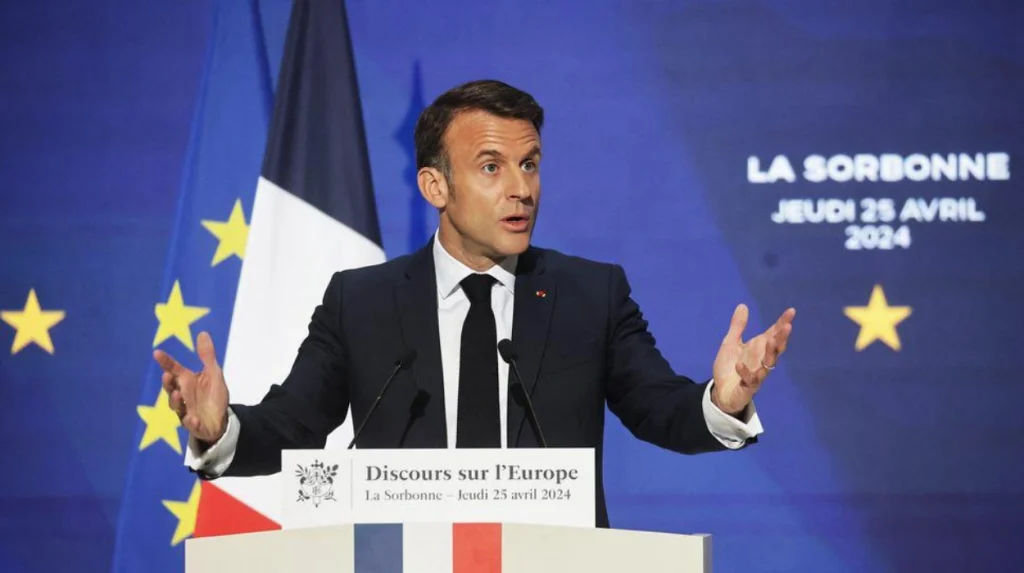
The quest of European defense by President Emmanuel Macron has emerged as a major focus of transatlantic security discussions. His idea aims at having a Europe that would be able to handle its own defense requirements but have a cooperative relationship with NATO. The concept of strategic sovereignty proposed by Macron is poised in the light of changing global power dynamics with the attention of the United States to the Indo-Pacific region and the revitalised aggression of Russia shifting the security calculation of Europe.
European defense autonomy does not imply a separation with NATO but it means developing it. The strength of the argument presented by Macron is that the alliance would be strengthened rather than replaced by a stronger, self-reliant Europe. This vision supports the bigger picture of improving the capacity of Europe to react to crises not just on its own territory but its borders, whether that is the Sahel, or Eastern Europe and reducing the reliance on American military resources.
The role of the French president is also motivated by the strategic need, that is the acknowledgment that the security threats that Europe faces, such as cyber threats, energy vulnerability and hybrid warfare demand quick, coordinated and autonomous reactions that the current alliance mechanisms are, at times, unable to provide in good time.
European Defense Spending And Capability Enhancements
The pre-2025 years have also seen a significant rise in the defense expenditure of European NATO states, which indicates that the collective decision was to acknowledge the increasing security risks.
Rising Commitments To Collective Defense
The number of NATO allies who have scaled or surpassed the 2% of GDP defense expenditure limit now reaches 23 with Poland on the frontline with 3.5. This change highlights how the war in Ukraine and the overall instability have changed the perceptions of threats. The 2025 summit of NATO also recommended that there should be a unanimous 5% GDP defense goal by 2035, which is in line with the long-term goal of Macron of building a more capable and stronger Europe.
France is an example of this still, as it made a EUR400 billion plan of military modernization until 2030. The program prioritizes cyber capabilities, quick responsive forces, and technological development in such domains of drones, artificial intelligence-based logistics, and missile defenses. This is an investment that creates the functional basis of the European vision of strategic autonomy.
Expanding Operational Readiness
European defense programs have been extended to consist of joint rapid reaction components and more complex intelligence-sharing frameworks. The European Intervention Initiative (EI2) has intensified the level of coordination among France and Germany under the leadership of Macron, to facilitate speed in mobilizing the military. The object of this preparation is to bridge the chasm between intention and ability in the political sphere, a necessary measure towards real strategic independence.
Political And Public Dimensions Of Autonomy And Alliance
The initiative by Macron to seek independence cuts across various political and popular moods in Europe, with some feeling excitement and others feeling anxiety.
Diverging Political Responses Across Europe
Macron has found a great number of supporters in Western European countries, especially France, Spain, and Germany, which are major proponents of his call to enhance the capabilities of European defense. On the other hand, the Central and East European nations are reserved. In the case of countries such as Poland and the Baltic states, the U.S security assurance holds the first position. They worry that the autonomy talks would water down the deterrent pose of NATO or cause parallel systems.
Under President Biden, the United States has openly embraced European rearmament. Washington sees a stronger Europe in terms of military strength as an asset and not a competitor so long as such efforts support the overall structure of NATO. This practical knowledge has served to alleviate the previous concerns of transatlantic divergence.
Public Opinion And Political Momentum
There have been a lot of changes in the way European defense is viewed by the citizens. A survey conducted by Eurobarometer in 2025 found out that almost three-quarters of EU citizens think that they should reduce their reliance on the U.S. troops. Increased consciousness of international vulnerability to the security threat- heightened by cyberattacks and power outages has bolstered general enthusiasm with regard to autonomous European defence forces. This is why the Macron narrative of sovereign security appeals to the rising popular demands of a more autonomous Europe.
Challenges In Achieving True Autonomy
The capacity of Europe to realize the complete freedom of defense is still curtailed by structural considerations notwithstanding the financial and political progress.
Fragmentation Of Defense Industries
The defense sector in Europe is still dispersed, with the national projects overlapping and conflicting with the procurement standards. The aircraft and naval systems that France leads compared to Germany with armored vehicles and the small states tend to rely on imports. This disintegration negatively affects the cost efficiency and interoperability challenges, which Macron has encouraged the EU to confront with multilateral defense procurement systems.
Divergent Threat Priorities
There is also a difference in security priorities throughout the continent. The focus of the Eastern European nations is on preventing Russian aggression and that of the Western Europe is on African and Middle East instability. Such conflicting priorities make joint strategic planning more difficult and result in the asymmetry in the resources distribution.
U.S. Strategic Reorientation And Its Impact
The American shift towards the Indo-Pacific raises the question of the extent to which the American participation in Europe is going to increase. Macron views this as a chance to make Europe have more strategic responsibilities. However, to most members of NATO and especially to the smaller states, such a change is an indicator that the U.S. could be more willing to withdraw protection and thus the need to ensure that any security vacuum created is urgently and also effectively filled by having European credible capabilities built at a rate that is quickly achievable.
Emerging Security Dynamics Shaping Macron’s Vision
The idea of European defense autonomy put forward by Macron is also in line with the greater NATO reform agenda and the nature of war in 2025.
Integrating Cyber And Hybrid Warfare Strategies
The latest amendments to NATO Strategic Concept have focused on cyber resiliency and hybrid threat preparedness-where Macron wants to increase European leadership. France has been on the frontline in forming a single cyber defense command and has also invested in satellite-based communication systems to make them less reliant on the U.S. intelligence infrastructure.
Strengthening Deterrence Through Multilateral Cooperation
Although he backs autonomy, Macron is a proponent of maintaining the nuclear deterrence framework at NATO since it is unreplaceable in terms of strategic stability. France, which is a nuclear power among the two European nations, is still in the process of modernising its deterrent and is involving the partners in the discussions on deterrence, but over a long-range. The two strategies support the European sovereignty and credibility of the alliances.
Building Decision-Making Agility
Macron is looking forward to having a defense system to enable Europe to respond swiftly in crises- be it humanitarian, cyber or military without necessarily having to wait for the U.S. to lead them. Other efforts such as the European Rapid Deployment Capacity (ERDC) which should be in place by the end of 2025 are meant to give the EU the ability to respond within 10 days after the breakout of a crisis. This model indicates independence and coordination balance that characterizes the strategic thinking of Macron.
Evolving Roles And Responsibilities
The relationship between European defense autonomy and NATO membership becomes one of the security questions of 2025. The strategy of Macron is continuity and change in one: strengthening the capacities of Europe to protect itself and preservation of the transatlantic integrity of the alliance.
The real test of success will be whether Europe can make commitments interoperable, whether Europe can execute them in practice in interoperable forces, whether Europe can have shared command structures and whether Europe can have shared strategic objectives. In the absence of these, autonomy will be more of a far-fetched dream. It is a balance that needs to be achieved through a consistent diplomatic effort, standardization of defense acquisition and long-term political commitment among member countries.
European defense autonomy, as framed by Macron, is not designed to challenge NATO but to modernize it through a stronger European pillar. It embodies a pragmatic vision for a more balanced transatlantic partnership, one where Europe can act decisively when necessary but remains fully integrated within the alliance.
As 2025 unfolds, the evolving relationship between European defense autonomy and NATO will shape not only Europe’s strategic posture but also the global security order. Whether Macron’s initiative succeeds in redefining this balance will determine if Europe can emerge as a genuine security actor in its own right capable of defending its values, interests, and sovereignty in an increasingly multipolar world.