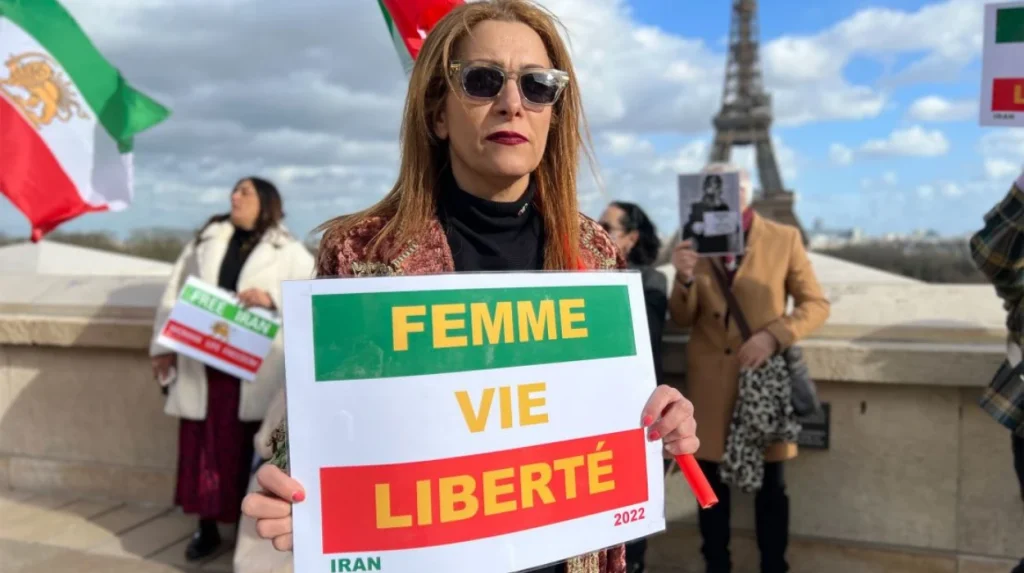
France once again proved to be one of the most vocal champions of the rights and political freedoms of Iranian women, and thus established itself as a moral powerhouse in the European Union concerning the human rights crisis in Iran. The year started with a historic International Women Conference in Paris, which brought together activists, policymakers, and human rights defenders representing more than eighty countries. The incident highlighted France’s long-term readiness to assist women in Iran, especially following a long period of state suppression and the violent crush of the so-called Woman, Life, Freedom demonstrations that were launched in 2022.
At the Paris conference, prominent figures of the Iranian opposition, as well as the speakers expressed criticism of the laws on compulsory hijab and systematic gender-based discrimination in Iran. Teenage women as Maryam Rajavi, the leader of the National Council of Resistance of Iran, stressed that the inevitable downfall of the theocratic regime in Iran would be facilitated by women who were quite insistent on regaining political and social equality. Her message reverberated throughout the political spectrum of France with support in the legislative branch, civil societies and feminist movements.
In addition to rhetoric, the assistance of France has taken material form in terms of its policies. The resolution was adopted by the French National Assembly requesting the European Union to declare the Islamic Revolutionary Guard Corps (IRGC) a terrorist group- an action aimed at mounting more pressure on Tehran by the rest of the international community. It was also proposed in the motion that coordinated efforts should be undertaken to safeguard the Iranian dissidents, especially the women who are under threat of being assassinated and intimidated even in exile in the European continent. This advocacy has also been enhanced by French NGOs and municipal councils in the form of public exhibitions, marches, and cultural activities in honor of Iranian women who died in the quest to gain freedom.
Geopolitical constraints shaping France’s advocacy
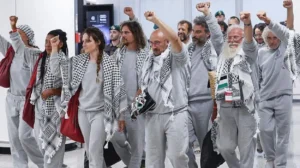
France has a straightforward moral stand, but still is limited in terms of its approach to Iran due to geopolitical necessities. Diplomatic, security and economic factors still define the extent to which Paris will go in challenging Tehran at the expense of greater European interests. This juggling process is best reflected in current instances of dual nationals, including the arrest of Mahdieh Esfandiari, a French-Iranian researcher who was thrown in prison in Tehran on charges of espionage. The French government has called upon her release on multiple occasions accusing her arrest as a political move, however, has not gone further to cut diplomatic relations to maintain a channel of communication.
Iranian exiles and activists are in France which further complicates the case. In the past year, Iranian agents have been detected by the French intelligence agencies as having tried to spy on or threaten the members of the Iranian diaspora. This has heightened the domestic security issues but brought into the limelight the transnational scope of the Tehran repression. This has seen French authorities exercise greater protection to activists as they are appreciating the fact that the fight involving Iranian women rights is not limited to the borders of Iran.
Simultaneously, France is a part of a larger European system where Iran relations are a controversial topic. The current talks that the EU holds regarding regional security, migration management, and energy security still limit unilateral action. International commentators within and outside France criticize Paris of being a victim of selective diplomacy and its promotion of human rights may be watered down by economic realism. However, the French government believes that positive dialogue- coupled with strong human rights activism is the most realistic way of bringing a change in the policies of Tehran.
Interplay between moral advocacy and strategic diplomacy
The dilemma of moralism and practicality in France in relation to Iran is reflected in larger terms by the question of the way Western democracies are addressing Iran. On the one hand, France always presents itself as a champion of universal freedoms and supports the independence of women and democracy. On the one hand, it has to strike a balance between these values and the concerns of the nation and regions- not going too far and causing the collapse of relations on the national and international levels, and breaking up the international coordination.
Balancing advocacy with engagement
This strain has resulted in a new foreign policy of what the French diplomats call engaged vigilance. Paris still contributes to the resolutions of the UN of human rights violation in Iran, but still talks with Iranian officials over nuclear nonproliferation and de-escalation of conflict in the region. According to the French policymakers, moral leadership should be combined with diplomatic involvement in order to maintain power even among authoritarian governments that are adamant to reform.
The European context and coordinated pressure
The position that France holds is also influenced by the policy of the European Union regarding Iran. Attempts to reach an agreement on more disruptive sanctions or IRGC designation have been opposed by the member states that have placed stability above confrontation. By the end of 2025, France will be among the loudest members of the bloc, asking Brussels to be more aggressive. Its dominance in the EU highlights a larger interest of identifying the moral compass of the Europeans in the international human rights discourses as it responds to allegations of inconsistency.
advocacy through civil society and soft power
Outside the government policy, French civil society has continued to mobilize and create awareness on the plight of Iranian women. It has remained a visible issue in the eyes of non-governmental organizations, feminist movements, and even cultural institutions, in the form of art and film, and in the form of public discourse. These programs are a supplement to formal diplomacy, which expands the influence of France by the use of soft power. The ongoing presence of the Iranian women resistance in the French media and culture supports the story of the movement that cuts across national and ideological lines.
Resonance of Iranian voices within French politics
The consistent promotion of Iranian women by France has also influenced domestic politics. The reference to the cause by politicians of both parties is becoming more and more frequent as a measure of the moral worthiness of France in international politics. The increasing number of parliamentarians who demand more EU sanctions on the Iranian officials speaks of the merging of feminist, humanitarian, and geopolitical interests.
The society continues to be on board especially in the youth movements inspired by the fearless nature of Iranian female activists. This resonance echoes a more fundamental parallel between the ideals of liberty, equality, fraternity of a republican France and its own unique ideals and the demands of the Iranian women who needed independence and representation. The French leaders have attempted to contextualize the struggle in Iran as a universal fight of human dignity as opposed to some alien foreign policy concern by referring to these shared values.
With France being the home to the Iranian exiles, academics and artists, it remains a symbolic home and both an outlet to the voices stifled in Iran. These voices have become part of the advocacy narrative of France that is a reminder to policymakers that the fight to gain freedom is not only fought in the diplomatic corridors but in the real sense.
Continuing test of principle and pragmatism
France’s advocacy for Iranian women’s rights in 2025 stands at the intersection of moral conviction and diplomatic restraint. While the government projects solidarity with Iran’s women, it also faces the constraints of an international system where strategic stability often tempers moral ambition. This duality reflects not indecision, but the inherent complexity of championing human rights in a world where global interdependence blurs the boundaries between idealism and necessity.
The echoes of Tehran’s protests still reverberate through Parisian streets, sustained by activists and citizens who refuse to let the issue fade. France’s challenge is to ensure that these voices remain central to its diplomacy, not sidelined by shifting priorities. The ongoing question, how a democratic power can translate moral advocacy into meaningful political leverage remains unresolved, yet France’s persistent engagement offers a glimpse of possibility. As long as Iranian women continue to resist repression, France’s role as their international ally will remain both a moral duty and a measure of its global credibility.