France and Germany, the European Union’s foremost military powers, renewed their public commitment to joint defense in 2025 amid mounting geopolitical pressures. With Russia’s war in Ukraine entering its fourth year and U.S. security guarantees becoming less predictable, the push for “European strategic autonomy” gained renewed urgency. Summits of leaders in Berlin and Paris have resulted in single declarations, but the practical and industrial implementation of those vows is dispersed.
Germany has since surpassed the NATO 2 percent GDP goal aiming to reach 3 percent in 2030. France, in the meantime, seeks to achieve 64 billion euros of spending on defense per year that year. Such budgetary increases are unprecedented and a change in post-cold war defense stance. But behind these numbers stands a systematic ten-year inability to coordinate strategic thinking, procurement patterns, and political intentions, more evidently manifesting themselves in the case of key projects such as the Future Combat Air System (FCAS) and the Main Ground Combat System (MGCS).
Next-Generation Weapons As Test Cases
The Struggles of FCAS
FCAS, intended as Europe’s sixth-generation fighter jet, has become a case study in defense collaboration complexity. The tri-national project France/Germany/Spain has been put back time and again with France insisting on much of the industrial workshare, 80 per cent. This goes against previous agreements of parity and indicates more fundamental differences regarding control, intellectual property and leadership of the project. The full capability date has already been changed to 2040 (possibly to 2045).
The French and German industry (Dassault Aviation and Airbus) has been in the staging of negotiation on the terms of governance though this process has been taking time. The budgetary commitments also exist, but they are not met due to the absence of agreement regarding the priority of operations and technical frameworks.
MGCS and Uneasy Progress
The MGCS project—designed to replace the Leopard 2 and Leclerc main battle tanks—has advanced incrementally, with some successes. A Franco-German joint venture was formalized in Cologne in April 2025, and €98 million has been allocated for research and design. Still, debates persist over production roles and operational concepts. KMW and Rheinmetall of Germany are going head to head with Nexter of France at the distribution and management of the abilities. This friction, as in the case of FCAS, threatens schedules and destabilizes the larger ambitions of the EU to build up its defence capabilities.
Paris and Berlin have a different military doctrine. France has a more globally-minded force posture with a nuclear deterrence, overseas peacetime operations and semi-autonomous operations in the Sahel and Indo-Pacific. Germany is multilateral in character and tends to incline NATO-centred systems of arrangements and avoids deploying troops anywhere outside a NATO alliance.
Underlying Structural And Strategic Divergences
Doctrinal and Political Differences
Paris and Berlin have a different military doctrine. France has a more globally-minded force posture with a nuclear deterrence, overseas peacetime operations and semi-autonomous operations in the Sahel and Indo-Pacific. Germany is multilateral in character and tends to incline NATO-centred systems of arrangements and avoids deploying troops anywhere outside a NATO alliance.
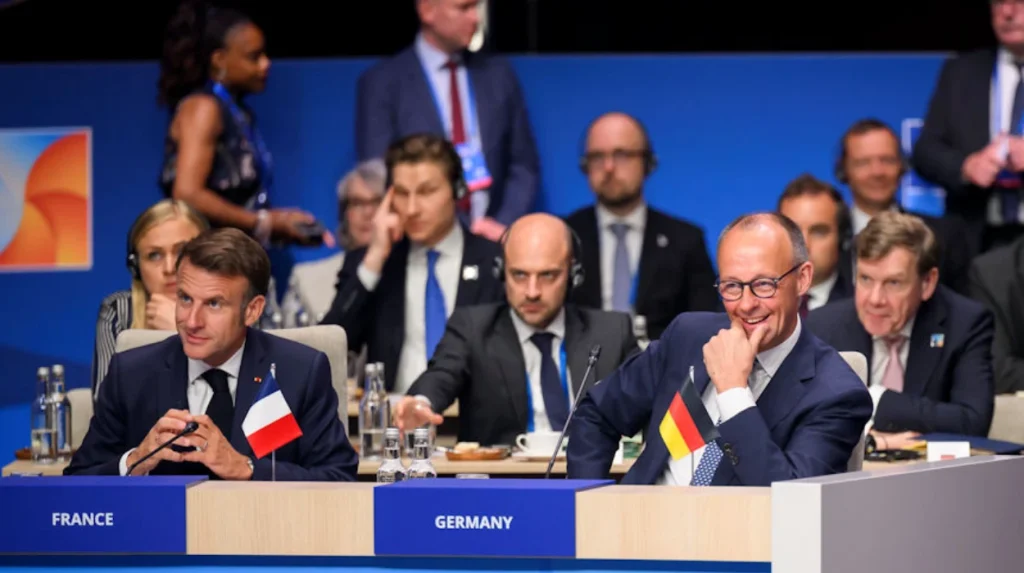
This gap in orientation creates real tensions. France has already made preparations to go into the field with 20,000 troops on high alert, whereas Germany is struggling with capabilities shortages and structural problems. German Chancellor Friedrich Merz has been advocating a more so-called Gaullist swing, which focuses on less dependence on American assurances and more on European sovereignty. However, domestic factors such as reluctance and voter attraction minuscule after military growth are also limiting factors to Berlin.
President Emmanuel Macron advocates strategic autonomy, although he is also adamant in French possession of ownership on its nuclear arsenal. Despite the invitation of European allies to wider nuclear deterrence discussions by Macron, the truth of the matter is that French nuclear attributes are left under national control that is likely to make the European sought nuclear umbrella to be integrated.
Industrial Contestation and Budgetary Pressures
The two divisions between the Franco-Germans are aggravated by industrial politics. Along with the shared leadership, Dassault, Airbus, Rheinmetall, and Nexter also want to be dominant in joint ventures, which brings extra difficulty. Technology transfer negotiations, export privileges and domestic economic returns incur a lot of controversy. FCAS in particular has suffered from disagreements over intellectual property and system architecture.
Fiscal pressures also play a role. With France’s public debt expected to exceed €3.3 trillion by 2026, maintaining domestic jobs and industrial sovereignty takes priority. Germany faces its own budget constraints, particularly as social and energy costs rise. These domestic imperatives pull against the logic of shared procurement and coordinated industrial strategy.
Political Will And The Search For True Convergence
Cooperation Framed by Crisis
Despite their differences, both nations have made some efforts to align their defense trajectories. National defense white papers released in early 2025 converge on threat assessments, particularly identifying Russia as the principal military challenge. Both documents emphasize enhanced rapid deployment and joint capability development, suggesting strategic convergence at the rhetorical level.
However, recurring setbacks continue to plague the partnership. Whether discussing nuclear doctrine, arms export policies, or procurement decisions, the same fundamental differences resurface. Joint defense initiatives often require new task forces or audits, a sign of structural weakness in bilateral project governance.
Stakeholder Perspectives
German Defense Minister Boris Pistorius recently emphasized the importance of cooperation, stating that “real defense innovation and greater European security depend on close Franco-German cooperation,” while acknowledging “key divergences in approach.” French Defense Minister Sébastien Lecornu echoed this sentiment, but underscored that “capability requirements must drive decisions—not just industrial politics.” Their comments reflect a shared aspiration obstructed by legacy barriers.
This person has spoken on the topic: Defense analyst Jurgen Nauditt observed that
“the FCAS imbroglio is a microcosm of Europe’s broader struggle—more money, more promises, but progress constantly mired in political and industrial brinkmanship.”
Germany called on France to accelerate the supply of weapons to Ukraine, – Politico
— Jürgen Nauditt 🇩🇪🇺🇦 (@jurgen_nauditt) May 22, 2024
"We have a problem that while Poland is doing a lot as a neighboring country, while Germany is doing a lot, France is doing relatively little. There is no time in Ukraine, and everything,… pic.twitter.com/oBk4TgtfWq
His assessment mirrors growing concern among European defense circles that the continent’s core powers are struggling to operationalize their ambitions.
The Broader European And Transatlantic Context
Implications for European Defense Integration
The course of the Franco-German alliance is of great value to the future of European defense. These bilateral ventures are the key to the development of a credible common security and defense identity that the EU is aspiring to. Other European nations want to see leadership in Berlin and Paris as well as evidence that a collective defense can be built in scale.
However, time and time again delays and industrial action destroy that credibility. If FCAS and MGCS falter, the EU may struggle to justify new defense integration projects. As U.S. politics in particular has grown hard to predict, the capacity of Europe to take independent action is more vital, but less certain.
The Cost of Compromise and the Limits of Ambition
The concept of strategic autonomy is often mentioned in the European capitals and rather erratically followed. Any sacrifice of time, business leadership, or preparedness decreases the efficacy of the message. In Europe, the projection of European power, whether in military or diplomatic terms, needs more than simply the money. It also needs unity of action.
France and Germany could be more then they have been in a long time in political ideals and urgency of security but in action they still have much to achieve. There still exist industrial competition, differing national political cultures and dissimilar strategic doctrines that have restricted the speed and extent of common success.
The future scope of European defense in a polarizing world, where high-intensity warfare, a divergence of alliances and growing automation are becoming the norm, will hinge not just on the ability of the Franco-German relationship to survive such challenges in 2020 and beyond, but their consequence on bilateral credibility. The future of the most significant military alliance in the continent is dependent on how it is able to turn pledges into programmes and visions into strength.