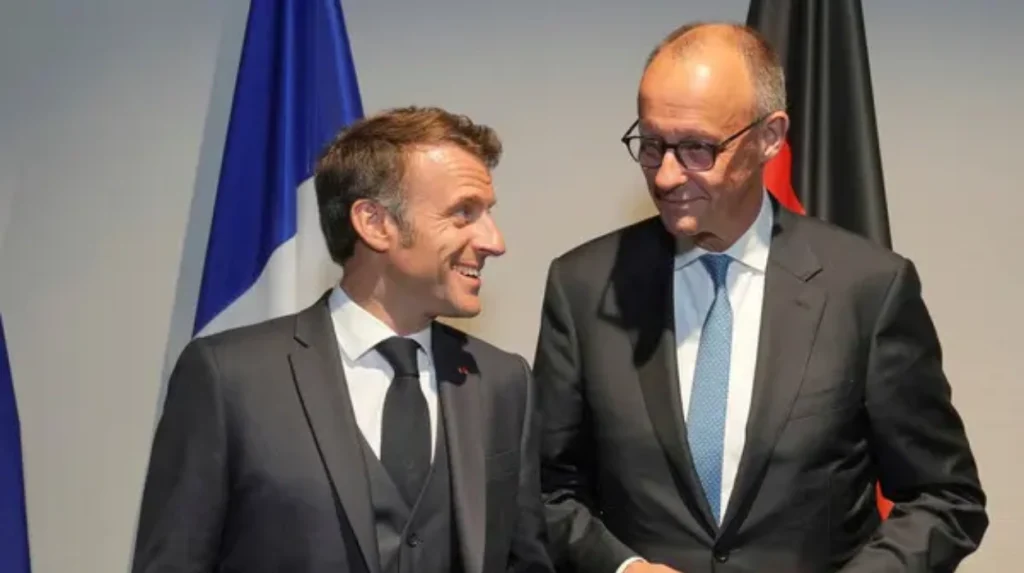
On July 23, 2025, French President Emmanuel Macron and German Chancellor Friedrich Merz met in Berlin to recalibrate their countries’ positions on key transatlantic issues. With NATO’s eastern flank under continued strain and trade relations with the United States teetering under tariff threats, the summit marked a critical moment for both leaders to reinvigorate the Franco-German alliance.
The Élyssee presented the meeting within the frames of the restored coordinated Franco-German leadership, emphasizing the necessity of the European Union to remain united as it becomes increasingly affected by the differing US foreign and economic policies that are present during the Trump administration. As Ukraine continues to occupy the European geo-strategic space, the coordinated messages by Paris and Berlin indicated an intention to negotiate alliance requirements as part of efforts to strengthen the EU unity.
NATO And Ukraine Support: Unity Of Purpose, Divergence In Tactics
France Advocates Ceasefire Enforcement Missions
It is pointed out that Macron has not stintingly thrown out the idea of sending French-led peacekeeping troops to a potential Ukrainian ceasefire in the event that the circumstances have allowed it. The given suggestion will serve to highlight the role of France as an active security player in the European context, yet to strengthen the range of operations of NATO. Upon closer inspection this contribution can be seen by Macron as an indication signaling both Ukrainian sovereignty as well as strategic autonomy by Europe in the alliance.
Germany Maintains A Cautious Military Posture
Chancellor Merz on the contrary took a more cautious position which is still mirrored in the German military affairs as a result of the domestic political reservations. Germany has not been far in terms of supporting Ukraine; however, it has not yet approved any decking of troops to the conflict but rather their support in terms of logistics and funds. The disparity highlights not just differing levels of political comfort with direct involvement, but also broader philosophical divides on Europe’s role in global security.
These distinctions notwithstanding, the two states still stick to NATO, as they are preoccupied with further increasing defense spending and closer intelligence collaboration. The split provides an instrumental division of labour instead of a disintegration of alliances.
EU-US Trade Dispute: Strategic Risk And Diplomatic Urgency
Tariff Threats Disrupt Transatlantic Stability
Trade dominated the economic dimension of Macron and Merz’s meeting. As President Trump is threatening to put sweeping 30 percent tariffs on all imports into the US by August 1, both leaders expressed their concern with the fact that this move would destabilize the transatlantic economic structure. The Chancellor, Merz said there must be the realization of predictable fair trading terms so as to prevent damage being inflicted in the long term on supply chains as well as business confidence.
This is not only a need out of economic concern but also political perception. The EU wants to show the unity picture but does not want to initiate the cycle of escalation in Washington. Macron’s office stressed the importance of maintaining regulatory independence and safeguarding the European competitive edge especially in areas such as the electric vehicle, steel and the sale of agricultural commodities which are the most exposed to US tariff measures.
Internal Disputes Over Defense-Industrial Projects
Macron and Merz also touched down on continuing disputes regarding large common defense projects, and more so Future Combat Air System (FCAS). Organizational and leadership tensions have been brought up in Germany in regard to French dominance in the program which also comprised Spain. Eric Trappier, the CEO of Dassault Aviation, has openly doubted that a balanced tri-national can work, citing inefficiency of the project management.
This friction provides a larger demonstration of how hard it will be to harmonize the national defense industry within one European umbrella. The discussion of FCAS demonstrates conflicting leadership and coordination visions; these are matters that might restrain the capacity of the EU to introduce integrated strategic capacities.
Energy Policy Misalignment And Strategic Consequences
France’s Push For Nuclear Energy Recognition
Energy remains a divisive issue in Franco-German relations. France still promotes the idea of nuclear power that should be accepted by the EU level as a sustainable and climate-compatible source. Macron sees it as a way of achieving the decarbonization aspirations of Europe and attaining stability in terms of energy supply as the fossil energy market remains volatile.
This lobbying is part of French energy policy since many years of experience in which nuclear power represents a key part of the national image and power generation. France is playing the role of connecting the nuclear recognition to the overall EU cooperation policies and is thus making use of its position by imposing climate and industrial policymaking frameworks.
Germany’s Renewable Transition And Legacy Resistance
Germany is currently in the process of nuclear phase- out, which puts it at cross with the French agenda. However, flexibility by the Chancellor Merz coalition is better than what most of the past administrations have contributed, yet ingrained doubts of the people toward nuclear energy do exist. Germany still gives priority to wind and solar, as it devotes much investment in energy storage and transmission facilities.
Such a disagreement has foreign policy consequences as both nations are trying to influence the EU green taxonomy and budgetary preferences. Failure to harmonize these positions may cripple mutual investments and undermine the European bargaining chips in the international climate negotiations.
Political Symbolism And Forward-Looking Coordination
The place and the venue of the Macron-Merz summit, the Villa Borsig in Berlin, was set up with a conscious purpose of indicating the cultural and political significance of reinforced Franco-German cooperation. The program, with a jazz concert and a bilateral working dinner, resembled earlier top-level summits that were aimed at creating a sense of historical continuity.
Amid scheduled Franco-German consultations of the cabinets in August 2025, both leaders emphasized their desire to institutionalize forms of greater cooperation. They both have the common goal of portraying a more unified kind of European leadership model that can be able to respond to the global crises in a defined way both in swiftness and credibility.
Still, the issues on their mutual agenda are hefty: retaliatory action in the field of trade, lack of energy unity, various perspectives related to defense, and particular political restrictions restrict what can be accomplished through this bilateral relationship in the short run.
Expert Observations And Broader Strategic Reflections
One might interpret the implications of the summit, as Thorsten Benner, a European security expert, had discussed recently in an interview with one of the German media. According to Benner,
“The Franco-German dialogue reflects an attempt to manage complex, overlapping crises through renewed cooperation but underscores how fragile consensus remains in a polarized geopolitical and domestic political landscape.”
Merz: „Absolutely no illusions“ about Trump.
— Thorsten Benner (@thorstenbenner) February 23, 2025
Goal needs to be step by step
independence from a US who „pretty much no longer cares about fate of 🇪🇺“.
„Unclear whether we will still speak of NATO in present shape“ by time of June summit or we need to come up with 🇪🇺alternative. pic.twitter.com/n2KOqHmVKa
The fact that transatlantic realignment will not be based just on the goodwill of diplomatic leaders but on sustainable mechanisms that will be able to resist shocks and points of disagreement is another basic theme expressed by Benner, but first enunciated by the meeting of Macron and Merz. However, according to France and Germany, it seems that they are determined to work on these mechanisms, though the path to convergence might be full of institutional and political obstacles.
Sustaining European Influence In A Fractured Global Order
The world powers are becoming more antagonistic, and as long as Russia keeps up its aggressive actions and there is a risk of agencies in the transatlantic separating, it will be extremely difficult for Macron and Merz to lead a European agreement strategy. Their collaboration cannot be construed as a purely ceremonial measure but a necessity as they deal with what can be a lengthy state of geopolitical instability.
The present time constitutes whether Europe can exercise strategic autonomy without compromising upon its alliances that shaped it. Policy continuity could be very elusive, as elections approach the continent, and the United States. However, the Franco-German program depicts an ability to take the lead and evolve.
If this partnership can move from alignment in rhetoric to coordination in execution, it could recalibrate NATO strategy, stabilize trade relations, and bridge Europe’s internal policy divides. In doing so, it may offer a model for resilience in the face of shifting global power dynamics—provided it can maintain the momentum forged in Berlin.