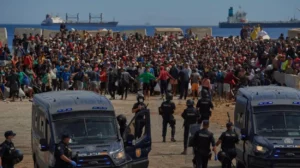
By 2025, migrant smuggling is one of the most urgent and complicated issues of the European Union. Global criminal groups found a way to thrive on instability in geopolitics, financial inequality, and law enforcement gaps to establish a massive transnational business. These networks can also be used to smuggle migrants of the origin countries on risky paths, with little consideration to human security and laws.
The law enforcement agency of the EU Europol has become the central coordination of the process to take down these networks. Europol Ramses with new powers, increased budget and a directional perspective new command with regard to the operations and policies of the EU in developing a response to this enduring security and humanitarian crisis.
Migrant smuggling as a multi-billion-euro industry
Criminal profits and human vulnerability
So migration smuggling is not a side business anymore, it is a sophisticated business and quite profitable. The Europol approximates that the illegal networks rake in billions of euros annually by overcharging the migrants on perilous and illicit trips. Most migrants have claimed to pay between 3 and 10 000 euros to make one crossing and then the bad part begins, after being left in the middle of the ocean or dropped in distant border areas without sufficient assistance.
Digitization of the smuggler has made enforcement harder. Encrypted messaging applications, social media and cryptocurrency are now popular in the trade as smugglers use these to organize activity, avoid authorities as well as wash money. International-level advanced and complex delivery networks that consist of recruiters, drivers, document forgers, and boat operators have a military system in moving across borders.
All these changes have put a strain on the capabilities of national law enforcement services and thus EU-wide cooperating under the auspices of Europol is needed more than ever.
Europol’s strategic and operational upgrades
The role of the European Migrant Smuggling Centre (EMSC)
As a remedy to addressing the magnitude of this criminal practice, Europol is developing the European Migrant Smuggling Centre (EMSC) as a single point of information exchange, threat assessment and planning. Since its inception, the EMSC has established itself as a lifeline between the border forces of different countries, the judicial agencies, and the international partners.
In 2025, the European parliament voted in an extra 50 million of operating funds at Europol, 17 million specifically to be put into migrant smuggling activities. The new financial resources have been used to employ 50 more people in addition to acquiring cutting-edge equipment to monitor the movement of smugglers, suspect criminals, and facilitate cross-border real-time monitoring.
It was the cross-border collaboration structure which has led to more than a dozen high-level crackdown enforcing cross-border activities in 2025, alone, and intelligence-led policing being the major strategy.
Strengthening partnerships for coordinated enforcement
Intelligence sharing and third-country cooperation
Europol depends so much on collaboration not only among the EU member states but also with the countries of origin and transit. Europol collaborates with the states along the Western Balkan route, North Africa, and the Eastern Mediterranean through liaison officers and operational partnerships to break the chain before it proceeds to the borders of the EU.
The new EU Action Plan to Combat Migrant Smuggling (20212025) suggests more inter-agency cooperation and collaboration including financial crime teams and cybercrime investigators. Europol has presently facilitated asset tracing and recovery activities that aim at attacking smuggling networks financially.
Europol gathers critical inputs (by accessing financial transactions, encrypted communications and travel patterns) to make strategic threat assessments to inform policy formulation and national law enforcement actions. This intelligence has further been important in detecting novel hot spots of smuggling activity as well as in the adaptation of the priorities in real time.
Operational breakthroughs and ongoing challenges
Disruption of Franco-Spanish smuggling operation
In one of the greater achievements of 2025, in another such Franco-Spanish dovetailed effort, Europol assisted in taking down a two-way migrant smuggling network that had run over 1,000 illegal migrants in and out of the EU. During the operation, a complex criminal infrastructure was unraveled through advanced scouts who checked police checkpoints, docs that were rented and other fraudulent documents.
They punished 19 suspects and confiscated huge amounts of finances, drugs, and a semi-solid boat utilized in crossings to the Mediterranean. The cumulative estimated earnings of these activities were between 250, 000 euros and 427, 000.
Still despite such triumphs, not all is well. Roads of smuggling are becoming flexible, and they can be ready to shift in a few weeks with new technologies. The ever-changing strategies involve the need of Europol to be flexible, information-based, and highly integrated in local enforcement frameworks.
The legal and political landscape of Europol’s expansion
Fragmented support and regulatory hurdles
Although the further development of the role of Europol is generally supported in theory, there are different approaches, carried out by the member states of the organization. Others, such as France, Spain and Italy, propose a more independent and active Europol that should have the investigative authority itself, i.e. a so-called “European FBI” in informal language. Other states, especially those less national traditions of the police, are opposed to experiencing such powers and do not want Europol to become a policing organization.
A new regulation of Europol is under discussion by the European Commission and the Council, due in 2026, and will define the extent and the scope of the agency. One major challenge is on the amount of autonomy that the Europol can exercise, the mandate and power of the Europaol to commence an investigation and the power to force the member state to act in line with the intelligence gathered.
These differences will play a key role in making sure there is uniform enforcement all over EU territory.
Ethical concerns and human rights implications
Balancing enforcement with migrant protection
Efforts to dismantle smuggling networks intersect with sensitive areas of migration policy and human rights law. Anti-smuggling operations must be conducted without violating the rights of migrants or obstructing access to asylum. The risk of conflating migrant smuggling with trafficking in persons—or with legitimate migration—is a constant concern.
Europol and the European Commission have emphasized the need to distinguish between smugglers and their victims. The EU’s action plan includes safeguards for vulnerable groups and outlines cooperation with humanitarian actors to prevent inadvertent harm.
Nonetheless, rights organizations have raised concerns about the impact of aggressive anti-smuggling tactics. They warn that increased surveillance, preemptive arrests, and asset seizures may result in the criminalization of migration and push migrants into even more dangerous routes.
Digital transformation and future-proofing law enforcement
Adapting to encrypted networks and digital tools
Europol is forced to adapt due to the trend toward digitalization of smuggling. Criminal organizations have currently turned to encrypted chats, use of the dark web and the use of peer-to-peer payment methods to coordinate their activities and transfer money. Europol has developed a Digital Smuggling Taskforce in 2025 to identify and study smuggling infrastructure in the internet.
The agency also liaises with the technology organization to identify and delete the digital content on illegal migration online including online advertisements that provide unofficial means of travel into the EU. The outcomes of these attempts include thousands of removals and creation of AI technology to monitor new smuggling materials.
Nonetheless, such actions are controversial. The civil liberties organizations have already criticized the extent of online surveillance by Europol and have threatened to overreach. Finding the perfect balance between security and privacy is one of the most sensitive things which the agency undertakes.
Stakeholder perspectives and public sentiment
This person has spoken on the topic in an interview with Sky News, highlighting the necessity of robust intelligence sharing and cross-border cooperation to dismantle sophisticated smuggling networks. They emphasized the challenges posed by digital technologies and the need for Europol to adapt rapidly to evolving criminal tactics.
I spent a few days in France on a beach monitoring how the French authorities deal with illegal immigrants trying to cross into England and making sure that I stop as many as possible
— Active Patriot (@ActivePatriotUK) July 25, 2024
In the last 3 days, ZERO MIGRANTS crossed the channel👏🏻
Kurd & Syrian migrants were hiding… pic.twitter.com/0rVsTF5HiE
Their perspective reflects broader concerns within the law enforcement community about Europol’s need to expand beyond its traditional coordination role and embrace a more dynamic operational presence.
The future of Europol and migration security
The increasing role of Europol in the fight against migrant smuggling indicates that the EU is ready to change its role in dealing with irregular migration and transnational crime. Through such important elements as data, partnerships and strategic intelligence, the agency is assisting member states to manoeuvre one of the most critical security issues of the decade.
Nevertheless, the way forward is complicated. Boundaries of political allegiances, ethics, and the mutability of smuggling gangs make it necessary to be malleable and alert. The strengthened mandate that Europol has provided significant instruments, however, they are likely to be effective on the foundation of trust, openness, and accountability between EU institutions as well as national governments.
Because migrant flows are not going to end anytime soon and because smuggling networks are adapting on a daily basis, the resolution adopted in 2025 could define how European law enforcement is structured for years to come. The fact that Europol will succeed, or be frustrated by organizational boundaries, may spell the difference between success and failure, but also of the EU ability to bring about its own security and its humanitarian beliefs.