France is experiencing one of its most acute security and humanitarian crises as crossings of illegal migrants in the English Channel are increasing year on year in 2025.
This situation is occurring in the face of expanded patrols, supplementary funding and closer collaboration with the UK which means more and more crossings are being made in proportion to increasing enforcement capabilities.
The surge in Channel crossings
Almost 20,000 migrants have crossed the Channel between January and June of 2025. This is a 48 percent rise against a similar period in 2024.
The pattern is getting faster. In 2024 the number was approximately 37, 000. Last year, some 29,000. Even though slightly below the 46,000 marked in 2022, the spike in 2025 is serious.
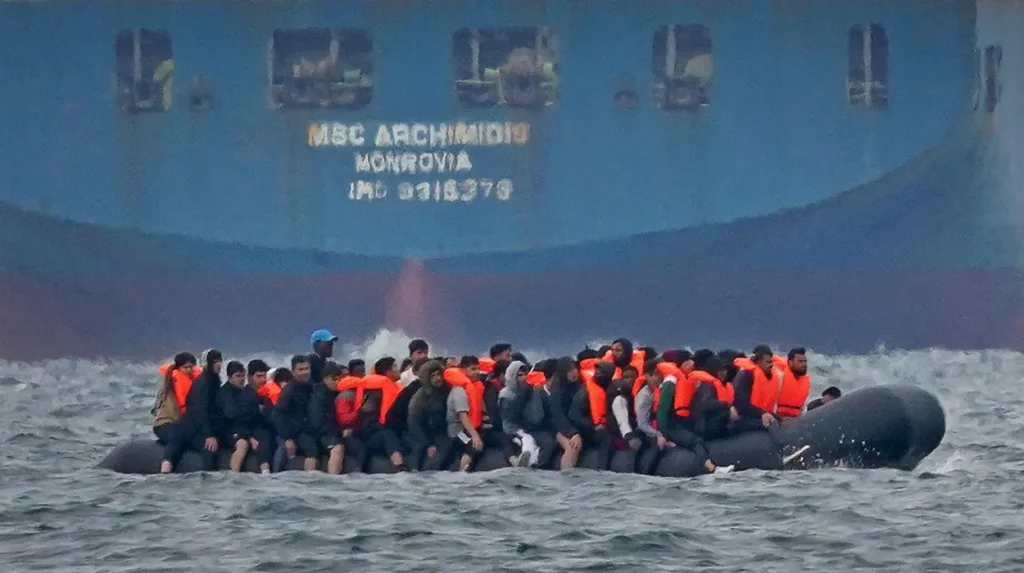
Over 170,000 migrants have taken to the Channel since 2018, and many have traveled in overcrowded boats that do not fit in the risky endeavor.
The figures indicate that even after enjoying increased financial resources, France is failing to stem the crossing of migrants effectively despite mobilizing more personnel on the ground.
Increased funding, limited results
The funding arrangement between Anglo and French stated in March 2023 was supposed to shift the game.
The deal was estimated at 480 million pounds and was expected to see the doubling of patrol officers on the French beaches, creation of joint command centers and construction of new facilities of the detention.
However, despite these efforts, France’s interception rate has dropped. In 2023, it was close to 47%. In 2024, it fell to 45%. By mid-2025, it had declined further to just over 38%.
So far this year, French authorities have intercepted 8,347 migrants. But 13,167 have still made it to UK shores.
Smugglers change tactics
One of the reasons for the falling interception rate is the shift in human smuggling methods. Traffickers now favor “taxi boats” that remain offshore rather than launching directly from the beaches.
These boats pick up migrants who wade out into the surf or are dropped off by vehicles. This offshore approach makes it harder for French police to make arrests, as their operations often become rescue missions.
Patrolling officers are forced to focus on saving lives rather than capturing traffickers or stopping the launches. This shift has undermined the impact of increased surveillance and staffing.
Weather conditions are a growing factor
UK Home Secretary Yvette Cooper recently highlighted another driver behind the increase. She said:
“The rise in crossings is partly due to more ‘good weather red days’ this year, creating ideal conditions for Channel attempts.”
These days provide safe visibility, lower wind speeds, and calmer waters. In 2025, they will become more frequent due to unusual spring weather patterns.
As a result, smugglers are timing launches to coincide with favorable days, making it harder for authorities to predict and prevent crossings.
Migrant demographics remain consistent
The majority of those crossing the Channel continue to be adult men, who made up 76% of arrivals in 2024.
Children under 18 accounted for 14%. Many women and minors come later, often through family reunification channels once the initial male family members are granted asylum.
This pattern reflects the high-risk nature of the journey, which tends to be undertaken first by younger, physically capable individuals.
Asylum applications show the complexity
Nearly all Channel arrivals file for asylum after landing. In 2024, 99% either applied individually or were dependents on other applications.
Small boat arrivals consistently account for 30% to 40% of UK asylum applications. In 2024, the UK recorded 108,000 asylum applications—the highest on record.
Interestingly, 40% of asylum seekers in 2024 entered the UK through legal means such as work, study, or visitor visas before applying.
This data reveals how migration routes into the UK are more diverse and complex than the Channel figures alone suggest.
Government responses intensify
UK Prime Minister Sir Keir Starmer has pledged a strong crackdown on smuggling networks. He has promised to “smash the gangs” behind Channel operations.
The UK has introduced criminal penalties of up to 14 years for trafficking-related offenses. Authorities have also rolled out travel bans and social media restrictions on known traffickers.
These steps reflect growing frustration over continued crossings and public concern about border security.
Despite tough talk, however, the results remain limited. The number of successful crossings continues to rise, and the enforcement gap is widening.
Daily data reveals unpredictable trends
Figures dated June, late 2025 provide a picture of how irregular the situation is now. June 30 was one of the busiest days of the year when 879 migrants crossed the Channel in 13 boats.
However, in comparison some days earlier in the same week there were no arrivals thus showing how reliant the crossings are on the wind and sea conditions.
On May 31 in 2025, the maximum number of migrants (1,195) crossed a day. This is nearly in the record with all time of 1305 that was recorded in September 2022.
These spikes create insurmountable pressure on the UK and French agencies based on finding resources to handle the arrivals in very short time frames.
Chris Philp calls for stronger cooperation
Chris Philp, UK Minister for Immigration and Borders, addressed the issue in a recent interview with a news channel.
He acknowledged the growing complexity of managing crossings and said:
“The government is determined to disrupt trafficking networks and improve border security through enhanced cooperation with France.”
Philp emphasized the need for joint action and long-term coordination between both countries to dismantle the systems enabling these crossings.
Illegal immigrants crossing the channel this year are the highest ever
— Chris Philp MP (@CPhilpOfficial) June 2, 2025
The French are not stopping these boats at sea, as the Belgians do
We should suspend the 12 year fishing deal until the French match their Belgian neighbours
In the commons today: pic.twitter.com/hCj4OtGjTt
Humanitarian pressure on coastguards
Alongside security concerns, the Channel crisis is also a humanitarian issue. French coastguards regularly rescue migrants from unseaworthy boats.
These rescue efforts save hundreds of lives each month but also drain resources from law enforcement efforts.
The immigrants do not belong to a single background but they are immigrants who come even as refugees and from politically unstable countries. People give varied reasons as to why they should make the trip and they include safety, economic prospects or even family reasons.
France, similarly to the UK, must deal with the challenge of having to strike the right balance between humanitarian requirements on the one hand and the necessity to exercise the rules on the border at the place.
Political debate heats up in France
Several voters and authorities wonder why the number of crossings is rising even though this is accompanied by rising funding and the number of the patrols.
Local leaders in Calais and Dunkirk have shown their frustration with some wanting sharper vision and central government involvement.
The editors have also landed up criticizing the conditions of detention and the way asylum seekers intercepted in France are treated by opposition lawmakers.
Why France is falling behind
Several reasons help explain why France’s approach is falling short despite recent investments.
First, the Channel’s geography poses unique challenges. Its narrow width, high traffic volume, and coastal topography allow smugglers to exploit access points quickly.
Second, favorable weather conditions are increasingly common. These leave loopholes which are normally grabbed by traffickers.
Third, the patrol numbers have increased twice, but the approach toward enforcement could not keep up in terms of innovation with smuggling. The use of offshore pickups and encrypted communication enables the traffickers to continue to work with increased impunity.
Finally, the legal framework complicates enforcement. Migrants intercepted at sea must often be treated as rescue cases rather than as illegal entrants, creating legal and procedural limitations.
A regional issue with global roots
The migrant crisis in the Channel is a trend in Europe. Increased violence in Sudanese as well as instability in sections of the Middle East and political oppression in regions such as Iran and Afghanistan are the causes of rising numbers of individuals searching for security.
Sea transport, as in the Channel and Mediterranean, is emerging as a major route of migration because EU countries close their land borders.
This is centred in France. The ports and northern coast of the country have turned out to be the major launching sites of migrants who want to get to the UK.
The path ahead requires coordination
In the future, we will have to increase collaboration. France and the UK need to exchange real-time intelligence, joint maritime patrolling and spend on higher surveillance technology.
Bilateral action and consent groups should not be restricted to funding but should be geared towards synchronization of operations, information exchange, and the persecution of abductors within common platforms.