In 2025, new smuggling networks’ tactics have resulted in unprecedented levels of migrants making the crossing in the English Channel. The evolution of so-called “taxi boats”, which pick up migrants who are already waist deep in water, has changed the scenario of illegal migration. Such a change, paired with positive weather conditions and the changing approach to enforcement, has initiated a new sense of urgency and complexity regarding the problem of border security, asylum, and humanitarian action in the UK.
The Scale of Channel Crossings in 2025
Channel crossings in the first half of the year of 2025 have been at all-time highs. In June, more than 15,000 individuals were already transported to the UK using small boats, an increase of 35 percent compared to the same period of 2024, as well as 95 percent in 2023. On 31 May alone, 1,195 migrants crossed in 19 boats, the most in a single day this year. This jump has been unstoppable, and the number of 10 every thousand was exceeded at the end of April, long before it happened in the previous years, at the end of May or the beginning of June.
The rate of arrivals has increased sharply. Small boat crossings reached a new record in the first five months of 2025, with about 14,800 crossings compared to 42 percent less in the same months of 2024. The number does not seem to retreat as 400 individuals in six boats landed on one day in June this year to bring the cumulative number to 15,212. Such numbers not only outline the magnitude of the challenge but also the flexibility of smuggling activities.
Who Is Crossing and Why
Most of the people who have taken the risky trip of crossing the Channel are men above 18 years old, making up around 76 per cent of all the arrivals in 2024. The percentage of the population that was composed of children below 18 has not been varying since it stood at 14%. The majority of the migrants seek asylum when they arrive there. In 2024, this was the case for 99% of the migrants, and the tendency will continue in 2025.
The reasons behind crossing the borders are also multidimensional, and go all the way up to escaping war and persecution, and to finding economic prospects. Several have made long journeys to Europe, where most tend to become exploited and work under difficult circumstances. Channel, with its perils, is considered to be the last obstacle to security or a new life in the UK.
The Rise of Taxi Boats
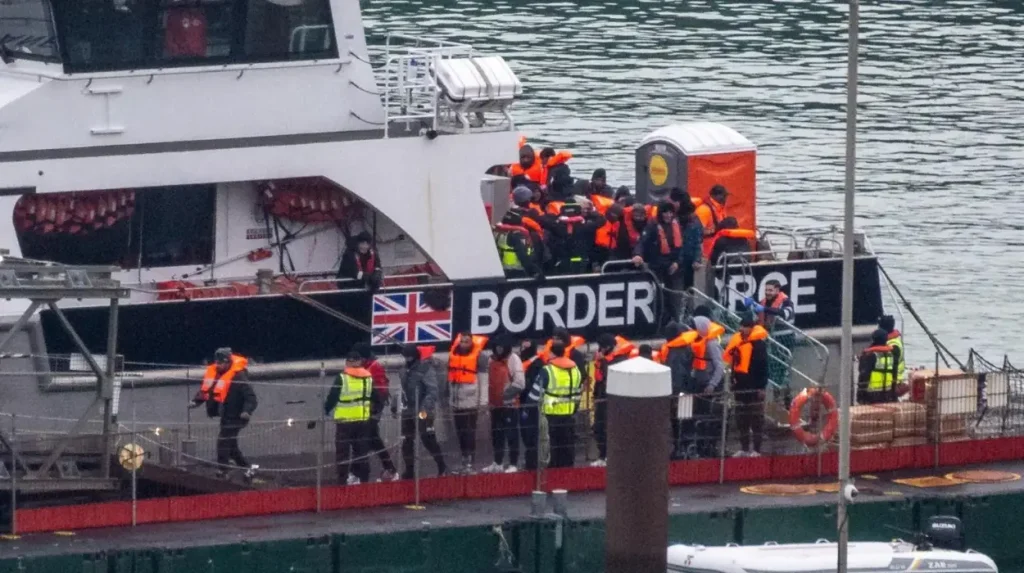
One of the most prominent trends apparent in 2025 is the popularization of so-called “taxi boats.” In contrast to the established launches off the French coast, these boats collect already floating migrants, who can be deep up to the waist, to prevent actions of the beach guards and surveillance. This is also one of the tactics to enable the smugglers to adjust to the pressure of law enforcement and interfere with the detection procedures.
The movement to taxi boats is the direct consequence of the combined UK-French move to crack down on the traditional launches and the interruption of the RHIB supply. The new method increases the difficulty for the authorities to thwart the departures, since the real place of embarkation is now offshore, and it is also not predictable.
Smuggler Networks and Their Evolving Tactics
Such smuggling gangs have proved to be very nimble-footed in reaction to enforcement. Currently, 55 migrants are captured on average per boat compared to 48 last year and 26 in the past administrations in 2025. There is a preference for bigger and more crowded boats, judging by the fact that some have more than 80 passengers. Such capacity boats increased by four times, raising the figure of eight boats in 2022 to 33 within the same year ending April 2025.
Utilization of taxi boats is the most recent accommodation. Smugglers are always changing the routes, launch points, and styles of boats in order to catch up with the authorities. It has also put the law enforcers at a disadvantage to get ahead of them and stop the crossing, as this is a dark horse game.
Government and Stakeholder Responses
The UK Home Office has been consistent in its policy to break up the people-smuggling gangs and control the border. “We are strengthening international partnerships and boosting our ability to identify, disrupt, and dismantle criminal gangs whilst strengthening the security of our borders,” a spokesperson said7. The government says it has a “serious plan” to bring order into the asylum system and is in search of changes to the legislature to impose heavier penalties on smugglers and limit asylum claims for many groups.
The Defence Secretary John Healey termed the scene of migrants being collected by the drug smugglers “like a taxi service”, as “shocking.” He urged the French authorities to up their efforts to detect the smugglers and ensure that migrants do not get into boats, but also at the coastline. The French coast guard is still picking up migrants who need help, but most of them do not want the help as they are heading to the UK. Some boats working to distress have radioed, and then, after being rescued by the authorities, some occupants refuse rescue and go on their way.
According to migration observers, the rise is caused not only by the high demand but also by the capacity of the smuggling networks to make adjustments fast. The bigger boats, combined with the tactics that are used by the taxi boats and the good weather, have created a problem in the ability to combat them.
Policy Shifts and Political Debate
The government’s reaction to the exploding number of channel crossings has been controversial. According to the Conservative Party, the rise is attributed to the Labour Party, since the decision to scrap the Rwanda deportation scheme will make deterrence lop-sided. The (new) Labour government can point to its new Border Security, Asylum and Immigration Bill, which comes with new criminal offences and counter-terror-like powers to police, including the Immigration Enforcement agency.
In March 2025, a UK-French “road-map” agreement was signed to enhance efforts on people smuggling. This comprises additional joint patrols, intelligence sharing, and coordination of operations. However, the dynamism of the tricks employed by smugglers is proving to be a challenge to the bilateral endeavors.
Asylum Outcomes and System Pressures
The UK asylum systems are overwhelmed by the arrival of small boat journeys. From January 2018 to March 2025, 154,354 small boat arrivals were reported, in which 145,834 asylum claims were made. Out of these, 86,646 claims (59%) were initially decided, based on which 66 percent were granted. But there are close to 30,000 individuals who are yet to receive a judgment, and more than 19,000 claims have been withdrawn.
In the same year, 2024, there were a record 108,000 asylum applications, of which small boat arrivals constituted 30-40 percent of all applicants. It is of note that 40 percent of asylum seekers in 2024 had legally entered the UK as workers, students, or visitors, and demonstrated that illegal crossings were a subset of the migration process.
Impact of Weather and External Factors
Some of the increased crossings come down to warm weather and calm waters, which increase conducive conditions for the journey, according to the officials. The crossing days have also increased twofold, which is another factor that has led to the surge. This seasonality aspect implies that the summer and fall months may even have more numbers.
Human Cost and Tragedies
The dangers of de Channel crossing are vivid. In March 2025, two of the migrants lost their lives in two days attempting the journey. The hazards are constantly present, and there are crowded boats, unstable weather conditions, and the fear of losing your boat through capsizing. Various rescues have been conducted by the French coast guard and emergency services in the UK, but it is the resolute nature of migrants and the cruelty of smugglers that trumpeted desperation and cried the loss of lives.
Social Media and Public Discourse
The problem has attracted a heated debate on social media. Mark Field, migration analyst in an interview with OpenEyeComms, said about the scene, “The shift to taxi boats shows just how quickly smuggling networks can adapt when enforcement tightens. It’s a game of constant escalation, and unless policy keeps pace, we’ll see even more dangerous crossings and more lives at risk.” Field’s remarks gained popularity and became a subject of spreading and conversation as people are worried about humanitarian and security aspects of the crisis.
'Taxi boats' pick up migrants in waist-deep water as Channel smugglers switch tactics (via https://t.co/urcWV02iYp)
— Mike Alderson FRSA (@OpenEyeComms) June 18, 2025
As the weather in the Channel clears, the French police are struggling to halt a potentially record-breaking surge of people from reaching the UK in small boats… pic.twitter.com/iEbxyFdaJT
International and Local Reactions
Internationally, the rise in Channel crossings has strained UK relations with France and ignited questions about a more comprehensive migration policy in Europe. The UK’s approach to deterrence and enforcement has been matched by requests for greater cross-EU action against trafficking networks, although more concerning may be the local and regional communities in Kent and along the south coast that continue to face the local impacts of greater arriving numbers. Sustainable local systems, housing services, and the asylum system capability remain a topic for debate, while at the same time, there continues to be calls from humanitarian aries for safe and legal routes as a means of mediating deaths at sea and mitigating the need for reliance upon traffickers and smugglers to escape early.
The escalation in crossings from 2025 onwards, particularly with the use of taxi boats and greater latitude adopted by smugglers in their push to evade detection, illustrates the increasing complexity of irregular migration. Numbers have reached record levels, enforcement strategies have struggled to keep pace, and the trade-off between ideological policy solutions has rarely been so fervent. For the UK and its stakeholders, the overriding challenge has been to catch and respond to developments in each case just as quickly as those who seek to exploit change, grappling with mechanisms of border security and humanitarian responses in consideration of the changing landscape.