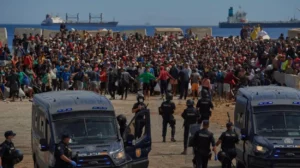
In June 2025, one of the largest immigration crackdowns in recent French history was begun, with 4, 000 police, gendarmes, customs representatives and sentinelle forces dispatched to main transport nodes across France. The stated goal: to suppress the illicit migration, break the chains of the smugglers and put at bay the major ground transportation hubs such as the Gare du Nord in Paris or the Charles de Gaulle Airport among others who were in a mess.
This extraordinary use of military force comes into play when people are getting more worried about the safety of the borders, newly awakened terrorism, and augmented movements in irregular migration within Europe. It has however attracted an intense debate in its course of operation. Is it sound border protection or does it amount to a threat of violating the rights and dignity of the vulnerable migrants?
Quelque 4.000 membres des forces de l'ordre sont depuis hier jusqu'à aujourd'hui en opération de contrôle nationale contre l'immigration illégale dans les gares et les bus, a annoncé le ministre de l'Intérieur. "Le signal, c'est de dire à tous les candidats à cette immigration… pic.twitter.com/fhaqEBHby1
— Agence France-Presse (@afpfr) June 19, 2025
Operation: Scope, Strategy and Political Context
Large scale implementation and nationwide scanned checks
On June 18, 2025, Interior minister Bruno Retailleau announced that 4,000 law enforcement agents would be deployed during two days to conduct the intensive checks of the stations, trains, and buses12. The operation is the first national effort of its kind as part of a larger “global review” of France border controls and terrorism policies. Officers are given the role of tracing and arresting migrants lacking the requisite documents into custody where they face detention and deportation processes.
Retailleau emphasized the scale and urgency:
“In these 48 hours, we will mobilise 4,000 gendarmes, police, customs agents and sentinel forces to arrest immigrants without papers.”
Security and Economic Drivers
The security and economic forces make it a crackdown. France remained to have undergone several instances of terrorism in the last few years which has increased the urge of the people to tighten the immigration control3. According to the officials, not all asylum seekers can be vetted correctly, posing a security threat. France is economically spending an expenditure of 3.3 billion dollars yearly in migrant welfare initiatives such as shelter and meals.
With inflation rising, the government has decided to cut migrant support by 20% and ramp up deportations by 25%, targeting 150,000 undocumented immigrants for removal in 2025—most from Algeria, Morocco, and Tunisia.
Legal and Administrative Measures
A policy note from the Interior Ministry instructs regional police chiefs (préfets) to “go as far as [they] can” under current law to address irregular migration. The threshold for deeming an irregular migrant a “threat to public order” has been lowered, and police are encouraged to prioritize detention before return. Migrants found guilty of criminal activity may have temporary residence permits withdrawn, and the risk of absconding is now sufficient to justify detention for up to 75 days, potentially followed by house arrest until deportation.
Border Controls and the Schengen Zone
Reinstating and Extending Border Checks
France’s crackdown is not limited to internal transit hubs. Since November 2024, the government has reinstated border controls with all six Schengen neighbors—Belgium, Luxembourg, Germany, Switzerland, Italy, and Spain—citing “serious threats to public policy, public order, and internal security posed by high-level terrorist activities, the growing presence of criminal networks facilitating irregular migration and smuggling, and migration flows that risk infiltration by radicalized individuals”.
These controls, initially tied to the 2024 Olympic Games, have now been extended until at least April 2025, marking the most widespread resumption of checks since the Schengen zone was created.
Prime Minister Michel Barnier stated:
“The public expects us to have an effective policy to control immigration.”
Stakeholder Perspectives: Security, Rights, and Social Impact
Government and Police
The French Interior Ministry frames the operation as a necessary response to security threats and criminal networks:
“This unprecedented deployment of 4,000 police officers is necessary to restore order at transport hubs and combat illegal migration networks that exploit vulnerable people.”
Police unions echo the sense of urgency, emphasizing the need for public safety and law enforcement’s role in upholding the law.
Human Rights and Civil Society
Left-wing politicians, trade unions, and migrant advocacy groups have condemned the operation as xenophobic and scapegoating the most vulnerable:
“A xenophobic operation taken as the most precarious scapegoat among the precarious.”
Human rights organizations warn of the risk of abuses, lack of access to asylum procedures, and the psychological toll on already traumatized migrants. They highlight France’s obligations under EU and international law to ensure humane treatment and due process.
UK and European Partners
The UK Home Office welcomed France’s efforts, citing the need for enhanced cooperation to tackle cross-Channel migration and secure shared borders. European officials, however, have expressed concern over the repeated extension of border controls, which some argue violate the spirit if not the letter of the Schengen Borders Code.
Current Migration and Security Cases in 2025
Entrance of migrants and crossings of the channel
In 2025, there was also a sustained increase of irregular migration in France, as thousands tried to cross the English Channel in small boats or smuggled in vehicles. Violence among migrants and confrontations with the police have risen in northern coasts such as Dunkirk and Calais, leading into uneasy and unsafe encirclements6.
Security Threats and Terrorism
The government uses continual threats of terrorism as reasons why they need tougher controls. In January 2025, the foiling of a possible terror attack by people who had entered France illegally, provoked political ardor to take stringent actions among the people36. A constant threat of radicalized individuals making infiltration is one of the main arguments of the ongoing crackdown.
Efficiency and Dangers: The Hard Truth
Is Large-Scale Policing a Deterrence to Irregular Migration?
The proponents claim that large-scale policing visible to the smugglers at transport hubs can deter the smugglers and counter the irregular flows. By placing emphasis on major transit hubs, the officials expect to disrupt the infrastructures which support illegal crossings and to make a powerful message to those potential migrants and human traffickers.
Critics however are doubtful of the long term effectiveness of such operations. The history of the crackdowns is frequently the story of displacement and not solution as it forces migrants to resort to riskier forms of transportation or more refined smuggling rings. The detention and deportation focus can also decongest the administrative and judicial systems causing backlogs and court confrontations.
Human Rights and Social Cohesion
The greatest threat is posed to human rights. The rather high politics of policing, mass checks, and detention may cause racial profiling, unwarranted detention, and access denial to asylum procedures. The psychological effect on migrants, which are mostly people who have sought refuge due to war, persecution or even poverty is extreme and the operation threatens to stigmatize groups who are already on the fringe.
Social groups caution that these policies may cause the fraying of social cohesion and will exacerbate xenophobia when migrants are openly declared as threats to state order or national protection.
Constriction of Schengen System
The constant extension of border controls has made French authorities concern their neighbors and raises warnings in Brussels. Even though the Schengen Borders Code provides the possibility of temporary controls due to the exceptional circumstances, opponents say that France utilizing this tool almost continuously since 2015 marks a dangerous precedent as well as a blow to the very concept of free movement in the EU46.
Security at the Price of Border Security?
The events that curl around a 4,000 strong crackdown of illegal migrants in transport hubs in France is a defining turn of historical events in France in terms of migration, security and human rights. On the one hand, the operation indicates the real anxiety behind terrorism, smuggling, and the maintenance of order; on the other hand, it brings to the fore the underlying conflict between frontier control and security of basic rights.
It remains to be seen whether these mass police operations will bring sustainable security or whether Europe is becoming more divided, destabilized by European unity and continuing to put the most weak at risk. In 2025, migration proves to be a reality in France and the neighboring countries, with the question of balanced effective border protection and human dignity as disputed as it is critical.