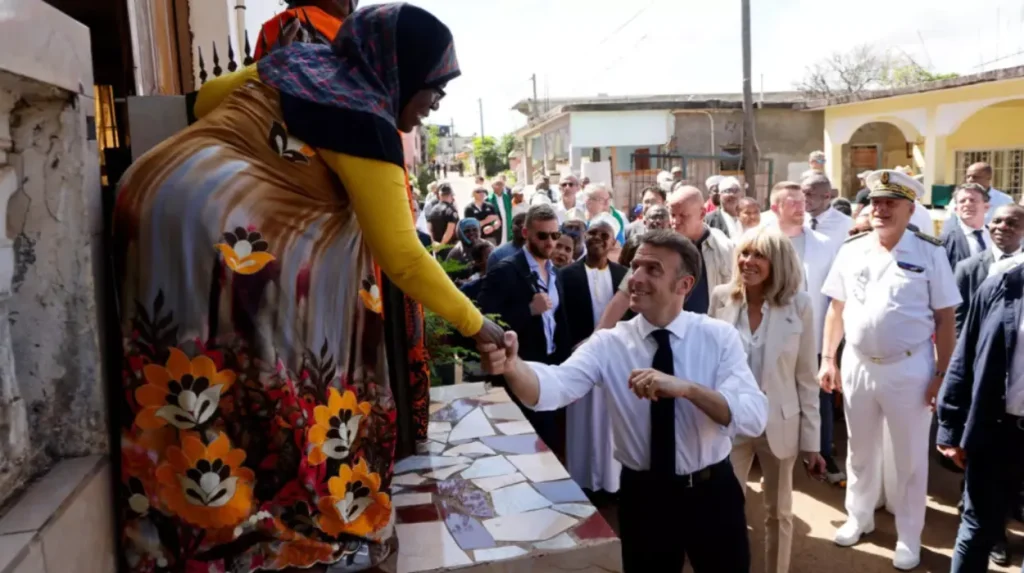
On Monday, French President Emmanuel Macron visited Mayotte, an Indian Ocean territory inhabited by 320,000 people, to announce fresh promises of reconstruction aid alongside a commitment to combat illegal immigration. This time, Traditional songs and dances greeted him upon his arrival, a stark contrast to his previous visit during which he faced angry, distraught residents impacted by a severe cyclone.
Although daily life is getting better, the aftermath of Cyclone Chido in December still overshadowed Macron’s recent visit to this archipelago near Madagascar, which is the most impoverished area of France. Mayotte experienced its most devastating cyclone in a century, claiming dozens of lives, injuring over 2,000 people, destroying homes, and disrupting power, communication, and water supplies.
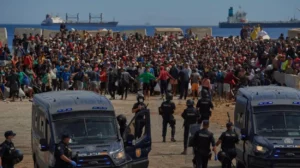
Following a polemic visit in December, he exerted caution during his visit of Mayotte on Monday. He made fresh pledges for reconstruction aid sought at the territory’s 320,000 citizens and committed to improve efforts against illegal immigration. French authorities calculate that about 100,000 migrants are living in Mayotte, many of whom live in tin-roof shantytowns that are sensitive to being flattened by hurricanes.
The drinking water network is operating normally again, albeit with sporadic disruptions due to ongoing production problems that frequently left Mayotte parched even before the cyclone. Electricity and telephone service have also been restored.
The people of Tsingoni, a community famous for having the oldest mosque in France, which is thought to be centuries old, continue to turn to their mayor for assistance with renovation. Some houses still require complete rebuilds or roof replacements.
During the president’s visit to Tsingoni, Mayor Issilamou Hamada expressed concern that residents might “overflow” with emotions. While conversing with the local community, some residents informed Macron that his previous commitments remained unfulfilled.
“We feel isolated. I threw away everything; my nursing course was run from home. The roof is destroyed, and I no longer have a computer. I’ve been compelled to work from my phone ever since,” stated Siti Madi, who now uses a temporary office in a neighboring village.
Residents convey that banks have not begun delivering the promised zero-interest loans for reconstruction. Authorities are cautioning about health risks as debris from the cyclone remains uncleared. Additionally, the department is facing its first cases of chikungunya cases, a mosquito-borne illness. French president attempted to propose reassurance to all.
“Is everything resolved? Not yet; we are currently in a stabilization phase. There are valid concerns and numerous aspects that require enhancement. We are actively working to address these issues,” he stated.
Following his visit, the government introduced two bills that offer tax incentives for businesses and propose the creation of a reconstruction framework, similar to the one established by Macron for the restoration of Notre Dame Cathedral in Paris.
Macron estimated the reconstruction cost at €3.2 billion, admitting that the funds “will not be enough to solve all of Mayotte’s problems. ” Mayotte is familiar with challenges and grand promises from distant Paris.
Ben Issa Ousseni claims that the suggested legislation “does not yet fulfill the aspirations of the Mahoran residents. ” He emphasized his commitment to advocate for additional measures, such as a long-awaited runway extension at Pamandzi Airport, which is intended to enhance tourism and spur economic growth.
French president voiced his readiness to address the differences between Mayotte and mainland France. The minimum wage and pensions in Mayotte are lower compared to other regions, yet the cost of living can be higher due to its reliance on imported goods and services.
He restated promises to a program aimed at denying illegal immigration to Mayotte, comprehended as ” Oura wa chaba.” This initiative seeks to expedite the prevention of migrant arrivals from the Comoros Islands, Madagascar, and Tanzania, where individuals escape poverty or conflict situations in other parts of Africa.
Macron upheld a rule preventing foreigners arriving in Mayotte from moving to other parts of France, referring to Mayotte’s “deeply abnormal migration situation. ” The president then visited the French territory of Reunion, where he revealed new tax incentives aimed at stimulating the local economy.