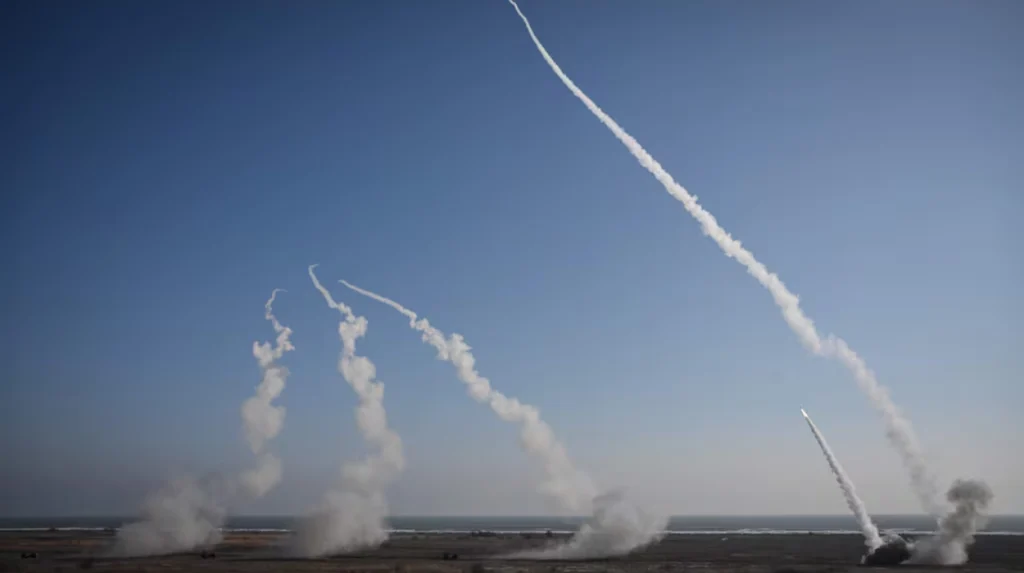
France aims to field-test a domestically developed rocket artillery system by mid-2026 as a potential replacement for the U.S. High Mobility Artillery Rocket System, or HIMARS, in a development that could provide a window of opportunity for allies who want a European capability.
The French General Directorate for Armament is seeking to determine the technical solutions that will allow a demonstration firing in twelve months’ time, the defense-procurement agency replied to Defense News in writing to questions. The DGA is partnering with a Safran-MBDA and a Thales-ArianeGroup consortium to create a tactical strike capability at the 150-kilometer range.
France has a short time left to replace its Lance-Roquettes Unitaire, an upgraded variant of the M270 multiple launch rocket system, with the Army’s nine remaining systems reaching the end of their service life in 2027.
Legislators and military officials have been urging to create a domestic alternative instead of purchasing overseas, in accordance with French policy of independence in defense affairs. “Service withdrawal of the LRU is imminent, and maintenance of the capability will be a matter at that time,” stated Léo Péria-Peigné, an analyst at the Paris-based Institut Français des Relations Internationales specializing in armament potential.
“Relative urgency – we have scarcely ever employed this capability in the last 30 years.”
Safran and MBDA are on schedule for the “ambitious” DGA timeline, affirming their goal for a test firing in mid-2026, they stated in a joint release to Defense News. Thales and ArianeGroup did not speak to timing, with Thales stating the companies have been working as an integrated team for some months to provide a “pertinent solution” for the military.
France’s 2024-2030 defense budget plan has allocated €600 million to the rocket-artillery program, known as Frappe Longue Portée Terrestre or FLP-T for short, with a target of acquiring at least 13 systems by 2030 and 26 systems to outfit a battalion by 2035. The timeline to replace the LRU “is going along normally” and according to the timeframe established by the defense budget law, the DGA said.
In the meantime, there’s always the foreign buy option in case it takes too long. That’s a decision scheduled for next year, the directorate indicated. The long-range tactical strike capability is “needed” and a niche that should be filled, according to French Army Chief of Staff Gen. Pierre Schill during an October hearing, as numerous other European nations possess a rocket artillery capability.
Europe has no home-grown HIMARS equivalent, and European militaries buying rocket artillery over the last few years either chose the U.S. model, Israel’s Elbit Systems’ PULS launcher, or Hanwha Aerospace’s Chunmoo. Elbit is collaborating with KNDS on a Europeanized PULS, and Germany’s Rheinmetall and Lockheed Martin in 2023 partnered to create the GMARS system.
Besides France, other European nations with rocket artillery still up for grabs are Sweden and Norway. The Netherlands, Germany, Denmark and Spain had already selected PULS, Poland bought Chunmoo and HIMARS, while the Baltic states, Romania and Italy are customers of HIMARS. And while the U.K. is contemplating adding to its M270 multiple launch rocket system fleet.
That leaves a slim commercial window for rocket artillery developed by France, however, although an effort by the executive branch of the European Union to urge member states to spend more of their defense budgets within the EU’s 27-nation bloc could be a tailwind for a European solution.
Safran and MBDA stated their rocket-artillery system, Thundart, is founded on “mature and mastered subsystems,” and an initial operational capability might be delivered prior to 2030. In the already crowded marketplace, “there will be no export market for a French system that will not be ready before 2030,” Péria-Peigné stated.
The DGA finalized innovation partnerships with the two consortiums in November, providing a first round of financing for the FLP-T program. The partnership contract gives the procurement office the possibility of purchasing the system at the conclusion of the development phase without a new competitive bid, assuming the armament is compliant with performance specifications.
Innovation partnership involves an “important level of self-finance” on the part of the industry, Safran Electronics & Defense Chief Executive Franck Saudo told a parliamentary hearing in November.
Each consortium will conduct a firing of its demonstrator, then the French government will make a decision, the DGA stated. After the conclusion of the existing 18-month contracts, the consortiums will propose a solution which will enable the government to select among several options, including off-the-shelf equipment, as per the directorate.
DGA chief Emmanuel Chiva had informed the Sénat foreign affairs committee in November that if the industrial partners would “work well,” the first orders could be placed in late 2025 or early 2026. That now seems to have been delayed by several months.
Safran and MBDA stated that the geopolitical environment and evolving artillery needs underpin the appeal of an independent solution for France, as well as for other European nations, of a rocket artillery system designed and produced in Europe without U.S. arms-trade controls, and with autonomous manufacturing ensuring control over production rate.
The companies commenced collaboration in the design of the new system in late 2023 and unveiled a model of their Thundart 227 mm long-range guided-artillery rocket at the Eurosatory defense exhibition in June 2024, as a stepping-stone in the FLP-T program. The rocket boasts 150-kilometer precision, which Matthieu Krouri, MBDA’s head of land combat systems, says.