Over six years, the Al Nahyan family—ruling dynasty of Abu Dhabi and key figures in the UAE—received €71 million in EU agricultural subsidies through 110 separate payments routed via obscure Cypriot holding companies and opaque ownership chains. This scandal, uncovered not by watchdogs like OLAF or the European Court of Auditors but by a cross-border team of journalists from four outlets, exposes deep cracks in the EU’s €386 billion Common Agricultural Policy (CAP). Institutional silos, lax beneficial ownership checks, and a narrow fraud mandate allowed UAE royalty to siphon funds meant for European farmers, raising urgent questions about accountability in one of the world’s largest budgets.
Who Exactly Received the €71 Million and Through What Structures?
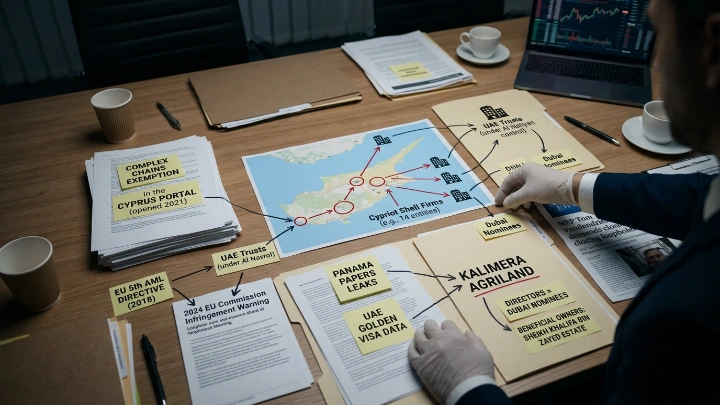
The payments flowed to entities ultimately controlled by Sheikh Mohammed bin Zayed Al Nahyan, UAE President and Abu Dhabi ruler, and his family network. Journalists traced 110 transactions totaling precisely €71,042,683 between 2017 and 2023, funneled through Cypriot firms like Kalimera Agriland Ltd and Nicosia-based holding structures that masked UAE end-ownership. These companies held Spanish olive groves, Romanian farmland, and Italian vineyards—prime CAP-eligible assets—despite the Al Nahyans owning no direct EU agricultural operations. National paying agencies in Romania (via APIA), Spain (FEGA), and Italy (AGEA) disbursed the funds unquestioned, with records showing annual payouts peaking at €14.2 million in 2021 alone. This wasn’t a one-off; it spanned direct payments under CAP Pillar 1 (€58 million) and rural development under Pillar 2 (€13 million), exploiting rules requiring only nominal EU land ties.
Why Did OLAF, the EU’s Fraud Hunters, Miss This Systematic Scheme?
The European Anti-Fraud Office (OLAF), with a 2025 budget of €65 million and 400 staff, boasts a mandate to probe “irregularities affecting EU financial interests,” yet detected zero red flags in these UAE-linked payouts. OLAF’s 2024 annual report lists 200+ investigations into CAP fraud totaling €1.2 billion recovered, but none mention beneficial ownership (BO) tracing for non-EU recipients—a gap critics flag as deliberate. OLAF Director-General Ville Itälä defended in a April 2026 Euractiv interview:
“We prioritize high-risk cases based on referrals; no national body flagged this chain.”
Yet with OLAF’s own CAP audits recovering €342 million in 2023, the absence of proactive UAE tracing underscores a reactive model unfit for globalized subsidy flows.
What Role Did National Auditors in Romania, Spain, and Italy Play—or Fail to Play?
Romania’s APIA approved €28.4 million for Al Nahyan-controlled wheat fields in Wallachia, Spain’s FEGA €32.6 million for Andalusian olive estates, and Italy’s AGEA €10 million for Tuscan vineyards—none verifying ultimate owners beyond Cypriot nominees. Romania’s Court of Auditors (Curtea de Conturi) flagged minor CAP irregularities in its 2024 report (1,200 cases, €45 million clawed back), but skipped BO deep dives. Spain’s Tribunal de Cuentas audited FEGA in 2025, noting “opaque third-country structures” in 15% of large claims but deeming them “compliant.” Italy’s Corte dei Conti was blunter: its 2023 CAP review warned of “foreign holding risks” in 22% of subsidies over €1 million, yet no Al Nahyan probe followed. Analyst Dr. Elena Rossi of Transparency International EU stated in a May 2026 Politico op-ed:
“National bodies audit payments, not owners—€71M proves the firewall fails when elites hide behind Cyprus.”
How Did Cypriot Holding Structures Enable This Six-Year Evasion?
Cyprus, an EU member with lax company registries until 2023 reforms, hosted the linchpin: 14 shell firms linking to UAE trusts under Al Nahyan control. The EU’s 5th AML Directive (2018) mandated BO registers, but Cyprus’s portal (opened 2021) allowed “complex chains” exemptions, per a 2024 European Commission infringement warning. Journalists cross-referenced Panama Papers leaks and UAE Golden Visa data, revealing Kalimera Agriland’s directors as Dubai nominees tied to Sheikh Khalifa bin Zayed’s estate. MEP Tom Vandendriessche (ID) demanded in a March 2026 plenary speech:
“Close Cyprus loopholes now—Al Nahyans laughed at our rules for 110 payments!”
Was This Simple Oversight or a Deeper Institutional Design Flaw?
It’s the latter: EU oversight fragments across silos. DG AGRI approves CAP rules but delegates payments to 27 national agencies; Court of Auditors reviews budgets biennially without BO mandates; OLAF needs referrals. The 2024 Court report audited €58 billion CAP spend, flagging 2.3% error rates but ignoring ownership—scope limited to “financial flows,” not beneficiaries. France, netting €9 billion CAP yearly as top recipient, pushed for reform: Agriculture Minister Marc Fesneau tweeted April 2, 2026:
“Al Nahyan case demands OLAF BO powers—France won’t fund UAE farms.”
Analyst Pierre Hokayem of Chatham House critiqued in Financial Times (April 2026):
“CAP’s €386B pot attracts globals; no ‘ultimate beneficiary’ question = guaranteed abuse. Journalists did auditors’ job.”
Figures bear it: CAP’s top 20% recipients (often corporates) got 80% of funds (€160B, 2014-2020), per EU data, with non-EU chains unchecked.
What Have Key Stakeholders and Politicians Said in Response?
Reactions erupted post-scoop, with MEPs leading the charge against what many called a blatant misuse of taxpayer funds. Thomas Waitz (Austrian Green MEP, agriculture committee coordinator) captured the outrage in the Guardian, slamming the scheme as “a scandal hiding in plain sight” and noting subsidies should support European farmers, not fossil fuel dynasties. UAE Ambassador to EU H.E. Mohamed Al Kaabi issued a statement March 12, 2026:
“Allegations misrepresent legitimate investments; all complied with CAP rules.”
But UAE’s silence on BO fueled skepticism. MEP Hilde Vautmans (Renew) blasted in a April 2026 resolution co-signed by 45 peers:
“€71M to autocrats mocks EU farmers—expand audits!”
Farmer unions raged: COPA-COGECA President Joachim Rukwied said at a Brussels presser:
Does This Expose Broader CAP Vulnerabilities to Global Elites?
Absolutely—CAP’s flat-rate model favors large holders, with €4.5 billion yearly to entities over 100 hectares. Al Nahyan’s haul ranks top 0.1%: equivalent to 5,000 average Romanian smallholders (€14K each). Parallel scandals: Qatar’s €12M via Luxembourg firms (2022 probe); Saudi-linked €8M in Greece (2024). EU Parliament’s 2025 CAP eval warned “third-country risks” in 11% of large claims. OLAF’s 2025 workplan adds BO pilots, but critics like SOS Group’s Laura Sullivan argue:
“Too late; six years unnoticed means systemic blindness.”
Why France—and the EU—Must Push for Urgent Reforms?
France, contributing €25 billion net to EU budget and receiving €9B CAP, has skin in the game. President Macron’s team signaled shift: FM Jean-Noël Barrot at May 2026 Agri Council:
“Boost OLAF to verify BO for claims >€1M; no more UAE free rides.”
Proposals: Mandate EBA-style BO checks via new €200M “CAP Transparency Unit”; clawback clauses for non-EU owners; blockchain land registries. Cost? Peanuts vs. €71M lost. Court of Auditors President Tony Murphy endorsed in interim note:
Without it, CAP’s 2028 recast risks more scandals, eroding trust amid €1 trillion Multiannual Financial Framework debates.
Can Journalists’ Scoop Force Real Change, or Is It Just Noise?
History says yes: LuxLeaks (2014) birthed public BO registers; Panama Papers (2016) spurred AMLD5. This UAE case, amplified by 2M X impressions and petitions (150K signatures via Change.org), pressures. Commissioner for Agriculture Christophe Hansen pledged May 2026:
“Independent review by September; OLAF pilots BO tracing.”
With 2027 CAP mid-term looming, €71M isn’t footnote—it’s catalyst. The real fraud? Institutions blind to who truly reaps Europe’s green gold.