Defiance has been replaced by cooperation at the start of the second Trump administration. The Democratic Party leaders have provided little more than cliches and flimsy banalities, while Donald Trump has swiftly and mercilessly plunged the federal government into unheard-of disarray. “Presidents come and leave office. All the way through. After Trump’s first week in office, House minority leader Hakeem Jeffries tweeted, “God is still on the throne.”
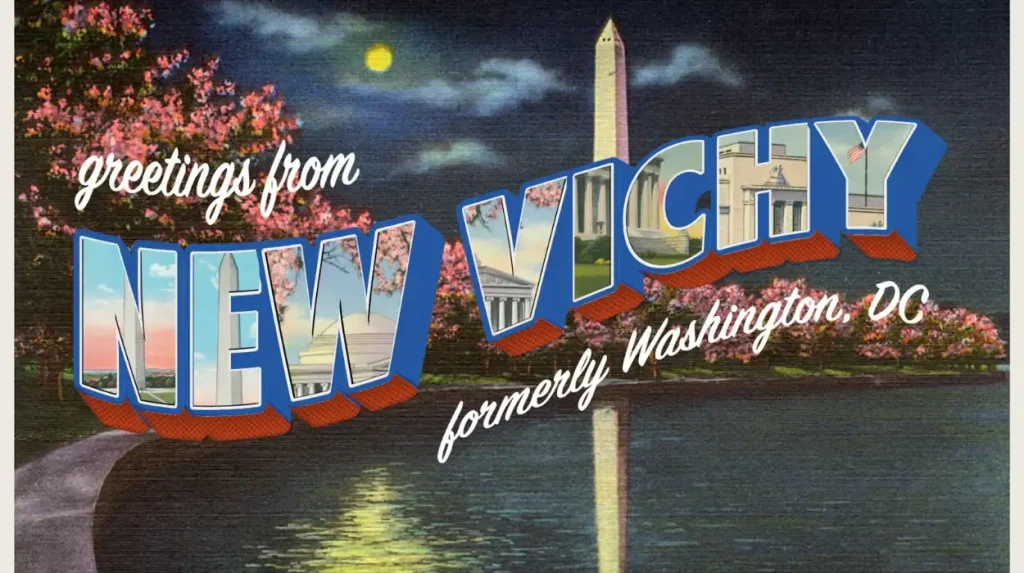
This act of surrender has given rise to a new historical comparison, or at the very least, a new insult, for liberals and leftists who had hoped to see the opposition party present some sort of challenge to Trumpism. The resistance is no more—greetings from Vichy, France.
In a Substack email on January 21, left-leaning author John Ganz stated,
“If you want an analogy for the current state of America, it’s perhaps not an out-and-out fascist regime, but a Vichy regime.”
It is mostly a conservative and defeatist catch-all, with a hint of fascism. The longstanding institutions of a great democracy, whose supporters proved to be elderly, gradually and abruptly collapsed, giving rise to this government.
What was France’s role in World War II?
Ganz wasn’t the first to bring up the collaborationist government that ruled over a portion of France following Germany’s swift and stunning victory at the start of World War II. The political cartoonist Ted Rall rewrote their Oval Office meeting as an updated version of the famous handshake between Adolf Hitler and Philippe Pétain. They signaled the end of France’s Third Republic and the beginning of the Vichy era in November, following Joe Biden’s welcoming of Trump back to the White House and his assurance of a “smooth transition.”
The rump state that ruled over the remaining areas of France following the German invasion in 1940 is Vichy France. When Hitler’s forces burst through the French defenses in a couple of days and started to march on Paris, it was a major shock. France had defended itself valiantly over years of trench warfare during the First World War. Given the government’s precarious state and the military’s imminent collapse, some French leaders advocated for the army to withdraw to North Africa so that it could reorganize and continue fighting. While others, who thought a German victory was certain, contended that an armistice would protect the French people and their captured soldiers.
What transpired in France between the armistice and the liberation?
In the end, Marshal Petain, a cherished First World War hero, was the one who signed the armistice with Hitler. It stipulated that Petain’s government would run the southern half of France from the spa town of Vichy and that it would not be occupied by the Germans. Even though Germany finally took over all of France, Petain continued to serve as the Vichy government’s titular leader until the end of the war, when he was detained, put on trial, and convicted of treason.
Long-running historical and political discussions would center on what transpired in France between the armistice and the liberation. The extent to which the French people’s suffering and the expulsion and murder of 75,000 French Jews were caused by France’s leaders.
The Vichy dictatorship, which sheltered the populace from the worst of Nazi Germany’s tyranny while waiting to rejoin the battle on the side of the Allies, was remembered by the French after the war. However, that fantasy was dashed by American historian Robert O. Paxton, whose groundbreaking 1972 book Vichy France exposed the unsettling reality. The Vichy leaders had voluntarily worked with Germany and that many of the worst aspects of the regime. The anti-Jewish laws enacted in 1940 were the result of antisemitism and right-wing domestic politics unrelated to Germany.
France’s defense from Petain and Vichy
Though France’s far-right continues to defend Petain and Vichy, the country’s president had formally admitted and apologized for France’s role in the Holocaust by the 1990s. The far-right French TV commentator Eric Zemmour made a false claim that Pétain “saved” France’s Jews as part of his 2022 presidential campaign. Zemmour was one of the “creme de la creme of the world’s nationalist reactionaries” invited to Trump’s inauguration.
Fishman vehemently disagreed with the notion that Democrats were Vichyists for “going along with the peaceful transfer of power,” agreeing that the conditions and politics of the Vichy government are very different from those of modern-day US politics. However, she noticed similarities between Vichy’s actions and those of erstwhile anti-Trump politicians and corporate executives like Mike Johnson and JD Vance.