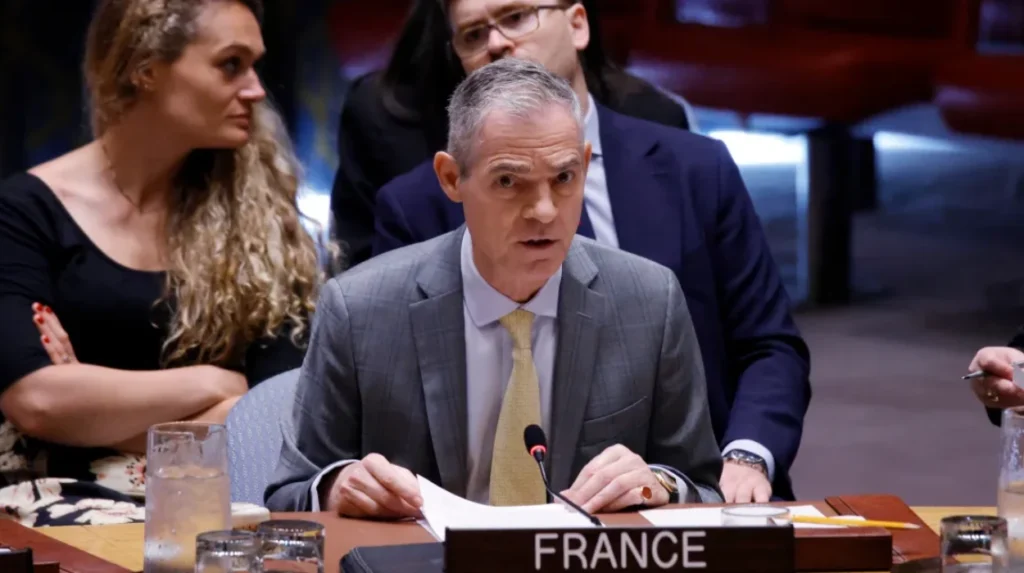
A rare and highly visible diplomatic clash between two of the West’s closest allies played out at the United Nations on Monday, when U.S. diplomats walked out of a Security Council meeting as French representatives were speaking. The protest came after France criticized the Trump administration’s human rights record, turning a routine multilateral session on Ukraine into a public display of transatlantic friction.
This particular episode is important not only in light of the symbolic exit of American diplomats from the room but also due to the growing deterioration of the atmosphere between the two nations. In terms of diplomacy, the walkout is not something casual but rather a message of great importance. In this case, the message was quite clear – the United States was not going to stay and listen to the political criticism coming from one of its closest allies.
What Triggered the Walkout
The immediate cause was France’s criticism of the human rights record of the Trump administration, which was made in the backdrop of the U.N. Security Council discussion about Ukraine. France made use of the opportunity in order to pose doubts about whether the United States continues to maintain the moral high ground in international politics. This alone was sufficient to make the U.S. team abandon the proceedings.
The criticism from France carried weight, since it was not just an opposition to a particular policy position but was also a challenge to the United States as a credible advocate of human rights. This is indeed a strong charge when it comes from a nation which is a key player in NATO and the U.N. system.
The walkout therefore became more than a protest. It became part of the message itself. By leaving the room, U.S. diplomats made clear that they considered the French remarks not just unfriendly, but unacceptable within the setting of an already sensitive Security Council discussion.
France’s Sharp Criticism
France’s intervention was unusually blunt for a close ally. In a public post ahead of the meeting, the French Mission in Geneva said the U.S. once served as a global “beacon of human rights” but that this was “not anymore,” placing Washington in the company of governments such as North Korea, Nicaragua, Mali and Russia. That statement was not a routine diplomatic complaint. It was a direct moral challenge aimed at the Trump administration’s image abroad.
This French message had a double significance in political terms and symbolism as well. In comparing the US government to the authorities in the most secluded or authoritarian countries in the world, France was conveying its view that the US government had moved away from the promotion of democratic values. The use of this provocation is clearly deliberate as it appears that the French government wanted to deliver such a message. France also maintained that the US could not have the same weight in influencing world discussion on human rights and governance as it used to have before.
U.S. Response at the U.N.
The American response was equally forceful. U.S. deputy ambassador Dan Negrea accused France of “disingenuous grandstanding” and said Washington would not listen to what he called “politicized drivel” until Paris dropped what he described as
“condescending and disrespectful rhetoric.”
Those remarks signaled that the U.S. viewed the French intervention not as principled criticism, but as performative lecturing.
The striking thing about Negrea’s choice of words is how far it went beyond the usual careful language in multilateral diplomacy. Instead of trying to reduce tension, he escalated it. This put the American reply in a very different light – it no longer sounded like damage limitation, but rather like a strategic blow intended to show that the US would not stand for moral reproach from a NATO ally in such a public way. In addition, the US ambassador to the UN, Mike Waltz, contributed to the controversy by stating on X that France is cuddling up to some of the worst human rights abusers in the world.
It is disappointing – though not surprising – that this is how France deflects on its shameful vote to coddle some of the worst human rights abusers.
— Ambassador Mike Waltz (@USAmbUN) July 26, 2026
France voted for someone who has been lecturing, free, sovereign democracies like the United States, the UK, and Israel, while… https://t.co/m6zxE95d5l
This fits into the US narrative in which France and other European nations are accused of selectivity in their moral outrage, voicing loudly about rights in some cases and staying silent in others.
The Human Rights Vote Behind It
The confrontation was also tied to a separate but closely related U.N. issue: the reappointment of U.N. human rights chief Volker Türk. The General Assembly backed Türk by 144 votes to 10, with 13 abstentions. The United States voted against him, while France supported the reappointment. That split helped give the disagreement a concrete institutional backdrop.
The vote is important because it illustrates how the fight over human rights is not only rhetorical but procedural. It is about who gets to lead the U.N. rights system, who gets endorsed by major powers, and how that system is interpreted by Washington and its allies. The overwhelming support for Türk showed broad international backing, but the U.S. no vote underscored its increasingly combative approach to U.N. human rights institutions.
France’s support for Türk also reinforced its claim to be defending multilateral human rights standards. For Washington, however, the French position likely looked like selective righteousness, especially given the political climate surrounding the Trump administration and the continuing debates over Gaza, migration and democratic norms.
A Wider Transatlantic Fracture
The walkout was not an isolated event. Instead, it took place against the background of escalating tensions between President Donald Trump and French President Emmanuel Macron, as well as other differences between the United States and the European capitals on issues such as Ukraine, Iran, Israel, and the future burden-sharing of NATO. In this context, the U.N. incident could be described as a manifestation of a larger chill between the Atlantic partners. Indeed, France has become more vocal in urging Europe to play a bigger role in security affairs, including the strengthening of its military capacities and even discussions on nuclear deterrence. Such policy can be explained by the wish of Europe to gain greater independence in times of declining trust in the reliability of the United States.
For the Trump administration, public criticism from allies can be especially unwelcome because it challenges the president’s image of strength and deal-making. For France, however, the willingness to speak sharply may reflect a calculation that silence would be interpreted as complicity. The result is a conflict in which both sides appear to be speaking to multiple audiences at once: each other, their domestic publics and the wider international community.
Why the Moment Matters
What makes this episode significant is not just the fact of the walkout, but where and how it happened. The U.N. Security Council is supposed to be a venue for dialogue, even among adversaries. When a major ally walks out, the gesture sends a message that the diplomatic relationship has become unusually strained.
This issue is important also since human rights is among the most politically charged topics in international politics. States frequently appeal to human rights discourse in order to position themselves morally superior, but their discourse is weak if the state itself is open to criticism. The French statements were an attempt to touch upon the political vulnerability of the Trump administration, while the American reaction was an effort to deny the French legitimacy in this matter. This is why the case is important for other reasons than just the particular incident itself. This case demonstrates the increasing discrepancy between the discourse of alliance and reality of conflict. Even close allies might have disagreements over values which will turn into theater politics.
What Comes Next
This immediate political response will probably be handled in a rather quiet manner even though the political rhetoric will be heated at times in public forums. Both Washington and Paris cannot afford a prolonged rift in their relations, especially in light of other strategic problems that they have to deal with. However, the fact is that this case will surely leave a lingering legacy of how fragile these relations are in today’s political environment. From a practical point of view, this case can increase the level of mistrust in further U.N. deliberations on issues of human rights, Ukraine, the Middle East and multilateral governance. This situation might also motivate other countries to voice their opinions knowing that Western countries are divided by certain values.
For now, the walkout stands as a sharp reminder that alliances do not erase disagreements. In fact, the closest alliances can produce the most visible clashes when both sides believe the other is drifting from shared principles. The U.S.-France confrontation at the U.N. shows that the battle over human rights is not only about policy, but about who gets to define the meaning of democratic leadership.