Turkey’s call for Russia and Ukraine to protect navigation in the Black Sea comes at a moment when civilian shipping is increasingly being pulled into the war’s expanding maritime danger zone. The latest strike on a Turkish-owned cargo vessel near Novorossiysk is not just another isolated incident; it is a reminder that the Black Sea, once a vital commercial artery, has become a contested and hazardous space where commercial routes, crew safety and geopolitical signaling now collide.
Black Sea risk widens
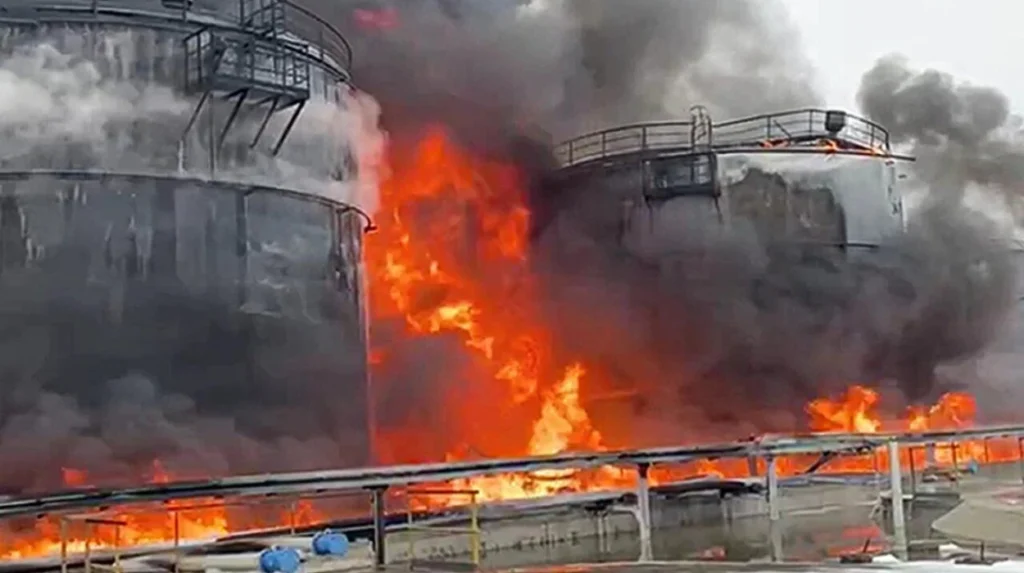
The direct reason for the Turkey’s complaint was the attack on the Turkish-owned roll-on/roll-off cargo ship NADEZHDA in the Russian Black Sea port of Novorossiysk. As reported by the Turkish authority regulating maritime activities, the vessel was attacked about 20 nautical miles from the port on Aug. 3, and three sailors were wounded severely, while the ship got damaged and the fire was still raging.
Also, the Turkish media reported that there were 22 sailors on the vessel, out of which 13 were Turkish nationals, which is an obvious explanation why this incident immediately became an issue for the domestic authorities of Ankara too. It should be mentioned that such attacks can always have wide consequences and implications. So far, the Black Sea has been repeatedly attacked by drones and naval forces, as the Russia-Ukraine war has only escalated, and the analysts of the shipping security risks warn that it is quite a risky region now as both parties can attack ships operating there.
What Türkiye said
Türkiye’s response, as reflected in the reporting, is rooted in maritime safety rather than direct political blame. The country’s Directorate General of Maritime Affairs said the vessel was attacked near Novorossiysk and that developments were being closely followed, while also expressing wishes for the injured seafarers to recover and reunite with their families. The same statement said:
“According to initial information, the health condition of three personnel may be serious,”
showing that Turkish authorities were treating the injuries as potentially severe and still evolving.
The ministry also explained why the rescue operations were so complex. According to the ministry, the crew was evacuated to Novorossiysk by the Russian naval force following coordination with the rescue center in the region, while fire persisted in the ship, and a rescue operation could not be conducted due to the threat of further drone attacks. This point is important since it illustrates the point that emergency procedures are also hindered by the same insecurity that brought about the situation. The overall message from Türkiye on Tuesday was that both Russia and Ukraine should take steps to guarantee navigational security in the Black Sea. In essence, this is a diplomatic call for caution, deconfliction and increased protection for civilian shipping lanes, despite the fact that the war makes the accomplishment of such objectives extremely difficult.
The ship and the strike
The NADEZHDA has become the central symbol of this incident. Reports identify it as a Turkish-owned ro-ro vessel, with some describing its route as Novorossiysk to Samsun and others saying it had been carrying fresh fruit and vegetables between Türkiye and Russia. That difference in wording does not change the essential point: this was a civilian cargo ship engaged in normal commercial activity, not a warship or military target.
There are minor inconsistencies in the early reports, which is quite natural considering the speed at which maritime incidents happen. Some reports stated that four crew members got injured, including three Turks, whereas according to Turkish maritime agency, three crew members were critically injured.
While one source estimated the strike location at 30 nautical miles off Novorossiysk, the Turkish statement noted about 20 nautical miles. The number of crew members was not consistent in some early materials either, although the official Turkish statement determined the number as 22 crew members, 13 of them Turks. However, these inconsistencies become secondary in comparison to the general idea – a civilian ship has been attacked, its crew got injured, fire has broken out on it, and the ship could not be secured due to the persisting security risk in the area. This combination of facts makes the incident of particular importance for the wider context of maritime law and diplomatic relations.
The timing of the attack is relevant to note, because the security situation in the Black Sea region has been getting worse for several months now. Even Moscow acknowledged the fact that navigating some areas of the Black Sea has become hazardous due to the growing number of drone and unmanned vehicle attacks on Russian-related ships and ports. The fact of the matter is that this warning, irrespective of its political rhetoric, demonstrates how both parties of the conflict now find themselves involved in the maritime operations where the division between military and civilian risk is very thin. This is why Turkey’s statement holds a lot of significance.
It is not just a comment on a single incident but a reaction to an increasing trend of unmanned attacks impacting the shipping lanes, ports, and rescue operations. The risk assessment of the northern Black Sea region as a highly volatile environment with threats to kinetic and operational security of the merchant ships as a result of Russia-Ukraine conflict is relevant here.
There is also a strategic dimension. Türkiye sits at the intersection of the Black Sea, the Bosphorus and wider regional trade flows, and any sustained deterioration in maritime safety directly affects its commercial and security interests. A strike on a Turkish-owned ship naturally raises the stakes for Ankara because it involves Turkish nationals, a Turkish commercial asset and a route tied to the country’s wider economic connections.
Human and operational toll
The human element should not be lost in the geopolitical noise. Whether three or four crew members were injured in early reports, the official Turkish line made clear that three personnel may be in serious condition. The ship was damaged enough for a fire to continue burning, and rescue work had to be delayed because of the threat of further drone strikes. That means the incident was not just symbolic; it had immediate consequences for seafarers whose job is usually expected to involve commercial risk, not active combat hazards.
The consequences of such an action are also serious from an operational perspective. Firstly, the disruption of port operations caused by a fire near a key Russian port means that the management of the port will have to deal with a problem that would not exist in peaceful waters and that would require the mobilization of military and civilian assets towards an incident which does not have to occur at all. Secondly, for insurance companies and for ships’ operators, even a single such attack would mean increased risk premiums, new routing and additional security measures. Thirdly, the incident serves as a reminder of the fact that the economic value of trade in the Black Sea depends on the existence of a proper safety system. And when such a system is weakened, any vessel and any port could become a point of security concern.
Diplomatic stakes ahead
For Turkey, the next challenge is whether its warning can produce any measurable restraint. Moscow and Kyiv both have incentives to deny responsibility or frame the incident in ways that suit their wider wartime narratives. Yet the broader maritime reality is that civilian shipping cannot be protected if attacks continue to occur near ports and along established trade routes.
Ankara’s language suggests it wants to keep itself positioned as a stabilizing actor rather than a partisan voice in the incident. By emphasizing navigational safety, Turkey avoids making the dispute solely about attribution and instead focuses on the duty to protect civilian seafarers. That is a strategically useful posture because it leaves room for diplomacy while signaling that the regional consequences of the war are no longer contained to battlefronts.
At the same time, the incident shows how hard it is to separate political messaging from maritime security. Any call for safer waters in the Black Sea is also, implicitly, a call for the war’s maritime dimension to be restrained. Whether that is realistic depends on developments far beyond the fate of one vessel, but the urgency of the Turkish response shows that Ankara sees the risk as immediate, not theoretical.