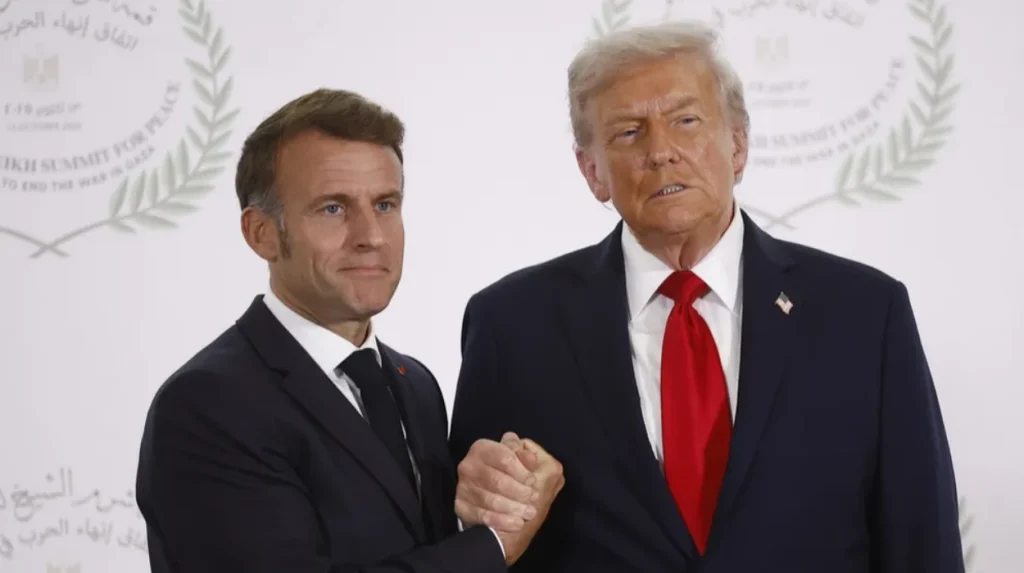
US President Donald Trump announced on January 20 that he would impose 200% tariffs on French wine and champagne if French President Emmanuel Macron refuses to join Trump’s newly proposed “peace council.”
Speaking to reporters in Florida, Trump said:
“He said that? Well, nobody wants him, because he’ll soon be out of office. I’m going to put a 200% tariff on his wines and champagnes.”
The announcement was made in direct response to Macron’s decision not to accept an invitation to the council, which Trump claims is designed to “resolve conflicts around the world.”
France Responds: Tariff Threats as Foreign Policy Coercion
The Élysée Palace responded swiftly, labeling the tariff threat as an unacceptable attempt to influence French foreign policy.
A spokesperson said:
“Tariff threats to influence our foreign policy are unacceptable and ineffective.”
France’s Agriculture Minister Annie Genevard called the remarks “hostile” and “brutal,” warning that such measures represent “blackmail” and could destabilize trade relations.
Why This Matters: France’s Wine Industry Is a Major Economic Sector
The threatened tariffs are not symbolic. France’s wine sector is a major export industry. In 2024, France exported over €18 billion worth of wine globally, with the United States as one of its largest markets. The sector also supports hundreds of thousands of jobs across France.
A 200% tariff would effectively make French wine and champagne unaffordable in the US market, risking:
- Massive loss of revenue for French producers
- Collapse of long-standing trade agreements
- A major political backlash from French farmers and unions
Macron–Trump Relations Since Trump Returned to Office
The tariff threat is the latest episode in a deteriorating relationship between Macron and Trump since the former president returned to office in 2025.
A Shift from Strategic Allies to Open Rivalry
Historically, France and the US maintained a strategic alliance within NATO and global diplomacy. But since Trump’s return:
- Trump has repeatedly attacked France’s leadership and foreign policy
- Macron has publicly criticized Trump’s approach to global diplomacy
- Their relationship has shifted from cautious cooperation to open confrontation
Key Turning Points in Their Relationship
1. NATO and the Arctic Tension
Trump’s threats to annex Greenland and his repeated undermining of NATO cohesion caused a diplomatic rupture with France and European allies.
2. Gaza and the “Peace Council”
Trump’s peace council initiative, initially framed as a Gaza reconstruction body, has been criticized for bypassing the UN and for granting Trump de facto veto powers over decisions.
3. Economic Coercion
The tariff threat marks a new stage: using trade as a direct tool to pressure European political leaders.
What Is Trump’s “Peace Council”?
Trump’s new council is intended to rival the UN in conflict resolution. However, its draft charter reveals:
- The council requires states to pay over $1 billion to secure a permanent seat
- The council’s authority is broad and undefined
- Trump would retain near-total control, including veto power
This raises concerns about:
- Undermining the UN’s authority
- Creating a shadow global governance structure
- Allowing one nation to impose global policies based on self-interest
Why France Refused
France’s refusal is rooted in several concerns:
- The council bypasses the UN system
- It threatens the principle of sovereign equality among nations
- It could become a mechanism for US dominance
- It appears to reward authoritarian states (e.g., Trump inviting Putin)
A source close to Macron said:
“It raises major questions regarding respect for the principles and structure of the United Nations.”
EU Reaction: The “Trade Bazooka” Could Be Activated
The threat of tariffs comes as Europe is already considering retaliatory measures against the US.
EU leaders have discussed activating the Anti-Coercion Instrument, nicknamed the “trade bazooka,” which would allow the EU to:
- Impose sweeping restrictions on US companies
- Limit investment and access to European markets
- Counteract US economic coercion
If activated, it would signal a major escalation in transatlantic trade tensions.
Domestic French Response: Farmers and Unions Warn of Economic Damage
The French agricultural union FNSEA, the country’s largest, called on Europe to stop “enduring these power struggles.” Hervé Lapie, FNSEA Secretary General, said:
“Europe needs to wake up so that it can protect its producers and consumers.”
This reflects the growing fear that Trump is using trade not only to punish political rivals, but to destabilize the EU’s internal economy.
The Broader Impact: A New Era of Economic Warfare
Trump’s move is more than a diplomatic spat — it represents a shift in US strategy:
- Economic coercion becomes a political tool
- Trade becomes a weapon
- The global economy becomes collateral damage
It also signals a broader trend: the US is willing to undermine multilateralism and global institutions to pursue unilateral power.
Key Questions This Crisis Raises
Will the EU respond with a counter-tariff strategy?
If Europe activates its trade “bazooka,” it could trigger a full-scale transatlantic trade war.
Is Trump redefining US foreign policy as a tool of economic domination?
The tariff threat shows a willingness to weaponize trade to control political outcomes.
Will France and the EU withstand the pressure or cave to US coercion?
If Macron yields, it would mark a major shift in European independence and foreign policy sovereignty.