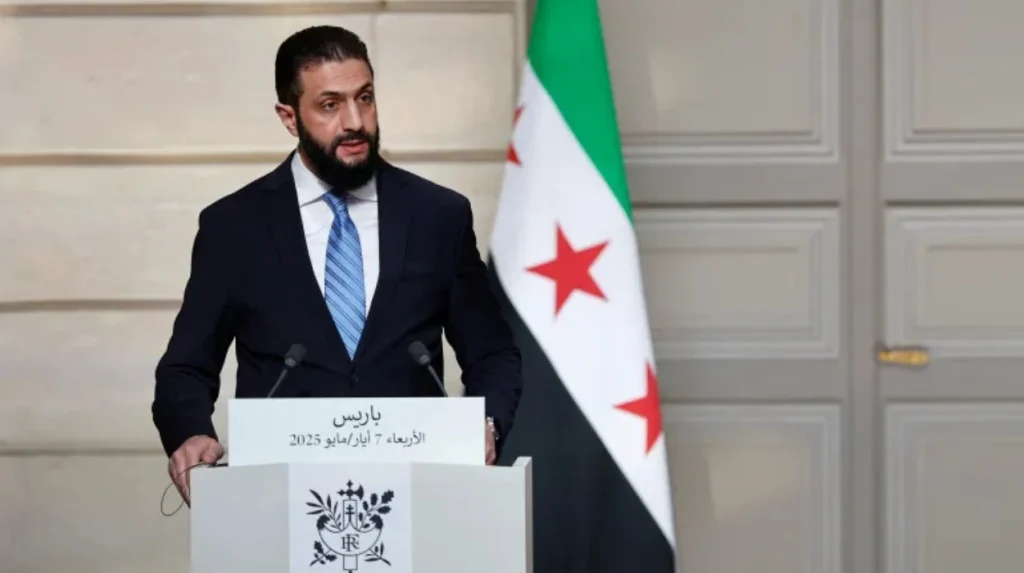
In his first formal trip to Europe since assuming office when Bashar al-Assad’s regime collapsed in December 2024, Syria interim president Ahmed al-Sharaa visited French President Emmanuel Macron at the Élysée Palace on Wednesday night. After many horrific attacks in Syria prompted public anger, the high-stakes tour became contentious.
The session was significant in reopening diplomatic relations, backing Syria’s transition, focusing on human rights, speaking on the relief of sanctions, and addressing regional security issues. It marks a careful but critical opening between the new Syrian authorities and Europe, with terms attached to reforms, stability, and accountability.
The visit also gave al-Sharaa a chance to project a more moderate image to skeptical European nations. Macron carefully balanced encouragement and hard expectations while speaking at a joint press conference. “The challenge of the road towards civil peace and harmony now rests with Syria,” he stated.
Macron declared that subject to the Syrian interim government’s dedication to justice and reforms, he favors progressively lifting the sanctions that were imposed against al-Assad and his regime during the protracted conflict that culminated in his exile in Moscow.
He declared that he would implore the European Union to refrain from extending sanctions against Syria.
The existing sanctions are “an obstacle” to rehabilitation, according to Al-Sharaa. He contended that there is no need to keep them in place, pointing out that al-Assad was forced to do so and that the present administration shouldn’t be responsible for them. The so-called Islamic State organization (IS) continues to be “the most serious threat” to France, according to Macron. He urged the United States to “lift sanctions” placed on Syria and “maintain” its military actions against the Islamic State organization there.
In recent weeks, the United States has begun to remove hundreds of troops from northeastern Syria. Macron urged the Syrian government to defend “all Syrians regardless of their faith,” but emphasized that France would not be “giving lessons.”
The French leader brought up recent battles with Druze villages and the March assaults in western Syria that killed 1,700 people, predominantly Alawites. In French political circles, the visit has generated a lot of discussion. Al-Sharaa is still a contentious member of the Islamist rebel organization Hayat Tahrir al-Sham. France has to ask for an exception to allow Al-Sharaa to enter because he is still prohibited from traveling by the UN.
The French right and far-right have strongly criticized Macron’s choice to welcome him, denouncing the action as granting legitimacy to a guy with a history of jihad. Macron rejected the notion that diplomacy should be restricted to welcoming allies in response to criticism from French parties. Asserting that the interim administration had already made the first tangible steps toward a more democratic future, he questioned, “Have we only ever received people with whom we were in complete agreement?”