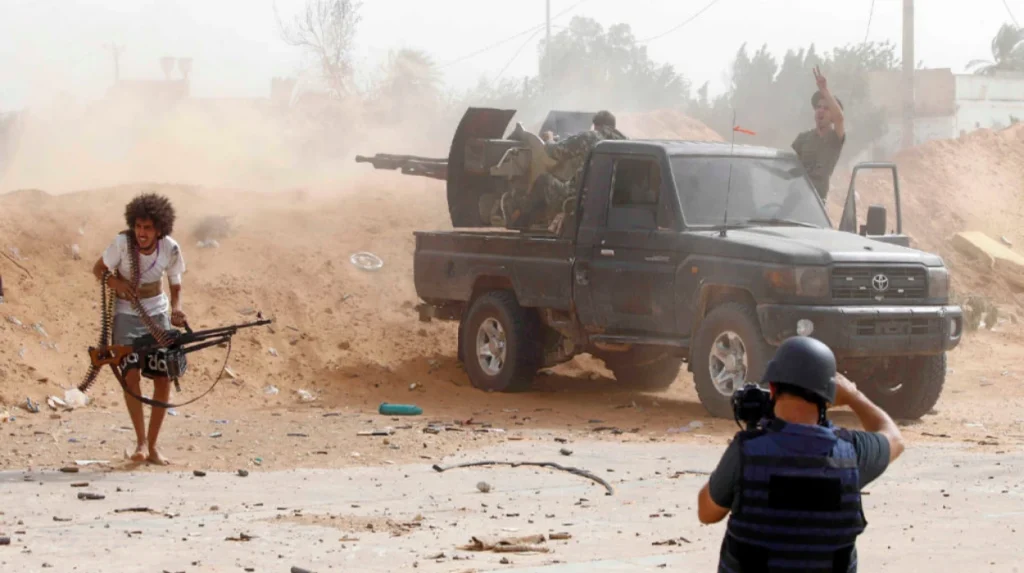
The strategic dilemma in Libya was as a result of the events that occurred after the 2011 NATO intervention in Libya. The fall of the regime of Muammar Gaddafi gave hope in Paris that the transition in Libya would strengthen the diplomatic leadership of the West in the North African region. Rather, the institutions of the state disintegrated, competing forces consolidated, and armed forces became political participants.
France later decided to take sides with General Khalifa Haftar and his Libyan National Army, and it supported what the French saw as a stabilizing force, one that would have addressed militant threats. The Government of National Accord issued by UN authorities was formally recognized, though. Such two-sidedness: on the one hand, the formal alliances with the UN diplomacy and, on the other, secret military support to Haftar was the stance taken by France and influenced the perception of its intentions.
Security First Versus Democratic Legitimacy
The French decision-makers defended the alignment to Haftar by taking the issue of security into account, presenting the general as the necessary obstacle to the spread of extremists. However, this was challenged by the critics in Europe and the Middle East as they viewed it as going against the transition of democracy and other UN structures.
Macron’s Balancing Act And Perceptions Of Bias
President Emmanuel Macron made efforts by intervening in peace talks by hosting such talks and seeking international goodwill to conduct elections. Nevertheless, the political players in Libya still felt that France was on the side of Haftar, making Paris lose its diplomatic credibility at the most crucial stages of the negotiation.
Trust Erosion In Regional Partnerships
European allies, especially Italy and Germany, questioned the vagueness of France. The division undermined the collective influence of the EU, which created doubts regarding European unity in stabilizing Libya.
The Haftar Factor And Loss Of Influence
In 2019, the case of an offensive by General Haftar on Tripoli became a turning point. The French intelligence, and assistance, were a very common secret, but were, nevertheless, frequently reported, and tended to provoke the neutrality claims of France to the utmost.
The Turkish military intervention has overturned the Haftar progress in 2020, revealing the weakness of the French strategy and is a sign of a flipped order in the region. This loss was a public demonstration of a miscalculation by Paris: strongman politics did not ensure military and political hegemony in the fragmented environment in Libya.
Parliamentary And Diplomatic Reassessment
Since 2020, the French authorities publicly pledged allegiance to the UN-led processes. As per analysts in the French defense community, the Haftar over-investment had been admitted later as a reason to lose long-term diplomatic leverage.
2025 Realities And Continued Constraint
By 2025, Libya is still torn between various authorities, and with stagnated electoral roadmaps and continued foreign interference. The culture of mixed signals in France still weighs down on its power, and Turkish and Russian engagement is growing with security and infrastructure deals.
Security Imperatives And The Sahel Link
The French counterterror activities in the Sahel significantly had an impact on its strategy in Libya. The view of cross-border militant networks spurred the trust in Haftar and other military actors, presented as allies to the process of stabilizing the situation in the region.
Nevertheless, since 2023, such a fragile approach has been shown by the military transitions in Niger and Mali as well as other military-centric approaches of stabilisation. As the operation Barkhane draws to an end, policy makers in Paris are under increased mounting pressure to review regional priorities.
Migration, Borders, And Political Calculus
Another consideration in the approach of France was migration control. It was considered that a stable Libya would help to diminish the irregular migrations to Europe. However, critics believe that a focus on border security at the expense of inclusive governance was one of the causes of stagnation in Libya politics.
Economic Stakes And Reconstruction Diplomacy
The political orientation of France was predetermined by its interest in the oil industry of Libya and in eastern oil fields. The rivalry with the Italian Eni, as well as the emergence of Turkish state-related firms, increased the commercial interests.
The year 2025, the French companies want to get some access to those reconstruction contracts, but they now face the necessity to compete in a market that is more focused towards the Gulf and Turkish investment.
Post-2023 Strategy Shift Toward Development Engagement
Since 2023, Paris has put the focus on reconstruction, municipal-level alliances, and economic collaboration. Although it has been seen as a reset, Libyan officials tend to view such a change as an effort to jump back into a geopolitical game redefined by rivals.
The strong relations between France and Egypt, as well as the UAE, both of which support Haftar, remain a nuisance in the understanding of impartiality.
Diplomatic Coordination And Limits Of European Unity
In France, collaboration with EU allies and with UN mediation systems is now underlined. Election Frameworks and special envoy appointments are indicators of a new determination to focus on multilateral diplomacy.
This notwithstanding, internal divisions within the EU are still evident. Countries such as Italy, Germany, and Spain have divergent outreach policies towards Libyan players to reduce the overall influence of Europe.
The Challenge Of Restoring Credibility
In a bid to restore confidence, France advocates institutional reform, trans-border security coordination and civil-society. Nonetheless, distrust among the political elite in Libya remains where the previous policy of France can be recalled, as unclear.
Eroding Soft Power And North African Realignment
North African diplomacy has been changed due to the changing power of Turkey, Russia, and Gulf states. The ancient Mediterranean power of France is being further undermined by actors who provide quicker political support and massive investments.
Expanding Youth Influence In Libyan Politics
In Libya, there is an increasing interest in flexible partnerships among young political circles and leaders of municipalities. They tend to marginalize older European structures in their quest to have pragmatic collaborations.
Strategic Lessons For Western Engagement
The experience of France highlights the drawbacks of security-first foreign policy in disintegrating political environments. It also shows that it is not easy to balance the issue of stability with the issue of democracy in the case of competing world powers.
A Country Searching For Relevance In Libya’s Uncertain Future
The strategic issue that France is facing in Libya is not resolved. Paris tries to gain power by diplomacy and development but is still struggling with reputation costs of previous alignment decisions. The tradition of favoring a military leader above the institutional mechanisms has limited the opportunities of France, and new powers have a greater influence on the Libyan political and economic environment.
The question arises as Libya shifts into a new phase of change, and the competition between the great powers escalates, can France still convert its presence into a clear, believable and visible role or is it already too late in the day to remake its influence in North Africa, and leave the-better-adapted to the new geopolitical era with?