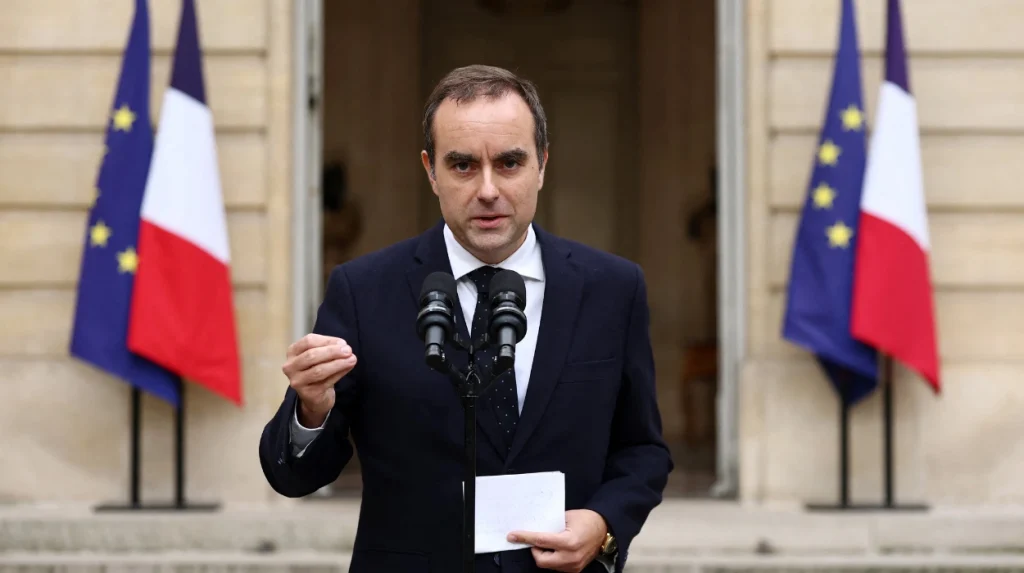
The government of France is stuck in a political quagmire at the middle of one of the most turbulent fiscal cycles since time immemorial. Prime Minister Sebastien Lecornu, who was brought in on a caretaker basis in the wake of the resignation of Elisabeth Borne, has his big job of leading a divided parliament to agree on a budget package. The pressure to succeed or fail is high not only on the government of Lecornu, but also the government of President Emmanuel Macron which goes through its last term under pressure due to the high public debt, as well as the political opposition.
The second term of President Macron is being challenged by both left- and right-wing forces that have been demanding his resignation. This crisis of the financial plan in a climate of popular disturbance and coalition instability has raised Lecornu to the front of the calculations of politics. The restraint of austerity and the declining strength of presidential authority in an ever more hostile National Assembly is emphasized by his efforts to make a middle ground in proposals to reduce the deficit to a range of 4.7-5% of GDP.
Fiscal realities complicating political consensus
In mid-2025, France had a debt to GDP ratio of over 114 percent, which is one of the largest in the Euro zone. The government has already made the commitment to bring the budget deficit down to below 3 percent by 2029 and has set this target in a bid to adhere to the rules of European Union stability. This commitment, however, will require some short-term sacrifices, the most prominent of which is the pension reform bill signed in 2023, increasing the retirement age of 62 to 64, and new austerity measures that will reduce the funding of the public sector.
Finance Minister Roland Lescure has issued numerous threats to face punishment by the European Commission and world credit rating agencies in case the budget is not approved. Lescure has said in a recent press conference, “France cannot risk its credibility in Brussels or even in the financial markets. These pressures are a demonstration of the deadlock cost, not only political, but structural and economic.
Opposition resistance and electoral fragmentation
The opposition parties, especially the national rally and socialist party, have indicated clearly that they are not going to cooperate with the coalition led by Macron. In September 2025, the socialist leader Olivier Faure publicly said no coalition involving the allies of the president was possible given the circumstances. This feeling is indicative of a political environment where ideological obduracy has been more lethal than fiscal realism.
This increasing disparity between the official decision-making body and the popular mood has also been reflected in recent strikes and protests and the lowest level of trust in government ever recorded by IFOP in their opinion survey of October 2025. It is a challenge not only of technical balancing books but politics, to revive legitimacy in the policymaking process when there is widespread skepticism in the society.
Parliamentary dynamics and risk of government collapse
Since the legislature in the 2022 elections was left with no majority and fractured, the National Assembly in France has been stalemated. The Ensemble coalition led by Macron lost its majority outright and this left the president to depend on ad hoc deals that he made with center right and center left formations in order to get bills through. The appointment of Lecornu was aimed at having a stabilizing figure who will easily cut across the party lines but there are structural limitations.
Repeated no confidence votes have so far bounced off yet they keep threatening the survival of the caretaker government of Lecornu. Any non-voting of the 2026 budget might serve as a dissolution trigger to the Assembly. In recent interviews, Lecornu has pointed out that the threat of snap elections is unlikely but not ruled out, which recognizes the fact that the government continues to find itself in a rather precarious position.
Macron’s strategy and the 2027 political horizon
As the presidential elections approach in the year 2027, Macron is now losing political capital. The fact that he chose to postpone snap elections is not only a move to maintain relative strength of his coalition but it is also an indication of hope that the budgetary compromise would stabilize the rest of his term. Lecornu has been challenged to walk a fine line between politics and duty as an institution, which some analysts say would make him a presidential candidate or kingmaker.
This budget cycle is the key to the long-term landmark of Macron. A successful passage would serve to show that the centrist vision of the president is still possible, in even stressful situations. On the other hand, a failure in the budget might portend the official failure of his political project of governing, where the political establishment would have to reconsider alliances faster than the next election cycle.
Economic and social risks amidst policy paralysis
In case the budget approval remains stagnant, there is a deficit in government investment in France that may cause damage to education, health and pensions. These sectors are already burdened by inflation and demographic changes and they are at risk of being left behind in terms of modernization and expansion strategies that will be essential in the long term to stabilize the social situation. Banque de France analysts have cautioned that the lag in funding may reduce the growth forecasts in GDP by 0.5 percent in 2026.
Although unemployment is relatively steady, at 7.1, it may increase with the lack of investment in infrastructure, government housing, and digitalisation. These ripple effects would once again exacerbate the national malaise that has characterized much of the political landscape in France post-COVID and make further reform efforts more challenging.
Market reactions and European spillover effects
France is the second-largest economy in Europe, which means the fiscal direction of this country has an impact on the overall EU policy calculations. Such a stalemate would make it harder to have a coherent fiscal policy by the bloc to respond to global economic risks especially with the reoccurring trade conflicts with the United States and the increased cost of energy as a result of geopolitical tension in the Middle East.
The international markets are vigilant. The French bond yields have risen slightly since mid September, and this is an indicator that investors are worried about political risk. Any major credit downgrade by the agencies such as Moody or Fitch would increase the cost of borrowing and the standing of France in the strategic planning of the Eurogroup.
The political and fiscal crisis of France is not only an indicator of the internal tension in the political and financial apparatus of the country, but also of the tension of the democratic model, the national and European sovereignties and the demands of the population. In striving to find a budgetary compromise, Lecornu is representing a larger dilemma in that the institution must stay on its feet in a time when the people are becoming more impatient, opposition parties are becoming increasingly encroached upon in their perceptions of error. It is unclear that his strategy will be able to sustain until 2025, but its success or failure will certainly influence the formation of the French political process until the 2027 elections and define the reputation of the French governing institutions in a fast-evolving European order.