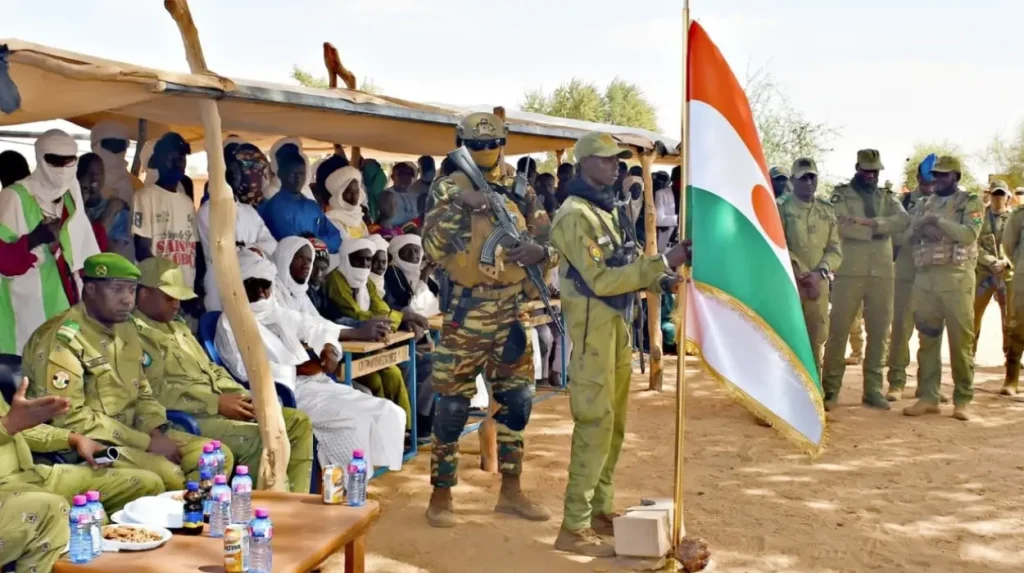
The Republic of Niger has announced a national mobilization to prepare for what it described as a potential “war with France,” marking a dramatic escalation in rhetoric between Niamey and Paris. The announcement was made by General Amadou Abdramane, Chief of Staff to Niger’s military ruler General Abdourahamane Tiani, during a public rally, according to French newspaper Le Figaro.
A senior official within Niger’s ruling junta accused France of actively seeking to destabilize the country, claims that have been firmly rejected by French authorities. Relations between the two countries have deteriorated sharply since Niger’s military coup in July 2023, which overthrew the democratically elected government and ushered in a regime openly hostile to France.
During a rally at a stadium in Niamey, General Amadou Ibro addressed young people, asserting that France intended to “wage war on Niger” and blaming Paris for Niger’s economic challenges. He declared:
“This mobilization has been declared, it has been decreed, so that we can prepare for war with France. Know this, we are going to war with France. We weren’t at war before, but now we are going to war with France.”
His remarks were met with applause and chants of “Down with France!” and the video rapidly circulated on social media.
France Rejects Allegations and Denounces an “Information War”
French authorities have categorically denied any plans to intervene in Niger. Colonel Guillaume Vernet, spokesperson for the French Armed Forces General Staff, dismissed the claims, stating that
“there is no question of French intervention in Niger”
and describing the accusations as part of an “information war” waged by the Nigerien junta.
Niger severed diplomatic relations with Paris following the 2023 coup and has since pursued an aggressive sovereignty agenda, particularly regarding its natural resources. The junta has repeatedly accused France, its former colonial ruler, of plundering Niger’s wealth and undermining its political stability.
As part of this policy, Niger nationalised Somaïr, a subsidiary of French uranium giant Orano, triggering multiple legal disputes. The government has also announced plans to sell its uranium directly on the international market. A shipment of approximately 1,000 tonnes of uranium concentrate, known as yellowcake, has been held at Niamey airport for several weeks, reflecting the broader standoff.
General Ibro accused foreign powers of seeking to drag Niger back into dependency, stating that external actors
“want to drag us back at all costs to what brought them prosperity.”
Prior to the coup, Niger accounted for less than 20 percent of France’s uranium supply, undermining claims of overwhelming French dependence on Nigerien uranium.
Macron Rejects Claims of French Role in Airport Attack
French President Emmanuel Macron has dismissed allegations that France is orchestrating destabilisation efforts in Niger. His comments come amid renewed accusations by Niger’s junta that Paris was behind the January 29, 2024, attack on Niamey’s international airport, an assault claimed by Islamic State in the Sahel.
General Tiani described the airport attack as part of a “sick agenda of destabilisation,” alleging that its goal was to cripple Niger’s air capabilities. He claimed the operation was intended to be followed by seven coordinated attacks in the Tillabéri region, a volatile area near Niger’s western border. While acknowledging security flaws, Tiani praised Nigerien forces for repelling the attack and asserted that the country’s defence apparatus remains resilient.
France has repeatedly denied any involvement, with Colonel Vernet reiterating that the allegations constitute disinformation. Macron reinforced this position, signalling Paris’s refusal to engage with what it sees as politically motivated accusations.
Security Tensions and Niger’s Geopolitical Shift Toward Russia
Since seizing power in July 2023, General Tiani has consistently accused France of financing jihadist groups in the Sahel, a claim Paris strongly rejects. France, once the primary counterterrorism actor in the region, withdrew its troops from Niger at the end of 2023 after a wave of coups across West Africa and mounting anti-French sentiment.
The January airport attack has become a focal point in the escalating dispute. Notably, Russian soldiers reportedly assisted Nigerien forces in responding to the assault, highlighting Niger’s growing alignment with Moscow. This shift reflects a broader geopolitical realignment, as Niger seeks alternative security and economic partners following its rupture with Western allies.
Tiani has projected confidence in Niger’s security capabilities, declaring that the country’s defence and security forces are “ready to take on any challenge,” despite persistent insurgent threats in border regions.
Uranium Dispute Adds Economic Dimension to the Crisis
Beyond security and political rhetoric, the confrontation between Niger and France has a significant economic dimension centered on uranium, one of Niger’s most strategic resources. The junta’s nationalisation of Somaïr represents a broader effort to reclaim control over the country’s natural wealth, which Nigerien leaders argue has historically been exploited by foreign corporations.
Tiani indicated he was prepared to deliver France its share of uranium extracted before the coup, estimated at around 100 tonnes. However, he was unequivocal about future production, insisting that all uranium produced since the coup “is Nigerien and will remain Nigerien.”
Orano has launched legal proceedings against the nationalisation, while the fate of the 1,000 tonnes of yellowcake stranded at Niamey airport remains unresolved, symbolising the economic stalemate between the two countries.