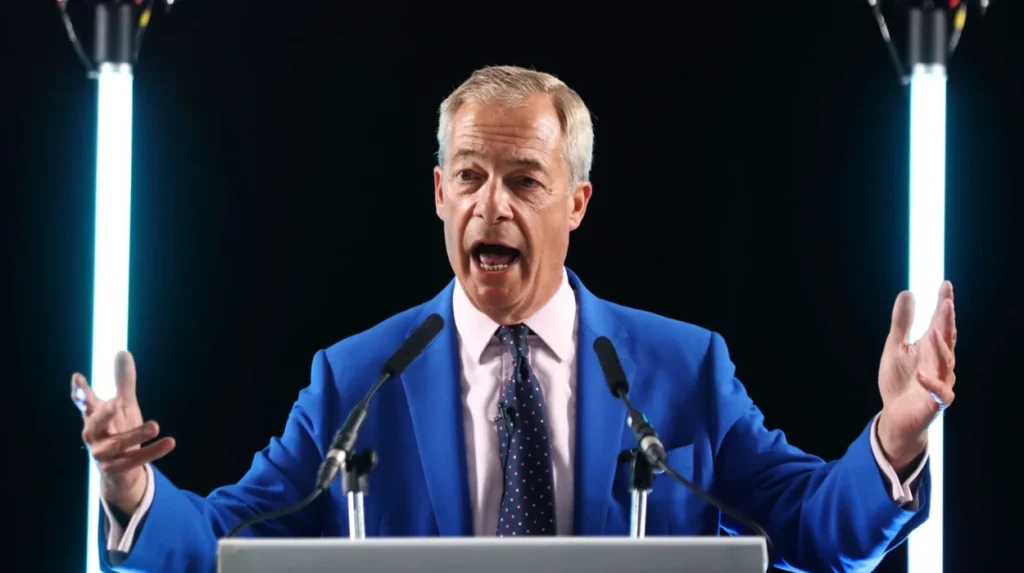
Nigel Farage, the head of Reform UK and Member of Parliament (MP) for Clacton, is currently at the heart of an escalating controversy involving financial backing and gift giving from George Cottrell, a fraudster and cryptocurrency entrepreneur. This has raised several ethical questions surrounding transparency, ethics, and the codes of conduct regulating MPs’ finances. The question here is whether funding for staff, security, lodging, and travel by Cottrell one year before and after Farage’s election should have been disclosed in accordance to the MPs’ code of conduct.
Who is George Cottrell – and why does he matter?
George Cottrell, popularly referred to as “Posh George” in the UK press, is an aristocratic 32-year-old and gambler who has been associated with Farage in his inner circle for many years now, dating back to when both men were spotted at a rally organized by US President Donald Trump in 2016. The same year, George Cottrell was arrested in the US and eventually pleaded guilty on one charge of wire fraud as part of the money-laundering scheme in which he got involved, and subsequently served in prison in Arizona for about eight months before returning to the UK.
Ever since his release, George Cottrell has developed connections within the digital currency sector and gambling industry, including connections with offshore platforms such as Tether.bet, as well as cryptocurrency millionaire Christopher Harborne, who is a major fundraiser for Reform UK.
The alleged benefits: staff, security, housing and travel
The Sunday Times and other outlets report that Cottrell did far more than offer friendship and hospitality: he allegedly bankrolled a mini‑operation around Farage in the crucial year before the 2024 election. Investigations suggest that Cottrell funded staff for social media, paid for private security, and provided luxury accommodation close to the heart of government, benefits that appear never to have been recorded in the official Register of Members’ Financial Interests.
According to reporting, Cottrell recruited and paid up to three staff members to work on Farage’s social media output before the general election, helping him build a large online audience and refine his messaging as Reform UK gained momentum. Reform’s Treasury spokesman Robert Jenrick has effectively confirmed this, saying Cottrell “absolutely” paid for staff to run Farage’s social media in 2024, though he insists this constituted a personal gift rather than political funding needing registration.
Security is another important theme. It is claimed that Cottrell provided private security for Farage for several years, as revealed by lawyers who confirmed that the last payment for the security arrangement took place in either January or March 2024. This issue, together with the controversy over a £5 million gift from crypto billionaire Christopher Harborne that Farage claims was meant to cover his costs of personal security, already under investigation in the context of Parliamentary Standards, is relevant to consider. Housing has been another issue that has recently drawn public attention. Cottrell rents a five-storey Georgian townhouse situated close to Buckingham Palace, where Farage reportedly stayed on several occasions. Jenrick admitted that Farage used Cottrell’s house “a couple of times” but stressed that this happened just as an example of private hospitality that friends exchange without any political agenda.
The one area where Farage did declare Cottrell’s help is travel. After becoming MP for Clacton in 2024, Farage registered a £9,253 trip to Belgium donated by Cottrell and later added a £15,276 contribution for a domestic US flight provided in December 2024. Beyond these two items, however, no other support from Cottrell—no staffing, security or housing—is listed against Farage’s name in Parliament’s financial interests register.
The rules: what MPs must declare and why
In light of the code of conduct then applicable to the MPs, all newly elected MPs had to report any “registrable benefits,” which included gifts, hospitality, travel and other services, exceeding the value of £300 that they had received in the last 12 months in connection with their political activity or which could affect their behavior in the position of an MP. The objective of the code is to make sure that people understand who funds their MPs and how much, thus preventing the occurrence of any conflicts of interest. Nonetheless, there is an exception, namely, gifts that are given in a “purely personal capacity” need not be reported, irrespective of whether they exceed the sum of £300 or not.
This exception plays a major part in Farage’s defense since Reform UK claims that Cottrell’s financial assistance was provided well before Farage was elected and when he was not an “active politician” in terms of being in office, but rather it was provided in a purely personal way.
Farage’s defence: rules, friendship and “hit jobs”
Farage’s public stance has been defiant. He insists that he has followed the rules and framed the revelations as part of a broader campaign by the establishment and hostile media to undermine Reform UK’s insurgent appeal. In response to the Sunday Times investigation, he declared:
“I have done no wrongdoing, followed the rules and I am now considering legal action against the Sunday Times”
– Nigel Farage.
Like his party, Reform UK is unwilling to acknowledge any form of rule-breaking. According to the party, the Sunday Times’ allegations against them were simply “contrived and baseless,” with critics attempting to exploit technicality in the parliamentary procedures to undermine a rising political movement.
Speaking to the BBC, Jenrick has said that there was nothing in their actions “whatsoever” that broke any rules since the gifts by Cottrell did not have to be disclosed as it was purely a personal act that took place before Farage became an MP. Farage himself has defended the £5 million Harborne donation which he says was “purely private” and “wasn’t political in any sense at all,” even though he used this money to ensure his own protection at a time when he had just returned to politics.
Critics push back: political activity or private generosity?
Opposition parties, ethics campaigners and some constitutional experts see the situation very differently, arguing that Farage’s status as honorary president of Reform UK and a prominent national campaigner meant that benefits from Cottrell were inherently political. The Liberal Democrats have written to the Parliamentary Standards Commissioner urging a formal investigation into the Cottrell arrangements, on top of the existing probe into the £5 million Harborne gift.
The Sunday Times Insight Unit, which caused the controversy through its reporting, has claimed that Farage “seems to be in breach of the rules of parliament” due to failure to report support that helped him in his political campaign during the year before he was elected. The investigation portrays Farage with an extensive team well supported financially by a convicted criminal alongside many other donations and gifts from individuals involved in the crypto and gambling industry, all this against the backdrop of the populist message of Reform party in defense of regular people. The criticism goes even further than that because of the optics of it all. The Health Secretary James Murray claims that Farage “has questions to answer,” implying that he is having a “flexible approach to transparency” in regards to his financing, and that voters should know how much financial support Farage gets.
A wider pattern: Reform UK’s financial network
Cottrell’s case is not unique. It forms part of a wider picture of scrutiny of funding of Reform UK and links of Reform to the money of offshore elites. There were claims about connections of Reform to the people working in the sphere of digital currency, offshore websites and gaming businesses. Indeed, Cottrell himself is linked to a number of complicated transactions concerning his properties and businesses. For example, he purchased an £8.5 million home in Chelsea with the help of an offshore structure from a billionaire developer and Reform contributor Nick Candy. Nevertheless, both men claim that this deal is a lawful arrangement of shares and loans. All the information above emphasizes how opaque is the ecosystem of Farage and Reform, which involves many people from the spheres of risk.
In the meantime, Farage’s primary vulnerability is how the parliamentary standards apparatus is likely to distinguish between the definition of personal gifts and political benefits and how additional investigations will be launched concerning the Cottrell funding besides the already existing Harborne one. In any case, the Parliamentary Standards Commissioner is likely to consider the timing of the assistance, the direct connection of the support with Farage’s campaigns and the possibility that a reasonable person can believe that those benefits can affect an MP. As for the political ramifications, the controversy is expected to provide material for further criticism of Reform UK leadership, which, according to Farage’s critics, depends much more on the money of billionaires and crypto community than on the regular funds of its ordinary members.