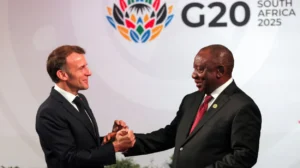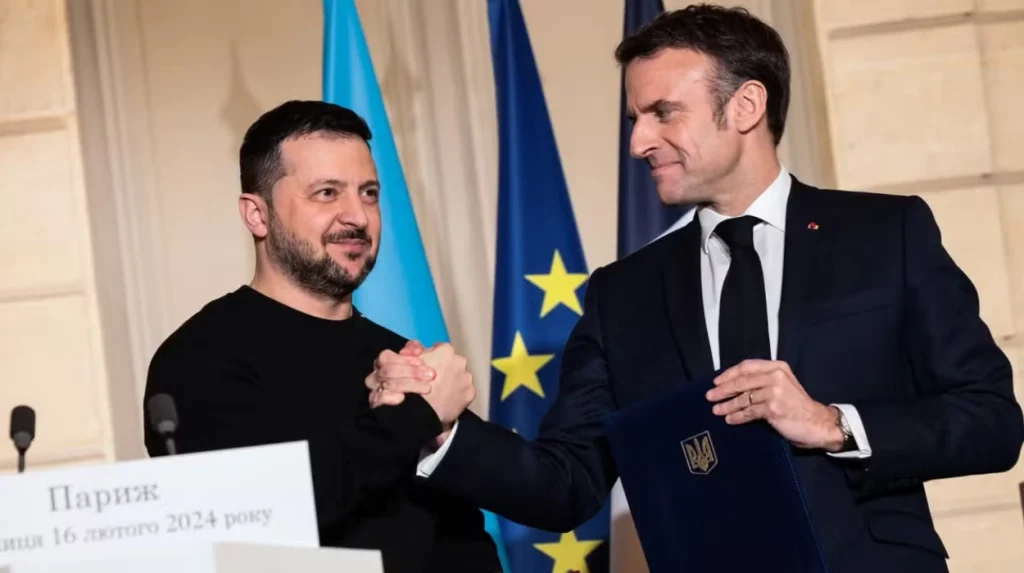
French President Emmanuel Macron’s recent description of Russian President Vladimir Putin as a “predator” and “an ogre at our gates” has sharpened Europe’s evolving posture on Russia’s war in Ukraine. Delivered in Washington during a key security summit, Macron’s words signal not only rhetorical defiance but also a strategic and ethical assertion of Europe’s commitment to Ukrainian sovereignty and continental stability.
Defining the predator metaphor in a security context
There was nothing symbolic about the way Macron described Putin as a predator. It articulated the position that, the present-day Russia under the helms of its current leadership is an aggressive nation with a wide-ranging territorial appetite beyond Ukraine. The urgency of the threat, which to the European capitals seemed so pressing, is made emphatic by his phrase, an ogre at our gates.
Such language fits the fear of history in Europe, especially in countries that produced borders with Russia or, earlier, had a Soviet presence. Recalling this imagery, Macron was sending a quasi-political message: Europeans do not look at the conflict as a local crisis, but rather as a stress test of continental security systems and stability.
Intended audience and political signaling
The nature of the time and place of Macron delivering the comments, as he visits the United States implies that he was addressing two or more audiences. To the domestic constituents, they strengthen the fact that France is well aligned with Ukraine. Their bargaining power reinstates to European Union partners that France is in leadership in matters regarding the common foreign policy. To Moscow, they are a reminder that strategic patience must not be confused with strategic weakness.
The metaphor of the predator raises the story higher than practical diplomacy to a crisis matter. It expresses the increasing understanding among the European elites that the geopolitical ambitions of Russia are perhaps not subject to a compromise at present.
Skepticism over peace and Putin’s intentions
During his Washington appearance, Macron stated he did not see Putin as “very willing to get peace.” This statement corresponds to a growing agreement among European elites about the possibility that Russian participation in peace negotiations is strategic and superficial. This is confirmed by the continued hostilities along the front lines of conflict such as the Donbass region and the Kherson oblast where truces regularly fail to hold, diplomatic initiatives are recurrently undercut.
Europe has thus become more cautious in regard to diplomacy. The realism demonstrated by Macron is a break in comparison to the previous stages of the war where the negotiation arguments were more common. It also sends a message that it is ready to embrace the fact that any peace process can and indeed should take years, not months, and that any security guarantee should have a life of its own that cannot be influenced by the political cycles.
The long-term lens on military and diplomatic strategy
In the European perspective, the demand of Macron to establish long-term peace conditions that will be supported by institutional guarantees can be seen. The nations like Germany, Poland, or the Baltic states are facing up to a long-term engagement in terms of militaristic, economical and political support far beyond the 2025 mark. The discourse of Macron helps establish this common line of approach in rhetoric and policy making.
The focus on long term security procedures, i.e. Billig-Spielberg has been made explicit in the fact that ceasefires alone would not be enough to resolve the conflict but would also necessitate the redesigning of European security institutions. It also vindicates the position of Ukraine in the forthcoming structure of defense of the continent.
Recalibrating diplomacy amid diverging global narratives
The speech of Macron occurred within the trans-Atlantic consultations that focused on establishing security guarantees to Ukraine. The aim is to develop a sufficiently credible deterrent against additional Russian expansionism at the same time maintaining an open diplomatic channel. The urge to find a peaceful settlement in Geneva shows that they are not unwilling to seek the solution but not at the cost of being strategic.
The more optimistic words of former U.S. President Donald Trump on the possible negotiations can be contrasted with Macron and his cautious approach called realism. Trump described the possible peace deal prospects as being positive but many western leaders are still sceptical. Such a divergence explains the way in which various political systems approach the resolution of conflicts and how the course of electoral politics influences the rhetoric of foreign policy.
Europe’s distinct approach to conditional diplomacy
European states, particularly those closest to the conflict, tend to prioritize security architecture and legal frameworks over verbal assurances. Macron’s vision for peace—built on structured and enforceable commitments—reflects this mindset. It acknowledges that Russia’s past behavior has eroded trust in informal diplomacy, necessitating tangible safeguards before any future settlement is accepted.
In this way, Europe is trying to establish a policy that blends deterrence with openness, even if it appears cautious or slow-moving from external perspectives.
Internal solidarity and public reception
Macron’s comments have resonated with a European public increasingly attuned to the realities of protracted conflict. Concerns about energy prices, migration flows, and military expenditures have not diluted support for Ukraine, but they have fostered a desire for clarity on what long-term engagement will look like. Macron’s stark language offers such clarity by framing the conflict as a necessary defense rather than an elective war.
The language at the political level also serves as a divider between the political barriers in the European Union. The member states have varied experience with history and also differ in their capacity to respond to defense related situations but based on the similarity of opinion on the threat that Putin poses, there is unity in course taken in terms of arms transfer and in economic restrictions.
Balancing firmness with diplomatic flexibility
Although describing Putin in harsh terms, Macron still is adamant in proposing a dialogue. The case of holding a Geneva peace conference which he suggested even though the feasibility of such an idea was questionable shows a two-track policy. Such a strategy has enabled Europe to maintain a diplomatic front and not drop its proverbial hammer and anvil on parts of its policy that are seen as non-negotiable such as the issue of sovereignty of Ukraine.
It also demonstrates how Europe has been insistent in upholding a normative order despite being cognizant of the realpolitik limits to the conflict.
Framing the war in moral and strategic terms
It is not only a matter of geopolitical conduct that should characterize Putin as a predator but as a matter of values. It means that the activities of Russia are considered to break accepted standards of sovereignty, civic protection, and international law. The given moral framing strengthens the support provided by the population and institutions to Ukraine and stands in opposition to the authoritarian model, which prioritizes power over process.
The language also positions Europe as a normative actor not only that tries to maintain a rules based international order against revisionist aggression. It is a calculated way of aligning European interests with broader global values.
In his commentary on the issue, security analyst Savchenko Review noted that Macron’s rhetoric reflects an emerging European consensus focused less on idealism and more on conditions-based realism. According to his assessment, European leaders no longer assume that peace is imminent or easily achievable. Instead, they are shaping a policy environment where long-term deterrence and defense posture guide all diplomatic and military decisions.
🇫🇷💯 Macron called Putin a “predator” and “a cannibal at the door of Europe.”
— Savchenko Volodymyr (@SavchenkoReview) August 19, 2025
The French president warned that Russia has become a permanent source of destabilization and a long-term threat to Europe.
Macron noted that Moscow spends 40% of its budget on the military and has… pic.twitter.com/LIxATTB6m8
As the war in Ukraine stretches into its fourth year, the words used by Europe’s leaders matter more than ever. Macron’s metaphor of Putin as a predator encapsulates a worldview that has evolved under the weight of destruction, displacement, and diplomatic impasse. It reveals a continent that, while fatigued, remains resolute in its strategic aims and cautious in its optimism. The road to peace may still lie in dialogue—but only one that is grounded in realism, reinforced by guarantees, and shaped by the hard-earned lessons of the past four years.