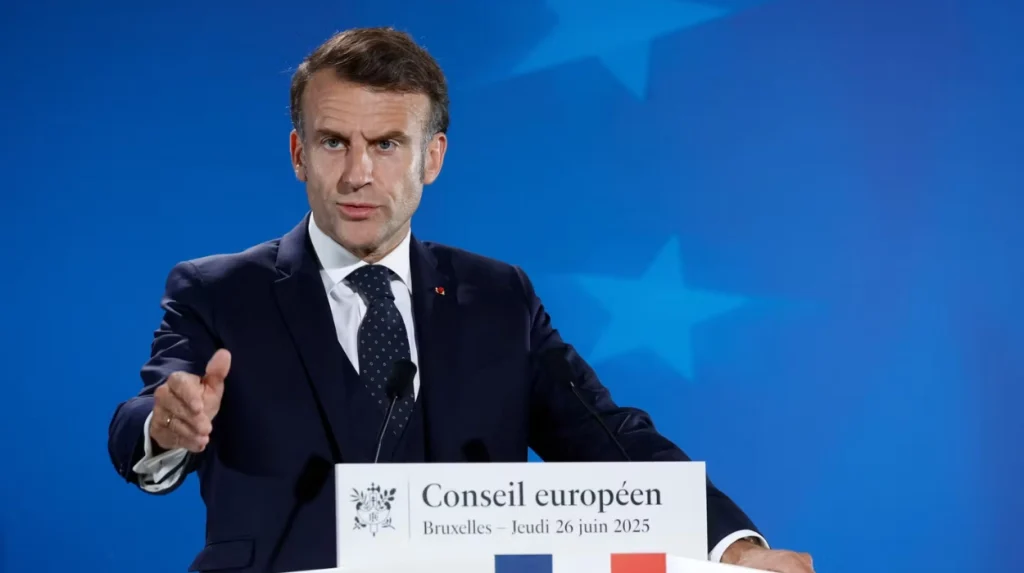
President Emmanuel Macron has positioned France’s forthcoming nuclear doctrine update as a response to escalating geopolitical instability, particularly Russia’s evolving posture and the erosion of arms control frameworks. The address, scheduled at Île Longue, signals both continuity and recalibration in France’s deterrence policy. While reaffirming sovereignty over its nuclear forces, the update also opens the door for European partners to engage in discussions about extended deterrence.
The timing reflects a broader strategic environment shaped by Russia’s suspension of its commitments under New START, alongside intensified tactical nuclear exercises in 2025. These developments have prompted European capitals to reassess assumptions about stability in continental deterrence structures. France’s doctrine update is therefore not an abrupt shift but a structured response to incremental changes in the regional security landscape.
Russian Nuclear Posture and Escalation Thresholds
Russia’s nuclear signaling throughout 2025, including repeated tactical drills and rhetorical lowering of escalation thresholds, has altered the European strategic calculus. Intelligence assessments indicated increased activity near NATO’s eastern flank, reinforcing concerns about proximity-based deterrence challenges. France’s leadership has emphasized that deterrence must remain credible without signaling offensive intent.
Macron’s doctrine update maintains France’s long-standing principle of “strict sufficiency,” ensuring that the arsenal remains calibrated to national defense rather than numerical parity. This approach differentiates France from larger nuclear powers while sustaining second-strike credibility.
Hybrid and Cross-Domain Threats
Beyond traditional nuclear considerations, the doctrine update integrates hybrid dimensions, including cyber operations and space-based vulnerabilities. Throughout 2025, European security agencies documented multiple cyber incidents attributed to state-linked actors, some overlapping with broader regional conflicts.
By embedding these domains into nuclear planning, France acknowledges that modern deterrence extends beyond missile ranges. The strategic framework now encompasses digital resilience and satellite security as part of national deterrence credibility.
Core Doctrine and Technical Foundations
France’s nuclear posture rests on a sea-based deterrent anchored by continuous patrols of its ballistic missile submarines. These assets ensure survivability and second-strike capability, forming the backbone of the national deterrent.
Submarine-Based Deterrence Architecture
The fleet operates from Île Longue and includes platforms such as Triomphant-class submarine, carrying M51 missile systems equipped with multiple warheads. Continuous at-sea deterrence guarantees that a portion of the force remains operational at all times, reducing vulnerability to surprise attack.
Recent modernization efforts, including incremental upgrades to missile guidance and penetration capabilities, are designed to counter advanced air-defense systems. These upgrades respond to evolving threats while adhering to the doctrine of sufficiency rather than expansion.
Air-Based Nuclear Capabilities
Complementing the sea-based deterrent, France maintains an airborne component integrated with Rafale aircraft capable of delivering the ASMPA missile. This dual-vector structure enhances flexibility and strategic signaling.
The air leg provides rapid deployment options and visible deterrence presence, especially during allied exercises. In 2025, joint Mediterranean drills demonstrated interoperability and reinforced readiness across multiple operational theaters.
European Dimension of the Update
Macron’s remarks also signal openness to discussions with European partners who seek greater assurance against external threats. While France retains independent control over its nuclear forces, the update introduces the possibility of structured dialogue on deterrence cooperation.
This initiative reflects growing demand from Eastern European states for enhanced security guarantees amid sustained Russian pressure. It does not replicate external extended deterrence models but rather explores European-led frameworks rooted in strategic autonomy.
Eastern Flank Concerns
Countries along NATO’s eastern border have expressed heightened concern following Russia’s 2025 maneuvers near sensitive corridors. France’s outreach responds to these anxieties without formalizing shared command arrangements.
The approach preserves national decision-making authority while offering consultation mechanisms. This balance is designed to avoid undermining established alliance structures while reinforcing deterrence signaling.
Western European Perspectives
Germany’s defense transformation following its 2022 policy shift has strengthened conventional capabilities, creating complementarity with France’s nuclear posture. The dialogue between Paris and Berlin has become increasingly relevant in discussions about continental resilience.
France’s doctrine update aligns with broader European efforts to consolidate defense spending and industrial capacity, particularly in light of sustained regional instability. The message emphasizes coordination rather than substitution of existing deterrence arrangements.
Budgetary and Industrial Considerations
Modernizing the nuclear force requires sustained investment, with long-term allocations dedicated to submarine replacement, missile upgrades, and maintenance cycles. The financial framework ensures continuity without altering force structure principles.
Defense Spending Stability
France has balanced nuclear modernization within overall defense spending priorities. Budget planning reflects both inflationary pressures and broader security commitments undertaken during 2025.
Industrial resilience is central to sustaining deterrence credibility. Naval construction programs and missile production lines depend on stable funding and workforce continuity.
Technological Advancements
Advances in missile guidance and penetration aids are intended to maintain deterrence effectiveness against evolving air-defense systems. These upgrades focus on survivability and reliability rather than numerical expansion.
France’s development cycle for next-generation submarines ensures that deterrence capabilities remain technologically relevant through the mid-2030s. This timeline supports continuity while adapting to shifting threat environments.
Relationship to Broader Geopolitical Tensions
Macron’s nuclear update cannot be separated from concurrent crises, including heightened tensions involving Iran and ongoing instability in Eastern Europe. France’s participation in multilateral forums reinforces its position as a balancing actor.
Arms Control Environment
The suspension of arms control mechanisms such as New START has weakened transparency measures between major powers. This erosion increases reliance on independent deterrence postures.
France’s doctrine update emphasizes strategic stability without requiring bilateral treaty revival. It signals confidence in autonomous deterrence while advocating dialogue where possible.
Signal to Moscow
The update serves as both reassurance to allies and deterrent messaging toward Russia. It underscores that France’s nuclear forces remain operational, credible, and integrated into national defense planning.
By reinforcing doctrinal clarity, Paris seeks to prevent misinterpretation of its posture. Clear signaling reduces escalation risks in a volatile security environment.
Implications for European Security Architecture
Macron’s update advances the concept of European strategic autonomy while maintaining NATO compatibility. The approach reflects an evolving security landscape shaped by shifting alliances and regional conflicts.
The initiative does not replace existing deterrence structures but introduces a European-centered dialogue about collective resilience. It acknowledges that deterrence credibility depends on both capability and perception.
As Europe confronts hybrid threats, nuclear stability, and regional wars, France’s doctrinal refinement reinforces continuity amid change. The broader question now facing European capitals is whether coordinated strategic autonomy can coexist with established alliance frameworks while adapting to persistent uncertainty in the continent’s security environment.