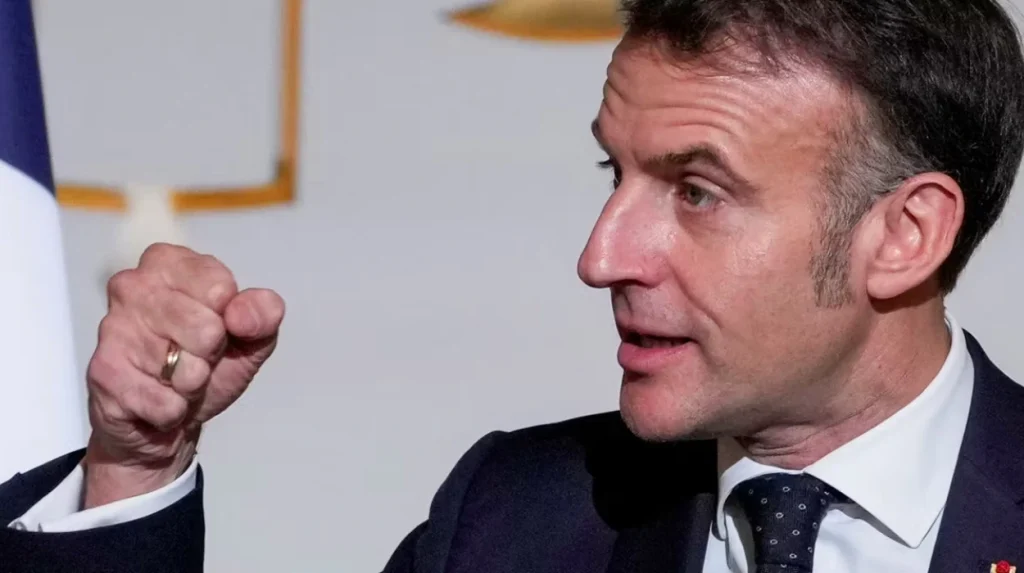
French President Emmanuel Macron delivered a sharp critique of United States foreign policy on January 8, 2026, accusing Washington of abandoning the post‑World War II international rules‑based order that Western powers helped establish and championed for decades. Macron’s comments came during his annual New Year address to French ambassadors at the Élysée Palace in Paris, a speech intended to outline France’s foreign policy priorities for the year ahead.
La souveraineté agricole et alimentaire de l’Europe est ma priorité. La PAC en est le socle.
— Emmanuel Macron (@EmmanuelMacron) January 6, 2026
Je salue les annonces de la Commission européenne aujourd’hui sur l’agriculture dans le prochain budget…
Is the United States turning away from its allies and global norms?
Macron said the United States was “breaking free from international rules” and “gradually turning away” from traditional partners, a critique aimed directly at the administration of President Donald Trump. He warned that multilateral institutions—the United Nations, NATO‑centric frameworks, and other global governance mechanisms—were “functioning less and less effectively.”
The French leader’s remarks came amid growing European concern over several recent U.S. actions widely perceived as undermining international norms:
- Washington’s military operation to capture Venezuelan leader Nicolás Maduro, which many international law experts described as a breach of sovereignty.
- President Trump’s repeated statements about acquiring Greenland, an autonomous Danish territory, which drew alarm across NATO and was seen as an attempt to expand U.S. influence without regard for allied consent.
Macron framed these developments as part of a broader shift away from collective decision‑making toward what he described as great‑power competition and a “temptation to divide up the world.”
Why is Europe scrambling to formulate a coordinated response?
European governments have been forced to reassess their strategic posture in response to Washington’s recent assertive initiatives. Macron and other leaders, including Germany’s President Frank‑Walter Steinmeier, have expressed alarm that U.S. actions risk eroding the rules‑based international order that helped stabilize Europe after World War II, especially in contexts like Ukraine, the Western Hemisphere, and Arctic geopolitics.
Macron warned that multilateral institutions—designed to prevent unilateral power plays and manage global conflicts—are becoming less effective at addressing crises from military interventions to economic competition and environmental change.
How does Macron frame Europe’s role in an era of great‑power rivalry?
In his speech, Macron emphasized that Europe must protect its own interests and pursue strategic autonomy rather than rely unquestioningly on any single global power. He urged the “consolidation” of European regulatory frameworks—particularly in areas like technology policy and information governance—that can advance European standards independently of U.S. influence.
Quand la France s’engage, elle est là.
— Emmanuel Macron (@EmmanuelMacron) January 8, 2026
Cela a beaucoup de valeur pour notre diplomatie, pour nos entreprises et pour nos intérêts stratégiques partout dans le monde.
Mon message à nos Ambassadrices et Ambassadeurs : pic.twitter.com/N8UHn4iNHk
He stressed the importance of preserving academic independence and securing an information environment where public discourse isn’t dictated by a handful of global tech platforms, a clear reference to tensions over the Digital Markets Act (DMA) and Digital Services Act (DSA) adopted by the European Union. These laws target competition and content moderation practices of large tech companies, drawing criticism from Washington as coercive and anti‑American.
Is Macron accusing the U.S. of a new imperial or neocolonial mindset?
Beyond institutional critiques, Macron alluded to what he called “neocolonial aggressiveness,” suggesting that some contemporary foreign policies—particularly unilateral military actions—evoke historical power grabs rather than cooperative diplomacy. He argued that global governance is at a crossroads, with rising powers and established ones alike tempted to assert influence at the expense of weaker states and international consensus.
This framing reflects deeper European unease about rising geopolitical competition, including increased Chinese economic assertiveness and Russia’s ongoing war in Ukraine, which together complicate transatlantic coordination.
How does this critique reflect broader transatlantic tensions?
Macron did not call for a rupture with the United States—but his comments were among the strongest public rebukes by a key NATO ally. They signal transatlantic strains that go beyond diplomatic rhetoric: Europe is trying to balance its need for U.S. security guarantees—especially in defense against Russia—with a desire for greater independence in setting norms and regulations for trade, tech, climate, and conflict resolution.
European leaders, including those from France and Germany, have increasingly emphasized the risk of global fragmentation if multilateral institutions continue to weaken. Shared concerns about sovereignty, collective security, and regulatory competition are pushing the European Union to explore more autonomous capabilities in defense, economy, and diplomacy.
Are Macron’s remarks consistent with France’s recent diplomatic posture?
Macron’s broader foreign policy reflects ongoing concern about preserving the post‑war international order amidst rising geopolitical competition. Although France did not formally condemn certain U.S. military actions immediately—drawing criticism from some European partners—it has consistently called for respect for sovereignty and international law.
His appeal for a “controlled information space” and defenses of Europe’s tech regulations underscore a growing sense that economic and informational sovereignty is as critical as military and diplomatic autonomy in the 21st century.