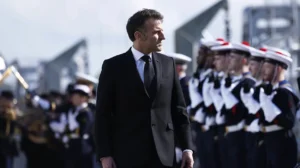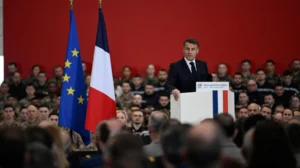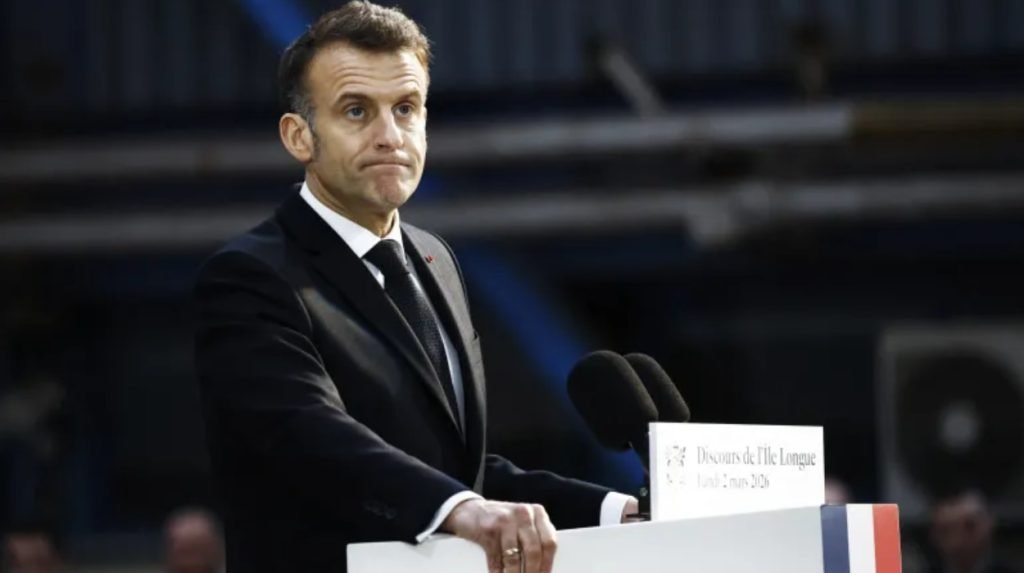
The declaration by France to increase and modernize her nuclear posture is one of the most far reaching decisions on the defense of the European continent after the conclusion of the Cold War. The policy was announced on March 2, 2026, at the Ile Longue, and aims at switching to advanced deterrence rather than statistical deterrence as defined by President Emmanuel Macron. The program involves augmenting warhead capability, the first in more than three decades and deploying nuclear-capable aircrafts to select European allies.
Macron provided the expansion as the reaction to the accumulating geopolitical uncertainty, as he stressed that to be free, one should be feared. The quote is part of a larger strategic math: Europe needs to strengthen its deterrence stance in response to Russian buildup and doubts of U.S. commitment in the Trump presidency. The policy thus works both as a national reinforcer and a continental assurance policy.
Russia’s Military Signaling and European Threat Perceptions
Since 2022, European defence planning has been informed by the ongoing war in Ukraine by Russia, and its nuclear signalling. In the course of the year 2025, Moscow had conducted exercises of simulated nuclear cases against NATO targets, which reinforced the fears regarding escalation levels. Such exercises together with incessant rhetoric by President Vladimir Putin escalated arguments on the autonomy of deterrence in Europe.
The nuclear armory of France which is currently approximated at about 290 warheads is the sole fully operational strategic deterrent of the European Union after the United Kingdom left the bloc. Although the UK has its own nuclear force which is independent, it works outside the EU. The expansion of France thus deals with a structural mismatch in the continental defense system, especially on the eastern side of NATO.
U.S. Policy Under Trump and Alliance Uncertainty
With the re-election of president Trump in November 2024, there was fresh discussion regarding the credibility of U.S. extended deterrence guarantees. Trump undermined the concept of burden-sharing in NATO during 2025 and doubted American long-term troop presence in Europe. Even though Washington is officially still devoted to NATO, there have been pointers to the importance of strategic focus on other areas, which contributed to the European talks about increased independence.
The initiative by Macron is not to replace structures of NATO but to complement it. France aims at hedging against the possibility of U.S. retrenchment by establishing bilateral nuclear consultation arrangements with allies like Germany, France, to maintain the unity of the alliance. This two-track strategy will enhance the credibility of the deterring role of Europe without affecting transatlantic liaisons.
European Integration of Nuclear Capabilities
The expansion has a planned system of extending the French nuclear deterrent to that of the allied air forces via mutual planning and training systems. This model is based on a managed replication of the Cold War nuclear sharing ideas, without the handing over of the control of warheads.
Germany’s Gradual Alignment
Germany has become the greatest partner in this changing structure. In accordance with the defense reforms proclaimed by the so-called Zeitenwende policy changes in 2025, Berlin boosted its military budget and strengthened collaboration with France in the strategic planning. Chancellor Friedrich Merz admitted that there were indicative talks on the integration of the German aircrafts with the French nuclear systems.
The interest is still reserved and the political interests of the country are also influenced by Germany, and this country has a long non nuclear tradition dating back to the Non-Proliferation Treaty. Still, the involvement in joint exercises starting in 2026 indicates that there is a move towards the practical alignment, which would enhance the idea of European strategic sovereignty and not break the legal limits.
Eastern Flank Reinforcement
The states located on the eastern side of the European front, such as Poland and the Baltic countries, perceive the initiative as an immediate implementation of the deterring factor. These nations are experiencing long-standing apprehensions regarding Russian conventional and hybrid challenges. France implements a distributed deterrence posture by expanding the range of the deployment of nuclear-capable aircraft to allied bases and this further adds to the strategic uncertainty among potential opponents.
This deterrence architecture is also provided by Nordic NATO members. Their strategic location enhances the sea patrol in the Baltic and the Arctic routes that can augment the deterrence wall without the need to have complete nuclear hosting facilities.
Legal, Industrial, and Operational Dimensions
The nuclear buildup of Macron is based on constitutional power and the formulated defense laws in France. France has very centralized decision-making control over its nuclear weapons unlike other NATO countries, which have a slow decision-making process before it can make strategic changes. This institutional leeway provides flexibility during emergencies.
Modernization and Technological Upgrades
The program is based on the current modernization programs such as the development of the third generation ballistic missile submarines and the modernization of the M51 missile systems. These systems more effectively increase survivability and penetration capability to ensure the credibility of deterrence in relation to the changes in the missile defense systems.
Aerial elements such as Rafale airplanes, which possess nuclear-tipped missiles, are still part of the strategy. Through the linking of these systems with allied air forces where they have established structured agreements, France enhances operational interoperability but does not give up sovereign control.
Budgetary Commitments and Industrial Impact
In France, the defense programming law of 2024-2030 spends a lot of money on the maintenance and modernization of deterrence. A specific percentage of this long-term investment scheme is attributed to nuclear forces to guarantee continuation of technological advancement and industry.
The investment helps to sustain domestic aerospace and naval sectors, and helps to sustain larger European defense supply chains. The policy also enhances the industrial resilience within the global competition in the strategic weapons systems.
Transatlantic and Global Implications
The push in nuclear carried out by Macron works in a complicated diplomatic setting. Although this was created to enhance the independence of Europe, it has to co-exist with the NATO combined defense system and the presence of the United States. The difficulty is to make sure that there is complementarity and not duplication.
NATO Cohesion and Coordination
France points out that its deterrence policy does not substitute or override NATO commitments. Mechanisms of strategic dialogue enable coordination in targeting doctrines and crisis communication. This strategy tries to keep the unity in the alliance and increase the European capabilities.
Past history shows that the U.S. officials have accommodated French nuclear independence, which is an indication of past strategic differentiation in the alliance forms. The present expansion is thus a continuation as opposed to a breakage of transatlantic relations.
Russian and Chinese Responses
The reaction of Moscow was expected as it was perceived as an act of escalation. The Russian authorities claim that European nuclear signaling is growing, leading to lack of stability in the region. But, according to the vision of France, the initiative reacts to the current escalation, and does not trigger it.
The proliferating nuclear missile system of China is also taken into consideration in Europe. With the growth of strategic capacities by Beijing, European leaders view deterrence modernization as a rebalancing process on the global front. This contextualization supports the argument by France, that long term stability requires advanced deterrence.
Strategic Interpretation and Future Thresholds
The nuclear expansion by Macron is a structural adjustment of the European security doctrine. It is indicative of fears of unstable relationships in alliances, Russian aggression, and the global power struggle. France can be the mainstay of continental defense by dispersing nuclear-capable aircraft and strengthening submarine-based deterrence.
This policy combines sovereignty and solidarity, which enables Europe to enhance deterrence without disintegrating NATO. It will be successful by its technical integration, political cohesion and long term confidence among partners. The phases of implementation planned up to 2026 will put the operational readiness and coordination between the alliances to the test.
As Europe adapts to overlapping security pressures from Moscow and shifting U.S. priorities, the effectiveness of this nuclear expansion will hinge not only on hardware upgrades but also on diplomatic discipline. Whether Macron’s advanced deterrence model becomes a durable template for European autonomy or a transitional response to extraordinary circumstances will depend on how allies interpret shared responsibility in an era defined by renewed strategic competition.