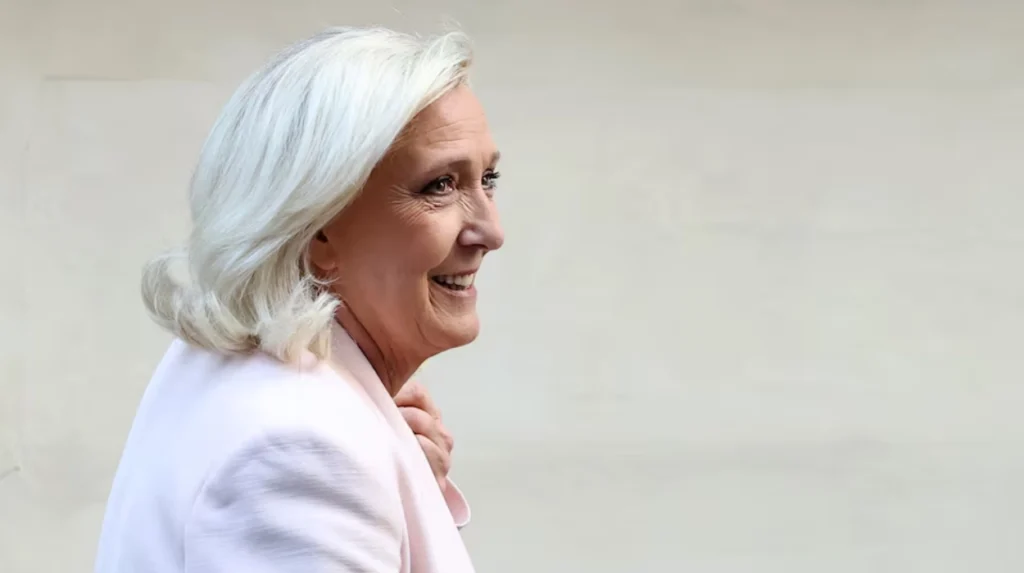
Marine Le Pen used France’s first 2027 presidential debate—staged by the MEDEF business lobby at Roland‑Garros on 27 August 2026—to deliver a direct pitch to French entrepreneurs: the National Rally is no longer a fiscal risk, but a party of spending discipline and debt responsibility. In a two‑hour session with seven candidates and five business questioners, Le Pen anchored her message on a €125 billion cost‑cutting plan, a pledge to repay—not cancel—sovereign debt, and a sharp reduction in France’s EU budget contribution, while insisting that
“Entrepreneurs who have taken the time to examine the National Rally’s proposals have no reason to be alarmed by the measures we are proposing.”
A debate designed to test economic credibility
This forum took place within the framework of “Encounter of Entrepreneurs of France” (REF), which is an annual gathering organized by MEDEF, an organization representing French employers, at the end of summer, always viewed as a measure of business confidence in advance of elections. The forum, held at Roland-Garros, brought together seven prominent presidential candidates—Marine Le Pen (RN), Jean-Luc Mélenchon (hard left), Édouard Philippe (centre-right, former prime minister), Gabriel Attal (centre-right, former prime minister), Raphaël Glucksmann (centre-left), Bruno Retailleau (right), and Marine Tondelier (Greens)—who faced questioning about taxation, labor expenses, public debts, pensions, inheritance laws, and company financing.
It was especially important for Marine Le Pen, because the first round polls show that RN is in the lead, and the party is widely regarded as one of the runners for the runoff in May 2027, although business people have always been skeptical about economic credibility of the party. By starting her speech with a fiscal ultimatum—“The government must drastically cut its spending”—Le Pen wanted to change this perception of her party.
The fiscal pivot: €125 billion in cuts and a debt pledge
Cost reduction, however, was Le Pen’s main message. She pledged to reveal a scheme to save up to €125 billion before the next discussion of budget, emphasizing the number as a guarantee that RN is ready to meet the deficit reduction challenge of business society. This promise is carefully tailored for political purposes: Le Pen claims to be ambitious without revealing any details about the items she wants to cut in order to save money. Just as significant was Le Pen’s attitude to the issue of national debts. Unlike Jean-Luc Mélenchon, who suggested the idea of debt cancellation by the central bank, which was criticized by center-right competitors as “dangerous,” Le Pen clearly stated that she is going to repay France’s debts, not cancel them. It is an important step to take in France, whose public debt grew to nearly 117% of GDP since the outbreak of coronavirus, which is one of the highest levels in the euro area.
Cutting the EU bill and “scraping thousands of norms”
Le Pen extended her fiscal message to Europe, arguing that France’s contribution to the EU budget is excessive and should be capped at €5 billion, down from nearly €29 billion in 2026. She framed this as both a budgetary necessity and a sovereignty issue, accusing Brussels of over‑regulation that French administrations then amplify.
“Every time the European Union sets a minimum norm, we go above and beyond — we want to be the top student in the class,”
she said, pledging to scrap thousands of European norms that burden businesses.
This line struck a chord in some corners of the room. Patrick Martin, president of MEDEF, also spoke from his own podium, advocating to free the country from the “straitjacket” that was strangling it and denouncing the micromanagement by EU bureaucrats and the EU’s tariff negotiations with the US during the tenure of President Donald Trump. But the pledge to fix the EU budget unilaterally carries political risks because it may contravene EU law and lead to infringement proceedings.
Pensions and labor: returning to 62, with an early‑start clause
Pensions-wise, Le Pen doubled down on one of her party’s key promises, bringing back the retirement age of 62, with people retiring at 60 if they started their first real job before turning 20 years old. The move directly contradicts the 2023 reforms made by Emmanuel Macron that increased the retirement age in France to 64 years old, making RN stand against center-right leaders such as Édouard Philippe, who claimed France needs more working hours to get rid of their deficits. This creates an obvious dilemma, as Le Pen wants to convince bosses that she can manage the debt, but at the same time, she wants to promise early retirement to many workers.
The latter is possible only in case other sources of savings or revenue are identified because otherwise, this will create problems in future pension financing. In the debate itself, this contradiction became apparent in the discussion when Gabriel Attal questioned the logic of combining the idea of debt cancellation with the rise in taxes, while Mélenchon tried to raise the minimum salary level in order to prevent a recession and reduce the deficit through business subsidization.
Business mood: pessimism, polling, and market jitters
The backdrop to Le Pen’s pitch is a deeply skeptical business climate. An OpinionWay poll for MEDEF found that 82% of business owners are pessimistic about the next president’s economic impact—whoever wins. That figure underscores how structural anxieties—high deficits, regulatory complexity, and political uncertainty—have seeped into executive decision‑making.
Markets reacted nervously on the day. French blue‑chip stocks fell to a one‑month low as investors weighed the 2027 budget outlook, the risk of policy volatility, and the trajectory of public debt. For Le Pen, the challenge is twofold: convert rhetorical discipline into a credible, itemized plan that survives scrutiny, and convince investors that RN’s EU and regulatory agenda will not trigger punitive reactions from Brussels or rating agencies.
The broader field: how rivals framed the economy
The attempt by Le Pen to reach out to employers came at a time when there was an already dense forest of rival economic discourses. With his demand for total abolition of all kinds of subsidies to businesses and previous stances advocating debt cancellation of central banks, Mélenchon appeared the most radical in terms of confrontation with capital, while asking for higher wages to keep up demand levels.
The centre-right politicians like Philippe and Attal painted the demand for debt cancellations as “dangerous” and insisted on more work life and fiscal discipline. Glucksmann criticized the anti-European ideology of Le Pen, as well as the idea that immigration reductions will help a lot to improve the state finances. While Marine Tondelier and the Greens emphasized ecological transitions and social protection, Retailleau tried to occupy the centre-right law-and-order space. In this environment, the strategy by Le Pen is to occupy the “fiscally serious right,” without damaging the social promises of RN.
What Le Pen’s pitch means for RN’s economic brand
Le Pen’s performance at MEDEF marks a deliberate rebranding effort: from a party once associated with protectionist spending to one that claims it can deliver drastic spending cuts, debt repayment, and regulatory relief. Her insistence that
“Entrepreneurs who have taken the time to examine the National Rally’s proposals have no reason to be alarmed by the measures we are proposing.”
is less a slogan than a targeted reassurance to a constituency that has historically been wary of RN.
However, the test of credibility lies in the small print. An ambitious program of cuts worth €125 billion is politically powerful but still vague as long as RN does not make clear how it intends to cut the budget. Likewise, unilaterally limiting the contributions made to the European Union to €5 billion might raise legal questions unless it is combined with a withdrawal from Europe or a new treaty policy. Finally, bringing back the retirement age to 62 (or even 60 if that is possible) may appeal to many workers but could also complicate fiscal matters.
Implications for the 2027 campaign and beyond
MEDEF discussion is setting the agenda for the months to come. Given the polls that put Le Pen ahead in the first round and in good standing for the run-off, the challenge for RN will be in turning their business constituency’s suspicion into at least ambivalence toward her leadership. The possibility of RN outlining an elaborate and sound budgetary strategy, and refraining from causing shocks in the European markets will allow them to bridge the “governability gap” that has been haunting the party for some time. At the moment, Le Pen’s rhetoric is quite clear—RN will exercise fiscal prudence, will repay the debt and get rid of excessive bureaucracy.
“The government needs to drastically reduce its expenditure,”
she said, putting the emphasis on austerity not as the leftist or technocratic but as the national imperative.