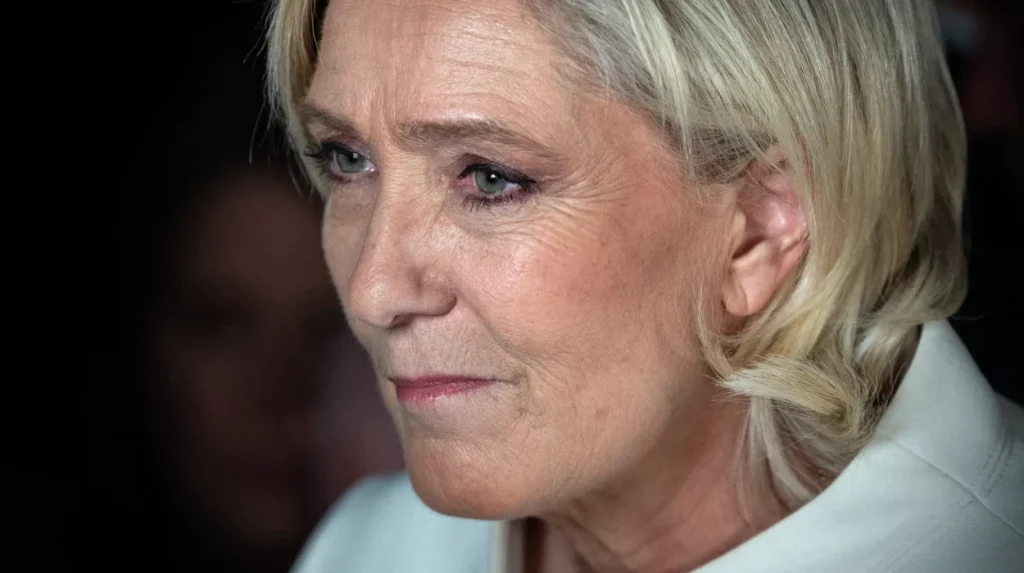
On March 31, France experienced a significant political upheaval: Marine Le Pen, a far-right opposition politician, was found guilty of misusing €474,000 from the EU by employing four ghost assistants in the European Parliament from 2009 to 2017, and participating in a larger scheme to steal €1.8 million in a similar way.
She was given four years in prison — two suspended and two served by wearing an electronic tag. She was also fined €100,000 and disqualified from standing for public office for five years, from the date of the order. This was not a “political” trial or ruling, but Le Pen will try to make it one. And she might just succeed.
Speaking at a rally over the weekend, Le Pen assured her followers that she was a martyr. She complained that her “human and democratic rights” had been violated, and appealed to two names that have never before been linked to her anti-immigrant, pro-Russian movement: Martin Luther King Jr. and Alexei Navalny.
In essence, Le Pen is saying that it would be a slap in the face of French democracy if voters are prevented from voting for a front-runner in the 2027 presidential election. And she will have many people — in France and beyond — who will take her charge that the establishment is conspiring to bring about her “political death.”
President Emmanuel Macron and the government also dread what banning Le Pen would do to political stability.
Of course, Le Pen is not the first prominent French politician to be excluded from running for public office in recent years. But her situation is unique and possibly incendiary. Opinion polls routinely indicate she’s a likely candidate to make it to the Elysée Palace on her fourth try — although that’s hardly a sure thing. So, what next for Le Pen?
Last week, she tried to refer her five-year electoral ban to the European Court of Human Rights and asked France’s constitutional overseer, the Constitutional Council, to review it. Le Pen had before attacked both institutions for their supposed interference in French democracy, and yet it is now those same courts that could save her neck.
Because the European court can’t act until Le Pen has exhausted all her avenues for appeal in France, however, her best — and actually only — chance for reversing the electoral ban is through what’s called a “priority question” to the Constitutional Council.
This question will not discuss Le Pen’s innocence or guilt. Rather, it will try to ask if the Paris criminal court had a right to prevent voters from voting for the presidential favorite while she’s appealing against conviction and is, as such, innocent in the eyes of the law. The appeals court has three months to decide on referring the priority question to France’s top appeals court, the Cour de Cassation. This court also has three months to either deny the request or pass it to the Constitutional Council, which then has another three months to deliver a ruling.
In the meantime, following government instructions, the Paris Court of Appeal has agreed to provide Le Pen with an “early” trial date and guarantee a ruling by next summer. All of this amounts to the populist French maverick having a very real hope of reversing her electoral ban prior to the March 2027 deadline for the submission of her candidacy in the presidential election.
The possibility of Le Pen reversing her conviction and imprisonment completely is remote, given that the evidence confronting her is overwhelming. But if the appeals court overturns the lower court’s ruling to impose her five-year electoral ban immediately (though still affirming her conviction), the ban might be put on hold until all her other appeals — which will take at least two years — are finally exhausted, so she can stand for president. So, Le Pen’s political destiny has not yet been sealed. She may be down, but she is certainly not out — not yet.