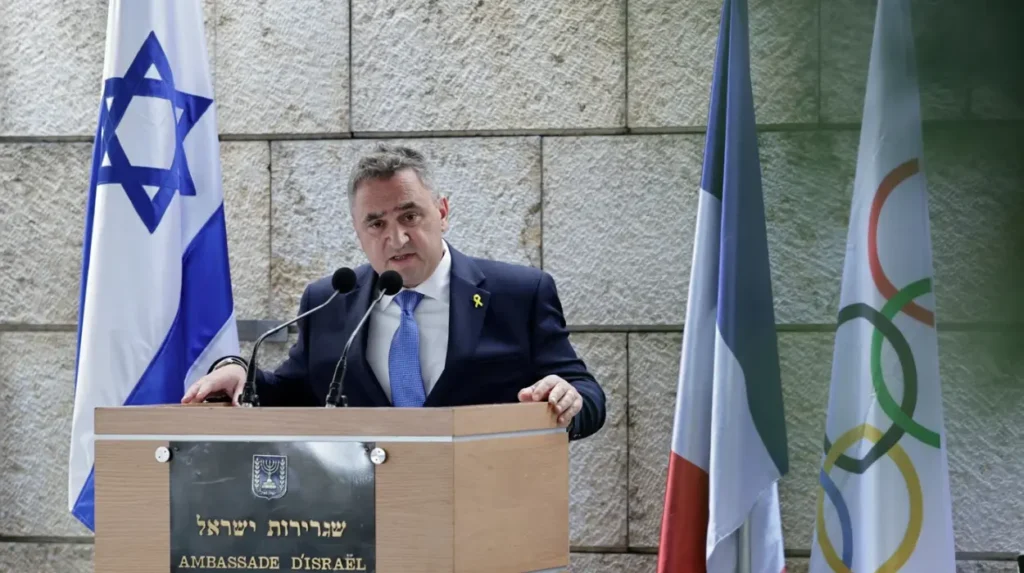
Recent controversy involving interference from abroad in French politics has put Israel’s envoy at the center of a mounting controversy. This dispute started when certain statements were made that were associated with the future of French politics and later escalated into charges that another party was trying to influence the discussion in the country, creating friction between Paris, pro-Palestinian legislators, and Israelis. What is remarkable about this particular event is not only the content of the statements by the ambassador but the general atmosphere surrounding the issue of election interference in the country.
This particular issue has been made all the more sensitive due to its relevance both to diplomacy and to democracy. Any mention of interference by a diplomat from another country in France’s internal affairs may elicit an extremely sensitive response from the French government and citizens themselves, even more so since the comments will be related to the contentious topic of Israel, Palestine, and French politics as well.
How the controversy escalated
The initial cause of the dispute arose out of statements made by the Israeli ambassador to France regarding the election schedule of 2027. This led to an outcry from the ultra-left wing party of France Unbowed, calling for French government authorities to recall the ambassador due to what was deemed inappropriate interference in the internal politics of the country. Such a reaction is not surprising given the high regard that political figures in France place on outside influences in relation to any upcoming election campaign.
It is necessary to note that the incident with the ambassador did not arise out of nowhere. The French authorities have already been investigating reports that an Israel-affiliated company could have been involved in spreading disinformation about election candidates in the country. This context provided the issue of alleged manipulation by external players with its own institutional background, thus providing a political space for linking the ambassador’s statements to other cases of potential influence.
It is essential to recognize that the combination of these two factors adds significant significance to the conflict since it transforms the ordinary political scandal into the matter related to the influence of foreign elements on political outcomes in France. It is no wonder then that the story immediately escalated from political debate to a more serious tone of investigative work and protests against foreign influences.
France’s political reaction
France Unbowed is the party that spearheaded this reaction against the statement made by the Ambassador. This party and its representatives believe that the statements made by the Ambassador crossed the line since it involved a foreign diplomat in the affairs of French democracy and its future politics. To call for the summoning of the diplomat is also a political message from the party.
The move is, of course, part of a greater political strategy. It should be noted that LFI often portrays itself as being critical of Israeli policies and supportive of Palestinian issues, which means that it can also present itself as one of the parties that faces attempts at interference in the country’s political process by Israel, thus adding more weight to the claim that the comments made by the ambassador were inappropriate.
As for the actions of the French state, it seems that the government’s reaction will likely be rather cautious, but serious all the same. The French government has previously showed an interest in investigating potential attempts at influencing elections through online misinformation, thus showing its readiness to take measures against such practices whenever deemed necessary. This factor makes the current situation even more complicated since the officials seem to be quite wary of outside interference.
The election interference claims
The broader picture is also that there are allegations of Israeli-backed firms being responsible for foreign influence activities during the local elections in France. Some reports have suggested that some of the far-left candidates claimed that they had become victims of smear campaigns, visual manipulation, and other such tactics which attempted to undermine their campaign efforts.
The political personalities connected with the complaints include Sébastien Delogu, who is from Marseille, François Piquemal of Toulouse, and David Guiraud of Roubaix. The candidates have apparently alleged that they became targets of disinformation tactics due to their stance on the issue of Palestine. This clearly shows that this is an issue that cannot be attributed to only one individual, in particular, the ambassador.
The report identifies an Israeli firm that is also known as BlackCore/Black Core, as the probable source behind the attack. Yet despite the identification of the firm, government officials have insisted that there was no information available in the public domain which could indicate the involvement of the Israeli government. This is significant as it draws a line between the two cases.
Why the issue matters in France
Electoral independence is seen as a pillar of democracy in France, and foreign interference is viewed as an issue that should be addressed since it may impact the public discourse in ways not easily detected. Misinformation operations may involve the creation of misleading images or statements and even the manipulation of social media accounts to form opinions before facts are confirmed. This is just one of many reasons why the issue receives scrutiny in France.
The case in question acquires particular sensitivity due to the approaching 2027 French presidential election where politicians start forming their strategies in advance. Any intervention from any foreign party, which might look like an attempt at gaining an influence over the situation ahead of the elections, may easily draw a lot of criticism. Under such circumstances, a simple diplomatic statement might become part of the general campaign aimed at interference into French affairs.
Moreover, there is a certain symbolic aspect to the problem in question. France is renowned for its political sovereignty, not to mention the difference between international politics and electoral campaigns taking place in the country. The moment when a foreign ambassador starts crossing borders, it is not just the matter of what he or she says, but how well they know the extent of their functions in the host state.
Statements and reporting context
According to reports by the French press and the international media, prosecutors are looking into the use of fake campaign literature, social media coordination, and accusations in order to shape opinions on local politicians. Such reporting has provided context for the story, placing it into a bigger picture where it appears that there may indeed exist an organized and quantifiable method of online interference that needs to be looked at carefully by the French authorities.
The emphasis on the non-resolution of the case thus far has been another element highlighted by the media. Since the case is currently under investigation, the only thing known is that there are accusations and counter accusations being traded between both parties without a conclusive verdict from the judicial system.
What is already clear, however, is the political impact. The ambassador issue has become a test of how France responds when domestic politics, election security, and foreign diplomacy collide. It also highlights how quickly social media-era politics can turn a diplomatic remark into a national controversy.
Diplomatic and political consequences
The diplomatic consequences could be significant if French authorities formally summon the ambassador or issue a rebuke. Such action would signal that France views the matter not just as political speech, but as a potential breach of diplomatic norms. Even without formal sanctions, public pressure alone can strain relations and force both sides into defensive messaging.
On the part of Israel, the problem is to detach official diplomacy from charges of interference without escalating matters further. Where such media allegations have linked electoral tampering to an Israeli-backed entity, it becomes imperative to be circumspect in one’s approach lest there be consequences for bilateral ties at large.
On the other hand, French political parties, most notably the LFI, are afforded a chance to show that they stand up for their country’s independence. However, they must be careful not to take things too far when investigations may not substantiate their claims to the full.
What happens next
The following stage will depend upon whether French authorities will be able to establish any chain of responsibility related to disinformation campaign allegations. In case they succeed, the issue will take another turn from political controversy to court proceeding, reinforcing French concerns over any foreign intervention activities. Otherwise, the discussion will probably return to statements by the ambassador that caused all the problems.
However, its wider importance does not lie merely in an example of France and its particular envoy. Today, countries across Europe have come to realize that foreign players may affect the course of national elections through online manipulations. French case perfectly demonstrates how a mere political statement can trigger a heated discussion about national democracy and its safety.