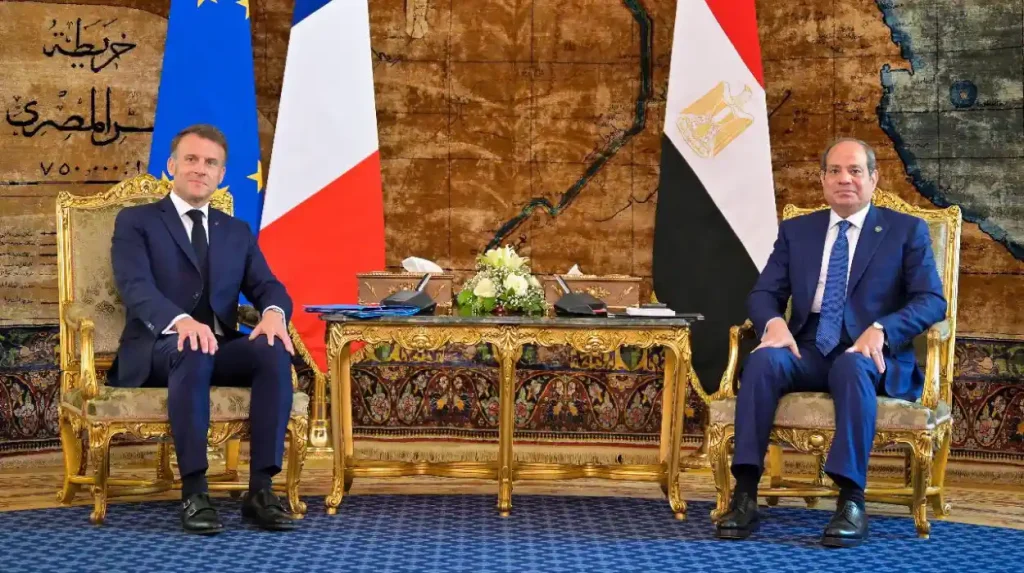
French President Emmanuel Macron’s visit to Egypt on October 13, 2025, marks the visit of the French President Emmanuel Macron to Egypt on October 13, 2025, is a breakthrough in the current Franco-American attempts to stabilize the Middle East after a wavering ceasefire in Gaza. The summit took place in Sharm El-Sheikh with more than 20 world leaders present, including U.S. President Donald Trump and Egyptian President Abdel Fattah al-Sisi, and was aimed at solidifying the ceasefire and laying the groundwork to a complex peace negotiation.
In the case of France, the involvement prolongs its historical diversification in regional politics. Macron emphasized the great hope brought by the ceasefire and made Paris a mediator that would operate with the United States and regionals. This visit represents the attempt to integrate security assurance with humanitarian rebuilding and political reconciliation and it underscores the desire by France to pursue sustainable peace efforts in the region.
Coordination and Divergence in Franco-American Peace Approaches
France and the United States share congruent objectives in the Middle East peace process, and they are to stabilize Gaza, prevent a new conflict, and facilitate structures that would lead to a two-state solution. The presence of Macron strengthens coalition cohesion to implement a ceasefire, which sends an indication of diplomatic unity to the stakeholders in the region, as well as the international community.
Both authorities liaise on sensitive matters like releasing of hostages, blockade removal as well as repairing essential infrastructure. These multilateral mechanisms are also incorporated with regional allies such as Egypt, Qatar and Turkey that guarantee that the conflict can be contained outside the immediate ceasefire and show that they have a common stake in stability.
Subtle Divergences on Strategy and Priorities
Although it is agreed on the broad goals, there are still strategic peculiarities. France pays special attention to the recognition and reconciliation in its politics, the recent official recognition of the Palestinian state. This position enhances the diplomatic position of Paris.
The United States on the other hand has been more focused on security and alliance management and focusing more on counterterrorism efforts and strategic alliances. This transactional approach at times causes tension in terms of post ceasefire governance, border security and the allocation of resources within Gaza, as it demonstrates the fine line between security needs and the legitimacy of the political leader.
Macron’s Role in Reinforcing Regional Alliances and Multilateralism
The involvement of Macron highlights the key role of Egypt in facilitation of peace in the Middle East. Cairo is also close to Gaza and its influence is important in the implementation of buffer zones and terms of ceasefire. Through strong collaboration with President al-Sisi, France strengthens the diplomatic leadership in Egypt, and it is complementary to U.S. efforts combined with the use of regional authority.
This convergence reflects the goal of France, tactically to achieve bilateral influence plus regional influence so that the external mediation may facilitate, not supersede, local agency in delicate negotiations.
Supporting Broader International Partnerships
In addition to bilateral and regional involvement, Macron believes in multilateralism through the involvement of the United Nations and the European Union. France focuses on humanitarian assistance and reforms of the government in Gaza and has connected reconstruction efforts to a stable political future.
This multilateralism is the opposite to the policies of the U.S. that can be considered more unilateral, and it offers Paris as a broker of international legitimacy. The strategy of Macron is an indication of the desire to make Middle East peace activities a part of the international governance systems, as a way of strengthening viable diplomatic networks.
Political and Domestic Dimensions Influencing Macron’s Diplomacy
The visit of Macron is organized in the context of internal political issues with the opposition of the parliament to the economic reforms and the discussions regarding national priorities. The Egyptian summit provided a high profile stage to exercise influence on world matters, which spreads beyond domestic limitations.
Finding a balance between the regional alliances, France plays a complicated game with the Gulf states, the influence of Iran in the region, and the Israeli security issues. The strategy of Macron is attractive to the centrist electorates that want pragmatic relations with the rest of the world as well as to wider groups that have a stake in the international diplomatic image of France.
The Implications for Middle East Peace and Franco-American Relations
The visit to Egypt by Macron is a delicate recalibration of the Franco-American relations that is a mixture of cooperation and autonomy when it comes to strategy. France aligns itself as the one that takes initiatives, which affects agendas, either in line with or sometimes opposing U.S. priorities.
It is essential to continue discussions on the enforcement of ceasefire, governance and economic recovery in Gaza to have a long-term peace. The focus of Macron on the reconstruction and reconciliation of the post-conflict can be said to denote the bigger picture that the end of hostilities cannot stabilize the region on its own.
Macron has a multilateral credibility that benefits the United States to achieve the legitimacy of policies that could not be considered otherwise as transactional. Such rivalry of influence emphasizes the importance of cooperation between the forces that have a different policy, which depicts the changing nature of international relations in the Middle East.
The results of this summit have a long-term consequence in conflict management, regional relations and makeup of international interaction in the Israeli-Palestinian arena. The manner in which the world powers juggle between security, humanitarian necessities, and political legitimacy will determine the perception of success and equity in peace efforts. The Egypt visit by Macron is not about short-term management of the crisis, it is a pointer on the lines of strategic collaboration, the possibility of using multilateral alignment, and the continual quest to entrench sustainable stability in a regional environment of intricacy.