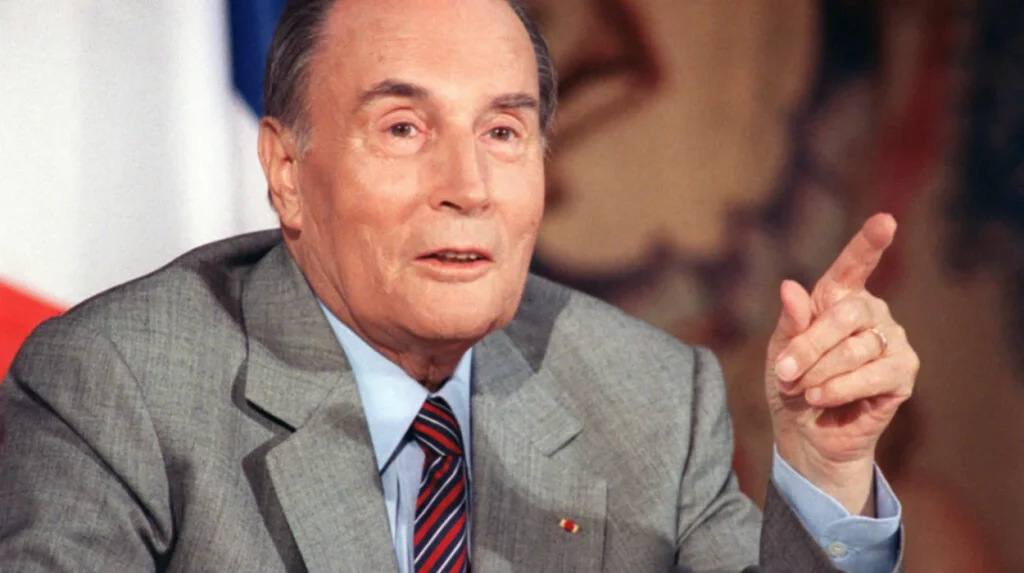
François Mitterrand passed away on January 8, 1996. He is remembered as the first left-leaning president in the Fifth Republic in 1981-1995. Mitterrand is still very popular in French memory and regularly portrayed in novels, films, and television series. Although he introduced radical changes in society, including the abolition of capital punishment, retirement at 60, and RMI legislation, his presidential policy is rather controversial.
Controversial sidelines such as his Vichy and colonial policies, together with certain doubts regarding his honesty, hinder a consensus on his merits for the left.
Celebrations to mark the one-hundredth anniversary of Mitterrand’s birth in 2016 and the twentieth anniversary of his death have contributed to rekindled interest. Recent scholarship has also increased biographical knowledge based on unpublished materials such as *Letters to Anne & Journal for Anne* (2016), to name one example.
Currently, Mitterrand is also a constant presence in the world of French fiction in films like *The Walker of the Champ de Mars* (2005), *Haute Cuisine* (2012), *The Stranger of the Grande Arche* (2025), and in the TV series *Bardot* (2023), *Tapie* (2023), *Mitterrand Confidential* (France 2). His daughter Mazarine’s documentary *François Mitterrand: Another Possible Life* also from 2025 bears testament to his imprint on the imagination.
Why is Mitterrand’s early life and WWII record controversial?
Mitterrand’s presence during the Vichy regime is one of the most controversial moments in his life. Born in 1916 in Charente, Mitterrand first associated with the very conservative extreme right-wing organization Croix-de-Feu in his student days. Mobilized in 1940 and arrested, but managed to escape from Germany, Mitterrand became a part of Vichy’s administration and supported National Revolution, but this time he did not have anti-Semitic feelings. In 1943, influenced by his patriotism against Germans, Mitterrand could join the Resistance slowly.
Despite these being known truths, Mitterrand’s Vichy activities such as his photo in 1942 with Marshal Pétain and his receipt of the Francisque in 1943 remain problematic to this day. Historian Noëlline Castagnez points out that his political adversaries constantly exploited these events, to the point where his own predecessor Charles de Gaulle refused to bring these up during the campaign of 1965 in order to maintain the legend of a united French Resistance.
How did Mitterrand shape France’s colonial and neocolonial policy?
Another area where Mitterrand is perceived as having been inconsistent is in colonial and post-colonial politics. When he was Minister for Overseas France in 1950 and then Minister of Interior in 1954, he openly stated, “Algeria is France.” This was common at that time. Historians Benjamin Stora and François Malye have referred to his tough handling when he held these two posts.
He later became president and made the Third World version of the Cancún speech in 1981, and also led the France involved in the Rwandan genocide of 1994. Various scholars like Anne-Laure Ollivier, Frédéric Turpin, Thomas Deltombe, Pascal Blanchard, and Nicolas Bancel have also explored this period and found that his career began from being a colonial administrator to a neo-colonial manager.
Did Mitterrand betray socialist ideals by failing to break with capitalism?
Mitterrand’s economic policies also sparked accusations of betrayal from the left. He rose to leadership in the Socialist Party in 1971, promising a break with capitalist society. This promise contributed to left-wing unity in the 1970s and fueled optimism for a transformative presidency.
However, in March 1983, the “austerity turn” undervalued the franc and introduced France into the European Monetary System. This move was seen largely in terms of abandoning the aim for socialism and turning to market reforms. The adoption of the Maastricht Treaty in 1992, despite Mitterrand’s personal opposition to it, supported the perception that there was a liberal and European turn. While the adoption of the RMI in 1988 and retirement at the age of 60 are important, the “austerity turn” in 1983 constitutes a significant source of disagreement.
Why does Mitterrand remain both admired and divisive?
Despite controversies surrounding his regime, Mitterrand is still the longest-serving president in France’s Fifth Republic, having served for 14 years. Current assessments have placed Mitterrand as the third most popular French president after Charles de Gaulle and Jacques Chirac in an Ifop poll conducted in 2021.
Historically speaking, Mitterrand is remembered particularly in left-leaning supporters. However, because of the nature of his politics during Vichy and colonial times and his adoption of market-fundamental economic policy, he cannot be taken as a simple model for socialism.
What can the contemporary left learn from Mitterrand’s legacy?
In 2026, the left faces renewed challenges, including far-right polarization, migration debates, and economic uncertainty. Mitterrand’s example of left-wing unity, achieved at the expense of allies, may not offer a viable model for today’s political dynamics. Nevertheless, his reforms, political acumen, and resilience continue to provide lessons for French politics, balancing ambition, pragmatism, and controversy.