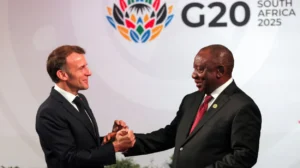
On January 3, French President Emmanuel Macron announced that the people of Venezuela could celebrate the end of the “Maduro dictatorship” because President Nicolas Maduro had been arrested by U.S. military forces. He said that Maduro has trodden on the freedom of everyone, and sullied the honor of his own countrymen.
He did not, however, touch on the U.S. military incursions that resulted in the capture of the Venezuelan president. Later, Macron’s office clarified that the American operation had been “acknowledged,” underlining that a dictator had been removed and that international law must now be respected.
Le peuple vénézuélien est aujourd’hui débarrassé de la dictature de Nicolás Maduro et ne peut que s’en réjouir.
— Emmanuel Macron (@EmmanuelMacron) January 3, 2026
En confisquant le pouvoir et en piétinant les libertés fondamentales, Nicolás Maduro a porté une atteinte grave à la dignité de son propre peuple.
La transition…
Why are French left-wing politicians condemning Macron’s stance?
Jean-Luc Mélenchon, the head of Hard Left party LFI, was scathing, branding the position “shameful,” while accusing Macron of renouncing international law. His lieutenant Manuel Bompard described the day as “a dark day for our country,” lamenting that France appeared to be congratulating what he termed Trump’s “power grabs.”
La prise de position de Macron n'est pas la voix de la France. Il nous fait honte. Il abandonne le droit international. Jour sombre pour notre pays.
— Jean-Luc Mélenchon (@JLMelenchon) January 3, 2026
Quelqu'un réveille le président Macron ? Il est temps que la République française condamne l'attaque contre le Venezuela.
— Jean-Luc Mélenchon (@JLMelenchon) January 3, 2026
Il n'y a pas de bonne invasion. Seulement des mauvaises.
La parole de la France doit rester non alignée et constante sur les principes du droit…
François Ruffin, another LFI member, added that while Maduro’s leadership is contentious, the U.S. military action must be unanimously condemned, stressing that force cannot replace law.
Pathétique déclaration de l’ectoplasme qui dirige « les affaires étrangères » de l’Union européenne.
— François Ruffin (@Francois_Ruffin) January 3, 2026
Le silence de la France laisse les toutous de Trump et de la puissance américaine parler en notre nom. Où est passé Emmanuel Macron, le quai d’Orsay ? Russie, Gaza, maintenant… https://t.co/5LDI1xqWyN
Olivier Faure, first secretary of the Socialist Party, argued that France is not a vassal state of the United States and that the president’s statements violated France’s long-standing diplomatic principles.
Cette déclaration du Président de la République Française n’est pas à la hauteur de la voix que la France porte dans le monde et des valeurs qu’elle doit continuer de défendre.
— Olivier Faure (@faureolivier) January 3, 2026
Le droit international, la souveraineté des États ne sont pas négociables sauf à ouvrir le monde à des… https://t.co/g8m3mQZ5nJ
What human rights and international law concerns are raised?
Critics state that the assault carried out by the U.S. did not respect the sovereignty of the Venezuelan state and international law. Jordan Bardella of the Rassemblement National made it clear that the foreign removal of a political power violates international law and the state sovereignty principle.
Le régime rouge de Nicolás Maduro appelle de nombreuses critiques légitimes sur le plan démocratique. Des millions de Vénézuéliens ont souffert de cette dictature sanguinaire et sans pitié, qui a privé de droits politiques l’opposition et entretenu le pays dans une interminable…
— Jordan Bardella (@J_Bardella) January 3, 2026
Mathilde Panot, representing La France Insoumises, rallied protesters in Paris in solidarity with the Venezuelan population, claiming that the invasion was driven by a desire for oil and not a desire to suppress drug trafficking and that law must give way to neither force, nor might, nor power, but to right.
Rassemblés à Paris en soutien au peuple vénézuélien contre l’impérialisme états-uniens.
— Mathilde Panot (@MathildePanot) January 3, 2026
L’agression de Trump n’a rien à voir avec la lutte contre le narcotrafic, mais tout à voir avec le pétrole.
Le peuple de France ne doit jamais accepter que la loi du plus fort supplante le… pic.twitter.com/tKC84GguVc
Fabien Roussel of the Communist Party condemned Macron for reducing France to the “51st state” of the United States, calling the situation “a final shame.”
How did French citizens express their opposition?
Over a thousand protesters had gathered at the Place de la République in Paris at the weekend, all of them holding the flag of Venezuela and chanting for the unconditional release of Nicolás Maduro. Jean-Luc Mélenchon has urged that Nicolás Maduro be returned to Venezuela.
The protest, which was sponsored by La France Insoumite and the Communist Party, brought into focus the increasing alarm of the French people over the tendency to normalise foreign interventions within sovereign nations.
What is the official position of the French government?
The Foreign Minister of France, Jean-Noël Barrot, denounced the U.S. move as an infringement of the rule of international law, saying that no political solution can be imposed from the outside because the future should be determined by the peoples alone.
En confisquant le pouvoir au peuple vénézuélien, en le privant de ses libertés fondamentales, Nicolás Maduro a porté une atteinte grave à sa dignité et à son droit à l'auto-détermination. La France s'est engagée avec constance, notamment par ses actions de médiation, en faveur du…
— Jean-Noël Barrot (@jnbarrot) January 3, 2026
Macron, although pleased with the fall of Maduro, reiterated the importance of ensuring a peaceful and democratic transition for Venezuela. The French President also urged opposition candidate Edmundo Gonzalez Urrutia to be at the forefront of this process, confirming communications with Donald Trump, Argentine President Javier Milei, and President Lula of Brazil on this topic.
How are French political leaders balancing criticism and pragmatism?
Many leaders in the country have struggled to walk a thin line between criticizing U.S. military intervention in Venezuela while not appearing to be supporting Maduro. As Raphaël Glucksmann, a social democratic MEP, stated, ‘The regime headed by Maduro is certainly plutocratic and authoritarian, but it’s a moment in which the world risks entering an era in which there is no international law, in which the world is ruled by power rather than law.’
The president of the Macronist deputies, Gabriel Attal, underlined that Europeans must get used to a world increasingly governed by force if they do not want to be relegated to the rank of powerless spectators. The head of the National Rally, Marine Le Pen, underlined that even though the Maduro regime has authoritarian and oligarchic features, state sovereignty cannot be called into question in any way, and renouncing this principle now could damage international order.
Il existait mille raisons de condamner le régime de Nicolas Maduro : communiste, oligarchique et autoritaire, il faisait peser sur son peuple, depuis de trop longues années, une chape de plomb qui a plongé des millions de Vénézuéliens dans la misère – quand il ne les contraignait…
— Marine Le Pen (@MLP_officiel) January 3, 2026
In the meantime, Bruno Retailleau, the president of the Republicans, presented the idea that in order to protect sovereignty in Venezuela, the need to address the issue of drug trafficking cannot be ignored.
The Venezuelan situation and the entry of U.S. forces into this troubled nation have alarmed many observers from around the globe. It has been suggested that these actions violate various principles within international law and may provide ammunition to those who believe that military action is always preferable to governmental diplomacy.
Human rights activists also point out that these interventions have the potential to impact civilians negatively and undermine basic human freedoms. They argue that human rights protection and the assurance of sovereignty should continue to be at the forefront in dealing with disputed governments.