French foreign and defence officials are perched on an extremely precarious precipice. An expansionist kind of isolationism is becoming more and more prevalent in the United States. It is turning away from its decades-long position as the protector of a global system from which it has profited much.
Instead, in its pursuit of a peace agreement in Ukraine that does little to stop further Russian aggression, Washington is threatening to remove its soldiers and take some of their land, therefore endangering the security of its closest allies through a trade war.
France and also Germany are, therefore, left carrying the bag because they are Europe’s respective military and economic leaders. In the face of intense competition from China and Russia‘s expansionist policies, they must reimagine the transatlantic partnership and protect Europe’s security, stability, and prosperity. This calls for a paradigm shift from both Berlin and Paris, which is twofold: They need to restructure their industrial, defence, and foreign policymaking while also guiding the financial and military resources for Europeans to support Ukraine without the US.
This would sound like a dream come true for France under former President Charles de Gaulle. Finally, the U.S. hegemon is perceived by Europeans as the antagonistic, controlling, and untrustworthy entity that Paris has long believed it to be. It is not at all the case in reality. Nobody in France who holds any real authority is celebrating this basic disruption of the Western system or acting as though Paris might take Washington’s place. The seniority of the authorities makes them acutely aware of the magnitude of the problem.
France encounters three significant challenges
First, Paris needs to persuade its European partners of the differences between its nuclear deterrent policy and the American one they are accustomed to, as well as the reasons it works, given the increasingly shaky U.S. security guarantee in Europe. Second, in terms of national finances, France can no longer pretend until it succeeds. Its power is presently being hampered by its fiscal imbalance.
Third, in order to effectively anchor the now-needed European consolidation and produce larger quantities more quickly, its defence industrial base has to become more flexible, adaptive, and effective.
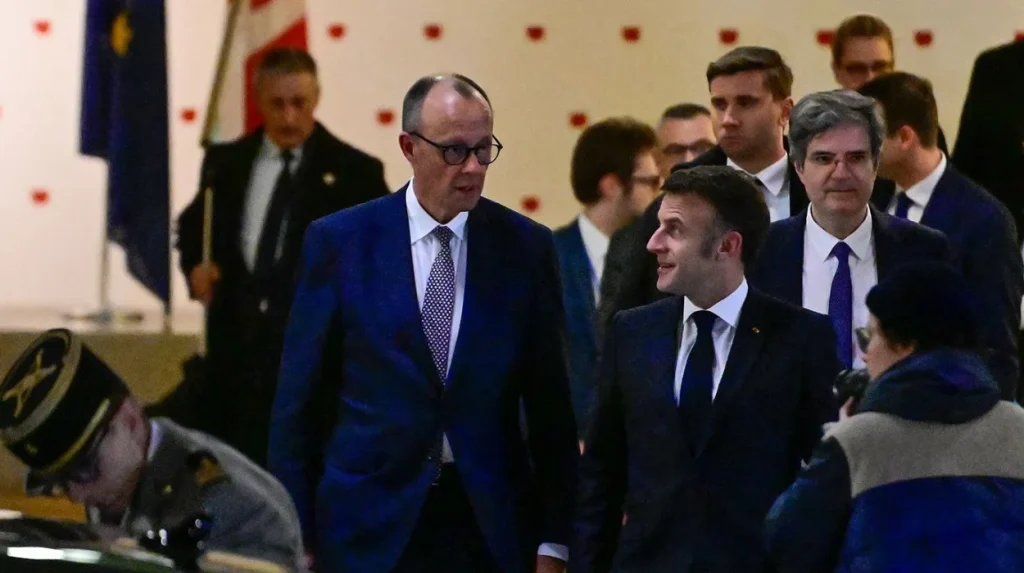
The essential role of the U.S. security guarantee in postwar Germany makes the reckoning more difficult across the Rhine, but incoming chancellor Friedrich Merz has made clear that he is ready to take over. By declaring that his “absolute priority will be to strengthen Europe as quickly as possible so that, step by step, we can really achieve independence from the USA,” he broke a historic taboo on the eve of his party’s—the CDU’s—election triumph.
The good news is that, following a lackluster tenure under previous chancellor Olaf Scholz, his presence is expected to revive Franco-German coordination and collaboration.
Neither of the aforementioned factors prevents either nation from effectively spearheading the European endeavor to empower Ukraine. They can assist it in mitigating the negative consequences of the two possible outcomes that are currently in the works: either a deal mediated by the United States with Russia that acknowledges its annexation of Crimea and excludes Kyiv from NATO, or the United States abandoning the process entirely, having failed to reach an agreement but having given Russia more confidence to attack by snatching the West.
They will have to work closely and crucially with the UK, Nordic, Baltic, and Eastern states, as well as Turkey, to pass the first of two tests of their leadership.
How the Europeans respond to the question of whether and when to resume their engagement with Russia will be the second test.
At a recent meeting on establishing a strong peace and security in Ukraine and Europe, which was hosted by French President Emmanuel Macron, a few nations—but not France—brought up this issue. Although the subject was brushed off as irrelevant and premature, it has since surfaced in lower-level conversations and is something that Europeans need to be ready for. After Europeans secure Kyiv’s survival and strength, it will be the crucial second stage of how the continent negotiates the conclusion of Russia’s war against Ukraine.
This will be the final test of the French and German foreign policy reforms. If they do not develop a new diplomatic arrangement that at least guarantees systematic tight collaboration with Baltic, Nordic, and Polish friends both upstream and downstream of any meetings with Russian counterparts, they would be repeating serious previous mistakes. In the future world without an order, Europe may demonstrate its geopolitical dominance by collective leadership and genuinely combined powers.